
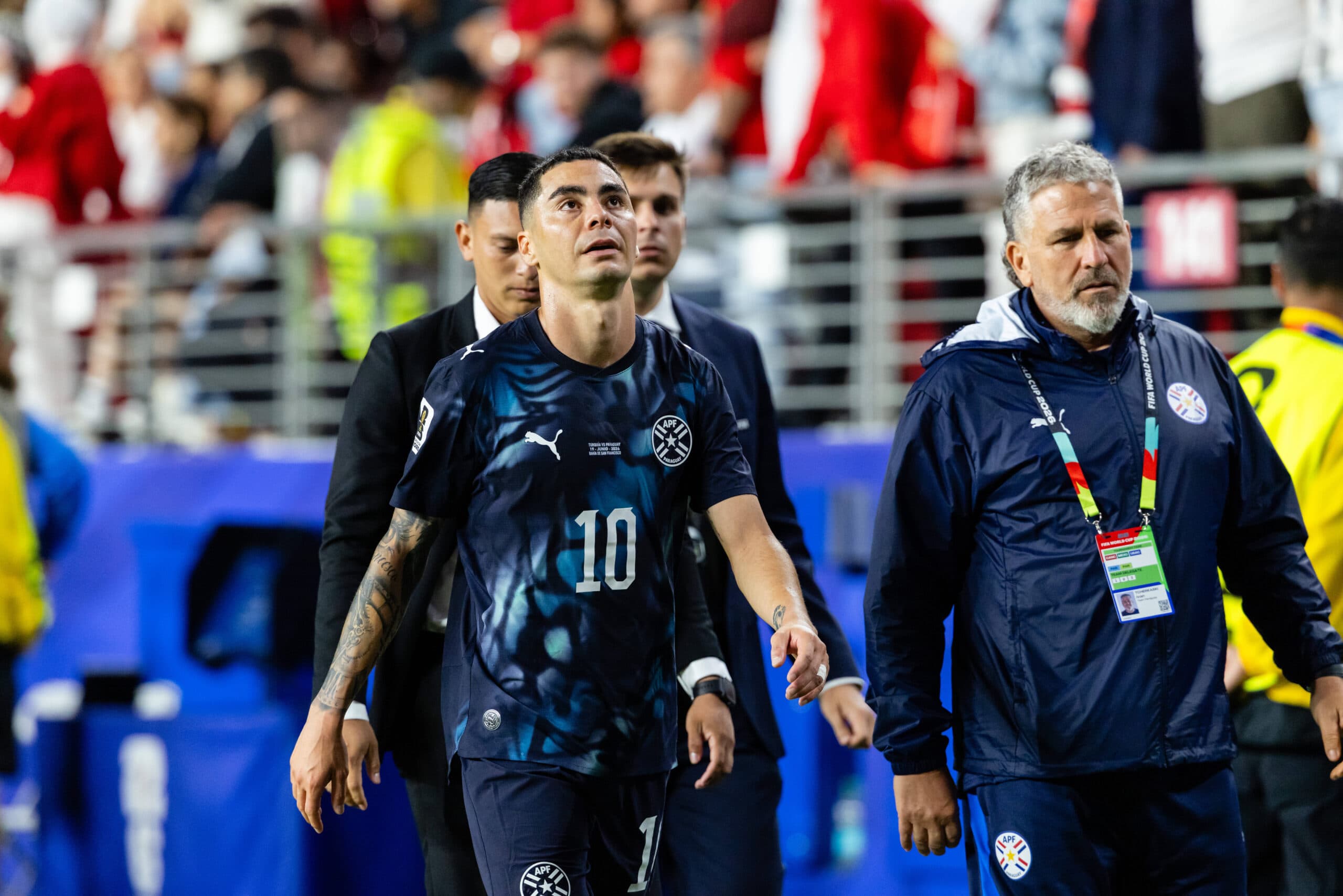
In a tense Group D clash, Paraguay edged out Turkey 1-0 at the San Francisco Bay Area Stadium in California.
Paraguay struck almost immediately, taking the lead after just 64 seconds, before Turkey regained control for much of the match. Despite registering 32 attempts, they failed to find an equaliser, and the Guaraníes held on to secure a crucial three points that keep their World Cup progression hopes alive.
A major talking point, however, was the dismissal of former Newcastle United midfielder Miguel Almiron during first-half injury time.
During a stoppage in play, Almiron appeared to confront Turkish defender Mert Muldur, with the Paraguayan covering his mouth while speaking to the player.
Having recognised the offence, Muldur immediately alerted the nearby linesman and, with the assistance of the Video Assistant Referee (VAR), Salvadoran referee Ivan Barton reviewed the incident on the pitchside monitor before ultimately showing a red card to the Paraguayan.
Almiron’s swift dismissal was in line with new IFAB (International Football Association Board) and FIFA regulations introduced ahead of the tournament in April 2026, stating that "any player covering their mouth in a confrontational situation with an opponent may be sanctioned with a red card".
With it being the first application of the rule - at FIFA’s discretion as tournament organisers - it has attracted significant media attention and led to broader questions about FIFA’s approach to regulating on-pitch communication.
Why Football Is Taking A Different Approach To Communication
Recently, it has become increasingly evident across the world’s elite football leagues that players often cover their mouths when speaking during matches.
As explained by The Athletic, it is a method employed by players to preserve privacy, whether they are discussing personal matters, or whether they are talking about tactics or in-game decisions.
In today’s highly televised, scrutinised and constantly filmed environment, players can unknowingly have multiple cameras focused on their every word.
This has created a sense of caution among players, with many now obstructing their mouths when speaking to teammates, even in harmless situations, to prevent their conversations being picked up.
With many teams also employing analysts in the dugout watching live feeds, there is even the possibility of lip-reading being used to decode an opponent’s tactical discussions.
Whereas covering conversations between teammates has generally been viewed as acceptable, incidents involving players speaking to opponents have previously crossed inappropriate boundaries, prompting wider debate and contributing to the IFAB and FIFA introducing this new regulation.
The Incident That Brought The Debate Into Focus
In spite of other past occurrences, the main incident to which the new ruling is believed to be a response involves Benfica’s Gianluca Prestianni and alleged racial abuse towards Real Madrid’s Vinícius Junior during a Champions League tie between the two sides in February.
During the match, Prestianni lifted his shirt to cover his mouth while confronting Vinicius Jr, who appeared visibly shocked by the language used and the Brazilian immediately informed referee Francois Letexier.
Following protocol, Letexier crossed his arms — a deliberate gesture introduced in 2024 to signal that an accusation of racist abuse has been made — as Vinicius and his teammates temporarily left the field in protest and solidarity before returning to play after ten minutes.
The event triggered a swift UEFA investigation. Prestianni denied any racial abuse, but after speaking directly with Real Madrid’s Aurelien Tchouameni about what was said during their on-field exchange, he was found guilty of homophobic abuse. He was subsequently handed a six-match ban by UEFA.
Days after the incident, Real Madrid goalkeeper Thibaut Courtois said he would welcome a ban on players covering their mouths if it helped eradicate racism and other abuse from the sport.
The Belgian added: “With Prestianni, it’s complicated because it will always be one person’s word against another’s. With the mouth covered, you can never know for certain what is being said.”
Even if Almiron’s choice of words towards Muldur were hardly discriminatory, the disguised nature of potentially harmful abuse is now being more closely looked at, with players no longer able to rely on covering their faces to create doubt over what was said.
What Young Players Can Learn From Almiron's Red Card
Football development is often associated with technical ability, physical preparation and tactical understanding.
However, modern football increasingly demands something else: knowledge.
The best young players do not simply understand how to play the game. They understand the rules that govern it.
Almiron's dismissal serves as a reminder that even experienced international footballers can be caught out by changes to the Laws of the Game.
For aspiring players, staying informed can be just as important as improving on the training pitch.
Understanding new regulations allows players to make better decisions under pressure, avoid unnecessary disciplinary issues and gain small advantages that can influence matches.
The incident also highlights the importance of emotional control.
Major tournaments create intense moments where players can become frustrated or react impulsively. Remaining calm, communicating appropriately and adapting to new expectations are all part of performing at the highest level.
Just as players spend time analysing opponents, improving fitness and refining technique, they should also take responsibility for understanding the latest changes to football's laws.
In a sport where margins are often incredibly small, awareness can be the difference between helping your team and hurting it.
The Game Never Stops Changing
Apart from cracking down on prejudice, the incident has reiterated the importance of both current and aspiring footballers understanding the ever-evolving Laws of the Game before they are caught out by them.
Almiron's failure to adapt to a rule he would have been informed of before the tournament put his side at a significant disadvantage in a crucial Group D encounter, potentially making the difference between elimination and progression.
Meanwhile, Mert Muldur's awareness of the offence and his quick reaction to alert the referee handed Turkey a numerical advantage for more than half of the match.
Although Turkey failed to capitalise fully, with the score remaining 1-0, Muldur was well within his rights to bring the incident to the referee's attention, and his knowledge of the regulations ultimately worked in his team's favour.