
Quick Summary: Women’s Football History in England
- Women’s football in England existed long before Euro 2022 and the modern WSL era
- The FA’s 1921 ban removed access to professional grounds for nearly 50 years
- Clubs like Dick, Kerr Ladies continued playing despite institutional exclusion
- The modern growth of women’s football is better understood as survival and recovery, not rebirth
"The game of football is quite unsuitable for females and ought not to be encouraged." — FA Consultative Committee, 5 December 1921
Every conversation about the modern women's game eventually reaches for the same word: rebirth. Euro 2022, the Lionesses, Wembley, the WSL's broadcast deals and record attendances. A sport, the story goes, that finally arrived.
It did not arrive. It returned.
The real story of women’s football history in England is not one of emergence but of survival - a game that had already built crowds, stars, and cultural weight before a governing body decided to take it all away. Understanding that distinction matters, because the usual narrative does something quietly dishonest: it flatters the institutions that suppressed the game by implying the modern era is their gift rather than a debt long overdue.
This piece is about what was taken, who kept playing anyway, and why the current boom only makes full sense when you know what came before it.
How the FA’s 1921 Ban Changed Women’s Football Forever
Most accounts of the FA ban treat it as a historical embarrassment: a dusty resolution passed by men in suits who thought football was too physical for women. That framing is accurate as far as it goes, but it undersells the structural damage the ban actually caused.
The FA did not make women's football illegal. What it did was arguably more effective: it removed access to everything that made the game viable at scale.
What the ban actually did
On 5 December 1921, the FA's Consultative Committee passed a resolution instructing all affiliated clubs to refuse the use of their grounds for women's matches. Registered referees could no longer officiate. The infrastructure of professional football, the grounds large enough to hold real crowds, the officials, the legitimacy, was closed off entirely. Women could still play. They simply could not play anywhere that mattered.
The timing was not coincidental. By 1920, women's football had an estimated 150 teams across England, and matches were drawing tens of thousands. The official justification cited concerns about the suitability of the game for women and alleged misuse of charitable receipts.
Historians have noted that neither charge was substantiated with evidence, and that the ban arrived precisely when the women's game was generating the kind of attention that threatened to rival the men's.
The FA's own heritage archive, Kicking Down Barriers, acknowledges the ban pushed women's football to public parks for nearly 50 years. What it cannot fully quantify is the generational cost: The players who never had a professional pathway, the clubs that could not grow, the audience that was never built.
Key milestones in the ban era
| Year | Event |
| 1920 | Dick, Kerr Ladies draw 53,000 at Goodison Park; women's football at its pre-ban peak |
| 1921 | FA bans women from affiliated grounds on 5 December |
| 1921 | English Ladies Football Association formed within days, keeping the game alive on non-FA grounds |
| 1969 | Women's Football Association founded as pressure on the FA mounts |
| 1971 | Ban formally lifted; women's football returns to affiliated grounds after 50 years |
The ban was not repealed until the FA's Annual General Meeting on 24 June 1971, and even then formal recognition of the Women's FA did not follow until February 1972. Five decades of structural exclusion is not a footnote. It is the defining fact of English women's football history.
Dick, Kerr Ladies Proved Women’s Football Already Had Mass Appeal
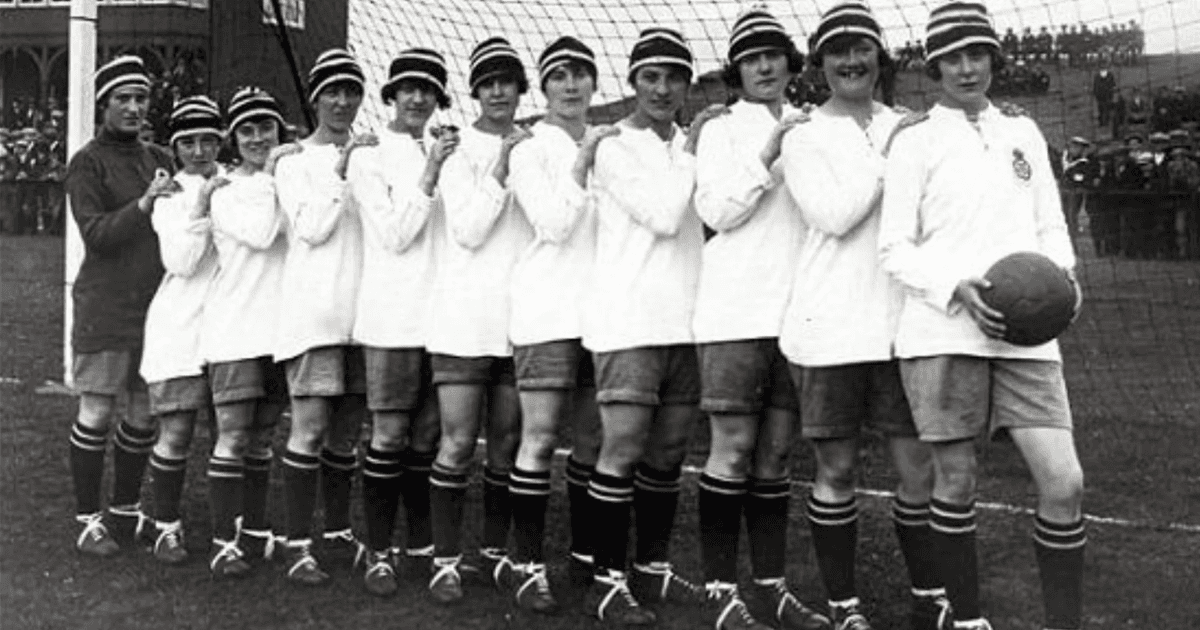
Before the ban, the question of whether women's football could attract serious support had already been answered. Dick, Kerr Ladies Football Club, formed in 1917 by factory workers at the Dick, Kerr & Company munitions plant in Preston, did not just demonstrate that women could play football. They demonstrated that women's football could fill grounds that men's clubs would have envied.
"The Dick, Kerr Ladies are considered the most important team in the history of women's football. Their legacy extends far beyond their playing record - they fundamentally shaped women's football during a critical period." — Gail Newsham, historian and author of In a League of Their Own
The numbers bear that out.
Dick, Kerr Ladies: The record
| Metric | Figure |
| Years active | 1917 to 1965 |
| Matches played | 828 |
| Wins | 682 |
| Losses | 24 |
| Peak attendance (Goodison Park, 1920) | 53,000 |
| Charity funds raised | Over £180,000 (equivalent to more than £10 million today) |
That Boxing Day match at Goodison Park in 1920 did not just set a women's football attendance record. According to Heritage Calling, it is believed to have drawn a larger crowd than any men's game in England that day, with thousands more locked outside. The record for women's club football it set stood for 98 years.
Their striker Lily Parr scored over 900 goals across her career and is now recognised in the National Football Museum's Hall of Fame. She was not a curiosity. She was one of the most prolific goalscorers in the history of the English game, full stop.
What the FA banned in 1921 was not a fringe activity. It was a sport with stars, crowds and a charitable record that should have embarrassed its critics.
Dick, Kerr Ladies continued to play until 1965, four years after the FA ban was still in force, largely on non-affiliated grounds and through international tours. The fact that they survived at all is a testament to the determination of the women involved. The fact that they had to is the indictment.
Read More: The WSL’s Real Breakthrough Is Not Revenue – It’s Control of Women’s Football
How Women’s Football Survived the FA Ban
One of the most persistent myths in women's football history is the idea that the 1921 ban created a void. That between the FA's ruling and its eventual reversal, the game simply ceased to exist in any meaningful form. That is not what happened.
Women's football continued. It was just pushed somewhere the history books were not looking.
What the shadow decades actually looked like
Myth: Women stopped playing football after the 1921 ban.
Reality: Around 30 clubs met in Liverpool just five days after the ban to form the English Ladies Football Association, explicitly to keep the game alive on non-affiliated grounds.
Myth: There were no structures or institutions supporting women's football between 1921 and 1971.
Reality: The ELFA maintained informal competition throughout the ban years. By 1969, representatives from 44 women's clubs had come together to found the Women's Football Association, building the organisational framework that would eventually force the FA's hand.
Myth: The FA lifted the ban because attitudes changed naturally over time.
Reality: The ban was rescinded under sustained external pressure, including UEFA's 1971 recommendation that national associations take responsibility for the women's game across its 32 member countries.
Academic analysis of the period, including scholarly work published via Taylor & Francis, describes the result of the ban as reducing women's football to a "tiny and stigmatised subculture" - not an absence, but a deliberate marginalisation. The game did not disappear. It was made to feel as though it did not belong.
The difference matters. Absence would mean the modern game is building from nothing. Marginalisation means it is recovering something that was always there. Those are different stories, and only one of them accurately describes what happened.
The Lost Lionesses and Copa 71 Destroy the Myth of ‘Rebirth’
In August 1971, fourteen young women from England travelled to Mexico City for a football tournament. Most were teenagers. The trip was sponsored by Martini & Rossi. They called themselves the British Independents, because the Women's Football Association, in the process of building the first official England women's team, had not sanctioned the trip. They did not wear the Three Lions.
What they found in Mexico was a version of women's football that England had spent 50 years refusing to build.
The tournament, now known as Copa 71, drew over 100,000 spectators to the Estadio Azteca. Merchandise filled the streets. Television cameras were there. The players received police escorts and were treated, by the host country at least, as major sporting figures. When England played Mexico, the crowd was reported at 90,000.
Then the team came home.
- Back in England, the coverage was minimal.
- Several players received suspensions from football authorities on their return.
- The organiser, Harry Batt, was banned from football. His son later said it broke him entirely; he never spoke about football again.
- The FIEFF, the body that organised the tournament, was subsequently banned by FIFA.
- The team's story remained largely untold for nearly 50 years, until the BBC Storyville documentary finally brought it to a wider audience in 2023.
The Lost Lionesses are the clearest proof that the problem was never a lack of audience, interest or quality. The problem was that English football's governing institutions refused to recognise what was in front of them - and then made sure the players paid a price for proving it.
Women’s Football Is a Story of Survival - Not Revival
The language we use to describe the modern women's game is not neutral. Every time a broadcaster calls Euro 2022 a "turning point" without context, or a feature describes the WSL as "the rise of women's football," it quietly erases what came before. It makes the ban era sound like a natural pause rather than a deliberate act, and it makes the current era sound like an invention rather than a restoration.
Here is what the historical record actually tells us:
- Women's football had already proved its audience. The 53,000 at Goodison Park in 1920 were not an anomaly. They were evidence of a market that the FA chose to close.
- The game never stopped. It was pushed to parks, non-affiliated grounds and unsanctioned international tournaments, but it continued because the women playing it refused to let it die.
- The institutions that suppressed the game were the last to acknowledge its survival. The FA did not lift the ban out of enlightenment. It lifted it under pressure, and even then took another year to formally recognise the Women's FA.
- The modern boom is overdue, not miraculous. Viewed through the lens of continuity rather than rebirth, the WSL era looks less like a sudden cultural shift and more like a correction of a 50-year structural injustice.
The Dick, Kerr Ladies filled Goodison Park. The Lost Lionesses played in front of 90,000 in Mexico City. Neither story made it into the mainstream version of English football history for decades.
That is the story worth telling. Not a rebirth. A reckoning.