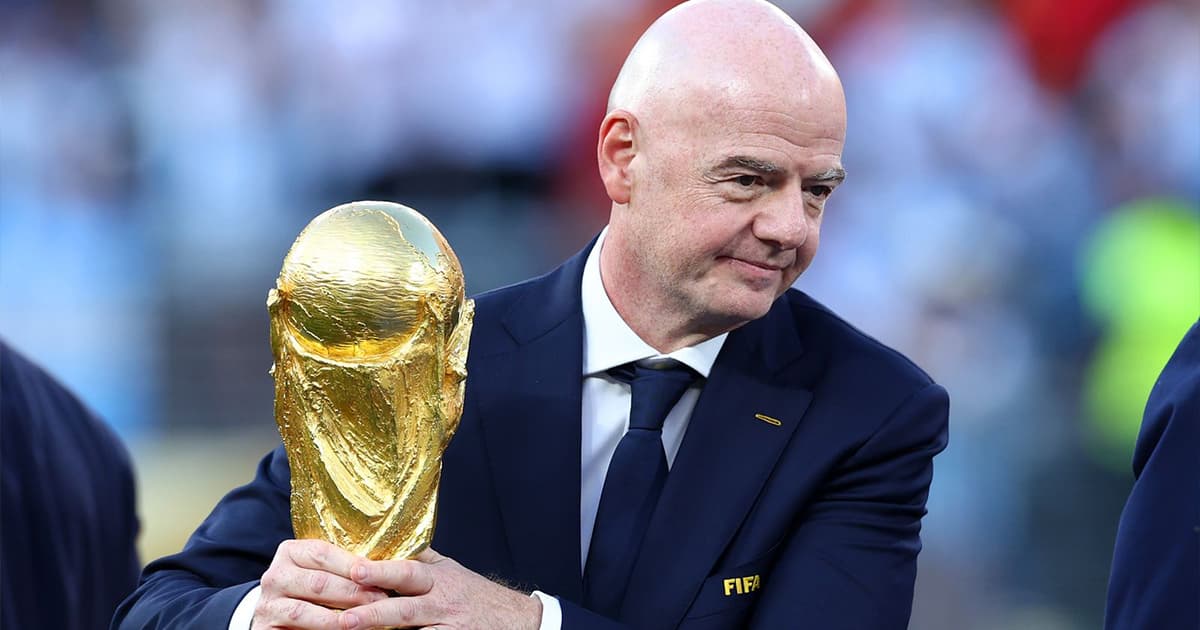
The FIFA World Cup has always been football's biggest sporting spectacle. The 2026 FIFA World Cup has broken records long before the final whistle.
Alongside expanding from 32 to 48 teams and increasing the tournament to 104 matches, FIFA has also approved the largest financial distribution in World Cup history.
A total of £538.0 million (€633.9m/$727m) will be distributed among participating member associations, representing a significant increase on the previous tournament in Qatar.
Of that amount, £484.7 million (€571.3m/$655m) has been allocated as performance prize money, while every qualified nation also received £1.1 million (€1.3m/$1.5m) to cover tournament preparation costs.
That means every country that reached the World Cup was guaranteed at least £7.8 million (€9.2m/$10.5m) before kicking a ball.
The increase reflects both the expanded tournament and FIFA's growing commercial revenues, making World Cup qualification more valuable than ever before.
World Cup 2026 Prize Money Breakdown
The deeper a nation progresses, the larger its reward.
Unlike previous editions, FIFA's expanded tournament means every knockout round now carries an additional financial incentive.
| FINISH | PRIZE MONEY | TEAMS |
| Champions | £37.0m (€43.6m/$50m) | Argentina or Spain |
| Runners-up | £24.4m (€28.8m/$33m) | Argentina or Spain |
| Third place | £21.5m (€25.3m/$29m) | France or England |
| Fourth place | £20.0m (€23.5m/$27m) | France or England |
| Quarter-finalists | £14.1m (€16.6m/$19m) | Belgium, Morocco, Norway, Switzerland |
| Round of 16 | £11.1m (€13.1m/$15m) | Brazil, Canada, Colombia, Egypt, Mexico, Paraguay, Portugal, United States |
| Round of 32 | £8.1m (€9.6m/$11m) | Algeria, Australia, Austria, Bosnia & Herzegovina, Cape Verde, Croatia, DR Congo, Ecuador, Germany, Ghana, Ivory Coast, Japan, Netherlands, Senegal, South Africa, Sweden |
| Group Stage | £6.7m (€7.9m/$9m) | Curaçao, Czechia, Haiti, Iran, Iraq, Jordan, New Zealand, Panama, Qatar, Saudi Arabia, Scotland, South Korea, Tunisia, Turkey, Uruguay, Uzbekistan |
Preparation payment (all teams): £1.1m (€1.3m/$1.5m)
Minimum guaranteed payment: £7.8m (€9.2m/$10.5m)
How Much More Are Argentina And Spain Playing For?
Following their semi-final victories, both Argentina and Spain have already secured runners-up prize money.
That means each nation has guaranteed themselves £24.4 million (€28.8m/$33m) in performance payments.
However, Sunday's final carries far greater financial significance than simply lifting football's biggest trophy.
The winners will receive £37.0 million (€43.6m/$50m), meaning the champions will earn an additional £12.6 million (€14.8m/$17m) compared to the runners-up.
Meanwhile, England and France will meet in the third-place play-off with £1.5 million (€1.8m/$2m) separating third and fourth place.
Do World Cup Players Receive Prize Money?
The money awarded by FIFA is paid to each participating national football association - not directly to the players.
How much individual players receive depends entirely on their federation.
Some associations divide the prize money equally among the squad, while others allocate bonuses based on appearances, performance or existing agreements.
In recent tournaments, several nations have adopted very different approaches.
Australia reportedly awarded players performance bonuses during the 2022 World Cup, while Germany has historically offered substantial title-winning bonuses. Ahead of the 2006 World Cup on home soil, the German Football Association promised each player a significant reward if they lifted the trophy.
The United States has taken perhaps the most high-profile approach. Under U.S. Soccer's landmark collective bargaining agreement, World Cup prize money is shared equally between the men's and women's national teams.
How World Cup Prize Money Has Increased Since 1982
Prize money has increased dramatically over the past four decades.
When Italy lifted the World Cup in Spain in 1982, the champions received just £1.6 million (€1.9m/$2.2m).
Fast forward to 2026 and this year's winners will earn £37.0 million (€43.6m/$50m) in performance prize money alone - more than 22 times as much.
| WORLD CUP EDITION | WINNERS' PRIZE MONEY |
| 2026 | £37.0m (€43.6m/$50m) |
| 2022 | £31.1m (€36.6m/$42m) |
| 2018 | £28.1m (€33.2m/$38m) |
| 2014 | £25.9m (€30.6m/$35m) |
| 2010 | £22.2m (€26.2m/$30m) |
| 2006 | £14.8m (€17.4m/$20m) |
| 2002 | £5.9m (€7.0m/$8m) |
| 1998 | £4.4m (€5.2m/$6m) |
| 1994 | £3.0m (€3.5m/$4m) |
| 1990 | £2.6m (€3.1m/$3.5m) |
| 1986 | £2.1m (€2.5m/$2.8m) |
| 1982 | £1.6m (€1.9m/$2.2m) |
The sharpest jump came after the 2002 tournament, when growing commercial revenues enabled FIFA to significantly increase the financial rewards on offer.
Why FIFA Increased World Cup Prize Money In 2026
The expanded 48-team format has not only created more matches - it has also resulted in a much larger financial commitment from FIFA.
The governing body has confirmed a total financial distribution of £538.0 million (€633.9m/$727m) for the 2026 World Cup.
That figure includes:
- £484.7 million (€571.3m/$655m) in performance-based prize money.
- £53.3 million (€62.6m/$72m) in preparation payments to the 48 participating nations.
FIFA has also committed additional funding towards travel, accommodation and delegation expenses for participating teams, particularly benefiting smaller football associations competing on the biggest stage.
How Does Men's World Cup Prize Money Compare To The Women's Tournament?
The financial gap between the men's and women's tournaments remains substantial.
The 2023 FIFA Women's World Cup distributed US$110 million in prize money, approximately one-sixth of the US$655 million performance pool available at the men's tournament in 2026.
However, investment in the women's game has grown rapidly.
The prize fund for the 2023 Women's World Cup represented a significant increase on previous editions, and FIFA president Gianni Infantino has repeatedly stated that the organisation's long-term ambition is to continue increasing financial support for the women's tournament.
Prize money for the 2027 FIFA Women's World Cup has yet to be officially announced.
The Richest FIFA World Cup Ever
The 2026 edition was already guaranteed to be the biggest World Cup ever staged.
It is now officially the richest as well.
With 48 teams, 104 matches, a record £538.0 million (€633.9m/$727m) financial distribution and unprecedented rewards for participating nations, FIFA has significantly raised the financial stakes of international football's biggest competition.
For Argentina and Spain, only one match now remains.
Alongside lifting football's most coveted trophy, the winners will also leave North America with a record £37.0 million (€43.6m/$50m) in prize money; the biggest payout ever awarded to a FIFA World Cup champion.