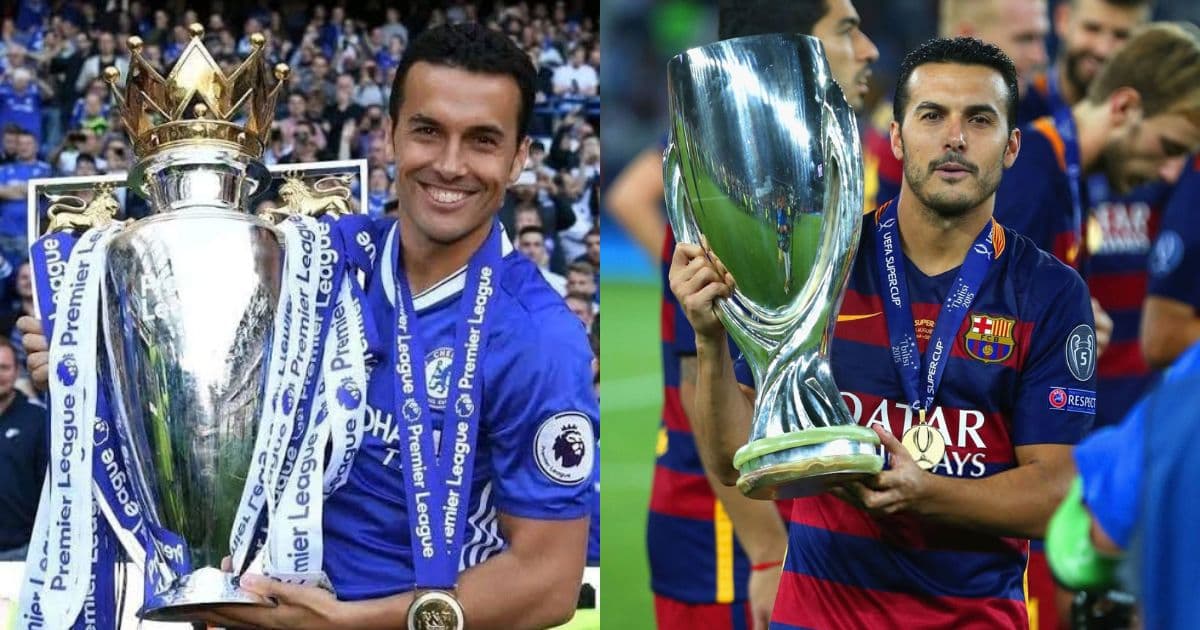
Thiago Alcantara, a man synonymous with control, craft and “La Pausa”. A man who glided across the football pitch, mesmerized onlookers with his mastery of the ball, and then bowed out as gracefully as he came.
Thiago Alcantara, mononymously known as Thiago, had a star studded career with the world’s biggest clubs - Barcelona, Bayern Munich and Liverpool. At 33, two years ago, he walked down the tunnel one last time. And yet, football hasn't found another Thiago Alcantara in all that time.
Why Thiago Alcantara Was One of Football’s Most Unique Midfielders
In Spain, newspaper El Pais perhaps described him best when it wrote that Thiago was “[un] jugador al que se le aplaudía hasta la intención.” [The player who was applauded even for his intentions.]
Modern football continues to produce extraordinary midfielders, but very few players can control time the way Thiago once did.
These days, footballers are subjected to rigid profiles. You got your ball-winner, the box-to-box engine, the advanced playmaker, the shadow striker. Thiago never was confined by these parameters. At different moments in his career, he operated as a number eight, a deep-lying regista, a lone number six or an advanced controller between the lines.
But reducing him to a position misses the point entirely.
During his peak years, which would be at Bayern, Thiago’s metrics were astonishing. In the treble winning season under Hansi Flick, Thiago frequently recorded over 90 per cent pass completion rates. He continued simultaneously ranking in the upper percentiles for progressive passes, shot-creating actions, and line-breaking carries.
But Thiago carried one special attribute about him. An element that is present in every world class Spanish midfielder. Iniesta, Xavi, David Silva, Pedri, Isco and Thiago among others all carry this one trait within them that sets them apart from midfielders that other countries produce. It's called "La Pausa"
La Pausa: The Lost Midfield Art Thiago Perfected
Thiago possessed an unmatched level of pausa.
But what is La Pausa? Total Football Analysis defines La Pausa as “a player’s ability to slow down the game’s pace, take control of the ball, and assess the situation around them.”
After all, La Pausa literally means The Pause in English.
At a time when modern football increasingly values speed and instant transitions, Thiago represented the opposite philosophy.
Thiago, trained in the halls of Barca’s famed La Masia academy - had La Pausa ingrained in him at a very young age. At the heart of the midfield of three of the biggest clubs in the world, Thiago was able to deliberately slow down the game to manipulate the opponent's defensive structure.
Time froze for Thiago with the ball at his feet, and it felt like he could spend an eternity patiently waiting for the exact millisecond a passing lane opens.
The Spaniard was basically immune to pressure. One of his trademark techniques was receiving the ball on a half-turn, confusing the opponent with his body orientation. He would drop a shoulder at a snap, tricking an oncoming opponent into committing erroneously, before effortlessly moving into space.
Very few midfielders in modern football possess abilities like his at an elite level.
Read More: Why Thiago Alcantara is Leaving Hansi Flick’s Barcelona Coaching Staff?
The Brazilian Flair and Spanish Identity That Made Thiago Different
Part of Thiago’s uniqueness came from his footballing identity. Many people forget that Thiago is actually Brazilian and was born in Italy.
His father, Mazinho, won the 1994 FIFA World Cup with Brazil, while his brother Rafinha represented Brazil internationally as well.
That contrast in his natural born identity versus his adopted Spanish identity also positioned him rather uniquely in world football.
Despite being eligible to represent Brazil, the former La Masia graduate opted for the Spanish national team, as he had lived in Spain since he was five years old and was eligible to represent the country. He navigated every youth level from U16 to U21 before making his senior debut.
As a La Masia graduate, he was educated in the Tiki Taka principles of Barcelona, the passing triangles, spatial awareness and La Pausa instilled by figures like Xavi and Sergio Busquets.
But having Brazilian blood in him, he would always be a little different with the ball. He carried that Brazilian flair in his step, doing stepovers and fancy skill moves in tricky situations that called for it. Xavi named him "an extraordinary player", and Neymar, one of the most technical players of this era, said Thiago might be more technical than himself.
That combination of Spanish structure and Brazilian flair made Thiago almost impossible to replicate.
Guardiola, Bayern and the Adaptation of Thiago
While it's true that his genetics and geographical upbringing played a part, but that’s not the only reason why there hasn’t been another Thiago Alcantara.
Thiago spent most of his career inside possession-dominant systems.
Until his move to Liverpool, Thiago had always played in a similar system. He played for Spain and Barca, where the Tiki Taka and Pausa philosophies are prominent. There he always had time and space to work his magic. Almost his entire Barca tenure from 2009 to 2013 was under Pep Guardiola, and he became an expert controller for Guardiola's style of football.
When Pep Guardiola joined Bayern in 2013, the only signing he wanted from the board was Thiago Alcantara.
“Thiago or Nothing”, is an actual quote Pep famously said.
Thiago continued to thrive under Guardiola's possession ideology. He stayed at Bayern until his move to Liverpool, which was a complete opposite of the footballing philosophy he had been used to all his career.
Jurgen Klopp’s Liverpool was built on "heavy metal football". Rapid transitions, Gegenpressing, direct vertical progression and counters. Incorporating a possession-oriented playmaker into the Liverpool midfield seemed quite counterintuitive.
But, Thiago adapted beautifully. At Anfield, he dictated the tempo, bringing his level of control to a team that never seemed to have a calm moment. His defensive contributions also often went unnoticed. Despite standing at just 1.74m [5'8"], he had elite anticipation skill which led to a high number of interceptions. He won the ball back not through force, but through an intelligent idea of space and predicting future moves before the ball was even struck.
If not for injuries, we would have still been enjoying Thiago’s magic for many years.
Why Modern Football No Longer Produces Midfielders Like Thiago
The sport has evolved. It has undergone a massive athletic revolution. Today's elite midfielders like Jude Bellingham, Federico Valverde, or Declan Rice are expected to be physical titans. They are required to cover more than 10 kilometers per match, win dozens of duels, and crash the penalty box.
The La Pausa is a lost art now with only a few proponents of that philosophy remaining.
Modern managers are also increasingly scared of taking risks in the midfield, instead preferring powerful athletes who minimize possession losses and who excel in moving the ball quickly. Profiles like those of Thiago are increasingly viewed as a defensive liability these days. Youth academies are optimizing for speed, stamina, tactical compliance rather than the art of the Pausa.
Furthermore, young players are scared to take the creative risks Thiago took. A youth prospect attempting a dangerous line-breaking pass from a deep position is quickly coached to choose the safer option to maintain possession.
This eradication of individual flair in deep midfield roles is giving rise to a plethora of homogenous profiles. The environment that forged someone like Thiago Alcantara simply no longer exists.
For those of us who were lucky enough to witness him at his peak, we are left only to look back at the video highlights and social media edits. Rest assured, we will forever be applauding the beauty of La Pausa as long as we talk about Thiago Alcantara.