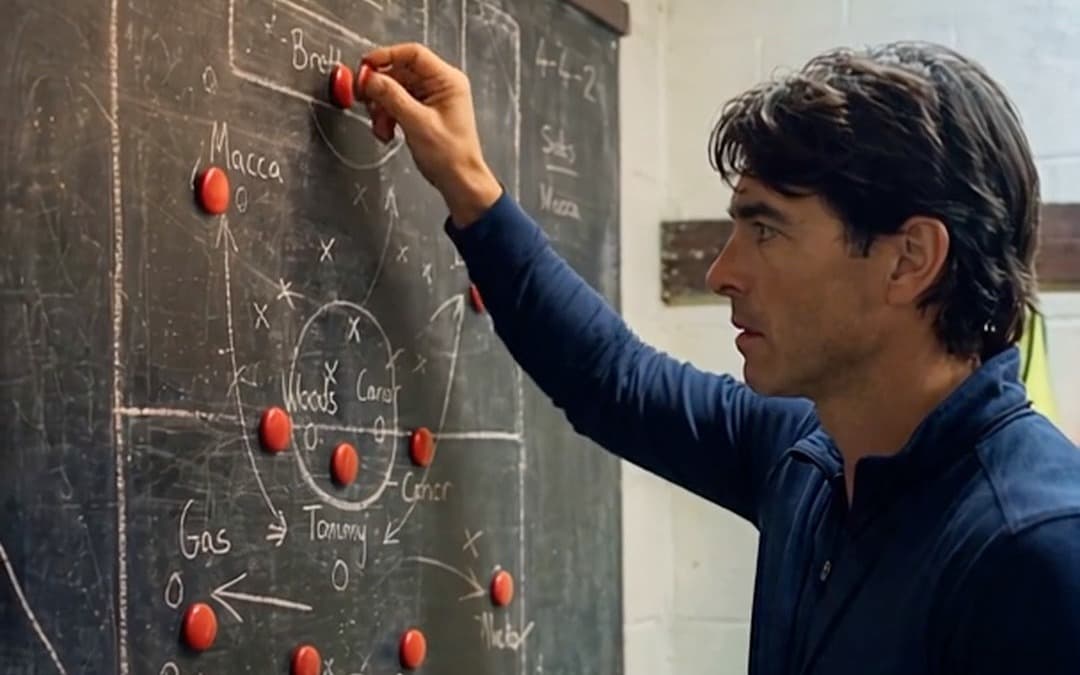
It is twenty to ten on a Saturday morning and the car park is already a disaster. Somebody has parked across the gate. The goals are still chained to the fence. And the coach, standing by an open boot with a flask going cold, is trying to pick a team.
On the bonnet sits the magnet board. One magnet has been missing since March. In the coach's hand is a phone with three versions of the starting eleven in the notes app, none of them current, and a parents' group with forty unread messages. Two players are ill. One has a cousin's birthday. One has turned up who nobody expected, holding their boots like a peace offering.
Kick-off is in fifty minutes. The coach has not yet decided who plays left back.
If you have ever run a grassroots side, you have stood in that car park. Davide Domenghini has stood in it more Saturdays than he can count. Then he went home and built something about it.
The Gafferboard launch film. Sound on.
The coach who writes code
Domenghini is a web developer by trade and a football manager by every other measure. He started coaching when his son was in the under 9s. His son is now in the under 15s, and so is he: he manages Ayat U15, who play in the Tandridge Youth Football League out of the Mitcham and Croydon area.
He has coached at two clubs, and he says the move between them showed him "a completely different reality" for parents and coaches. Different families, different pressures, different Saturdays. The same problem every week, though. Too many moving parts, and only one person holding them.
He describes himself as a very practical person. That is the whole story of Gafferboard, really. Not a grand plan to change football. A coach who was tired of the magnet board, and who happened to know how to build the replacement.
Built for the 90 minutes, not the paperwork
There is no shortage of software in grassroots football. Clubs run registrations, subs fees, fixtures and kit orders through all sorts of apps. What almost none of them touch is the bit that actually happens on grass: the hour before kick-off and the ninety minutes after it.
That is the gap Gafferboard goes after. It is a matchday board, and nothing else. The squad, who is called up, the shape, the bench and every substitution, on one screen that works on a phone held in a cold hand.
You open it in the browser at gafferboard.com. There is no app to download, no account, no email address to hand over. It is free for your team, with no adverts. You pick the team and you get on with it.
Age decides everything
The first thing the board asks is not your name. It is the age group you coach.
That one answer sets the format, because the format changes as children grow. Under the FA's new structure for 2026-27, under 7s play 3v3, under 8s and 9s play 5v5, under 10s and 11s play 7v7, under 12s and 13s play 9v9, and from under 14s it is the full 11v11. Pick the age and the board loads the right number of players and the shapes that go with them. If your league or county does things differently, you can change it.
Pick the age group and the board sets the format: 3v3 at under 7s, all the way to 11v11.
It also sets something more interesting: the mood.
Up to and including under 11s, the results do not count, and Gafferboard behaves accordingly. Everyone gets a go. The board keeps an eye on minutes so nobody spends the whole morning on the bench getting cold. From under 12s, results matter and league tables start, and the board treats you like a manager who has to win.
Meet the Gaffer
This is the bit that makes people laugh the first time they use it. Gafferboard talks.
Every line on the board comes from a character called the Gaffer, a coach on your staff who has done a hundred wet Saturday mornings and still loves every one of them. And the Gaffer has two ways of talking.
For the younger age groups, you get the eternal optimist. Bring a player off and it will tell you they had a great shift. Clear the bench and it says, "Everyone's had a go. Proud of that." Save a line-up: "Lovely stuff."
From under 12s up, you get the old pro. Short sentences. No exclamation marks. Praise so rare it lands. Make a sub and you might get "Good." Run out of players and the board simply says, "Bench is empty. That's your lot." Tap a player in a shape you are not sure about and it wants to know: "What are we thinking?"
Bench is empty. That's your lot.
The Gaffer, from under 12s up
It is funny because it is familiar. Every grassroots coach has worked with both of these people. There are rules behind the jokes, though. The Gaffer is tough on the job and never on people. It never mocks a child, never has a go at the ref, never swears. This is kids' football, and the board knows it.
Four taps on a Saturday
Strip away the personality and the job is simple.
Type the squad in once. You can paste the names straight from the parents' group, with shirt numbers and positions if you have them. They are there every week after that.
Paste the squad once, straight from the parents' group.
Tick who is available. Injured players stay flagged, so you do not pick the one who rolled an ankle on Tuesday.
Tap a shape and drag players where you want them. Save it. The Gaffer may question it. You will probably pick it anyway.
Tap a position to see who can cover it. Drag works too.
Then start the clock. Bring the bench on with a tap, and every substitution is logged to the minute. At full time you know exactly who played how long, which, if you have ever had a difficult conversation with a parent in a car park, is worth more than any trophy.
Clock on. Every substitution logged to the minute.
The message the parents actually get
The last step is the one that matters most to the people standing on the touchline.
Gafferboard writes the call-up for the parents: who is in, by shirt number, ready for the WhatsApp group or an email. After the whistle it can send the result too. It goes out plain, in the coach's name.
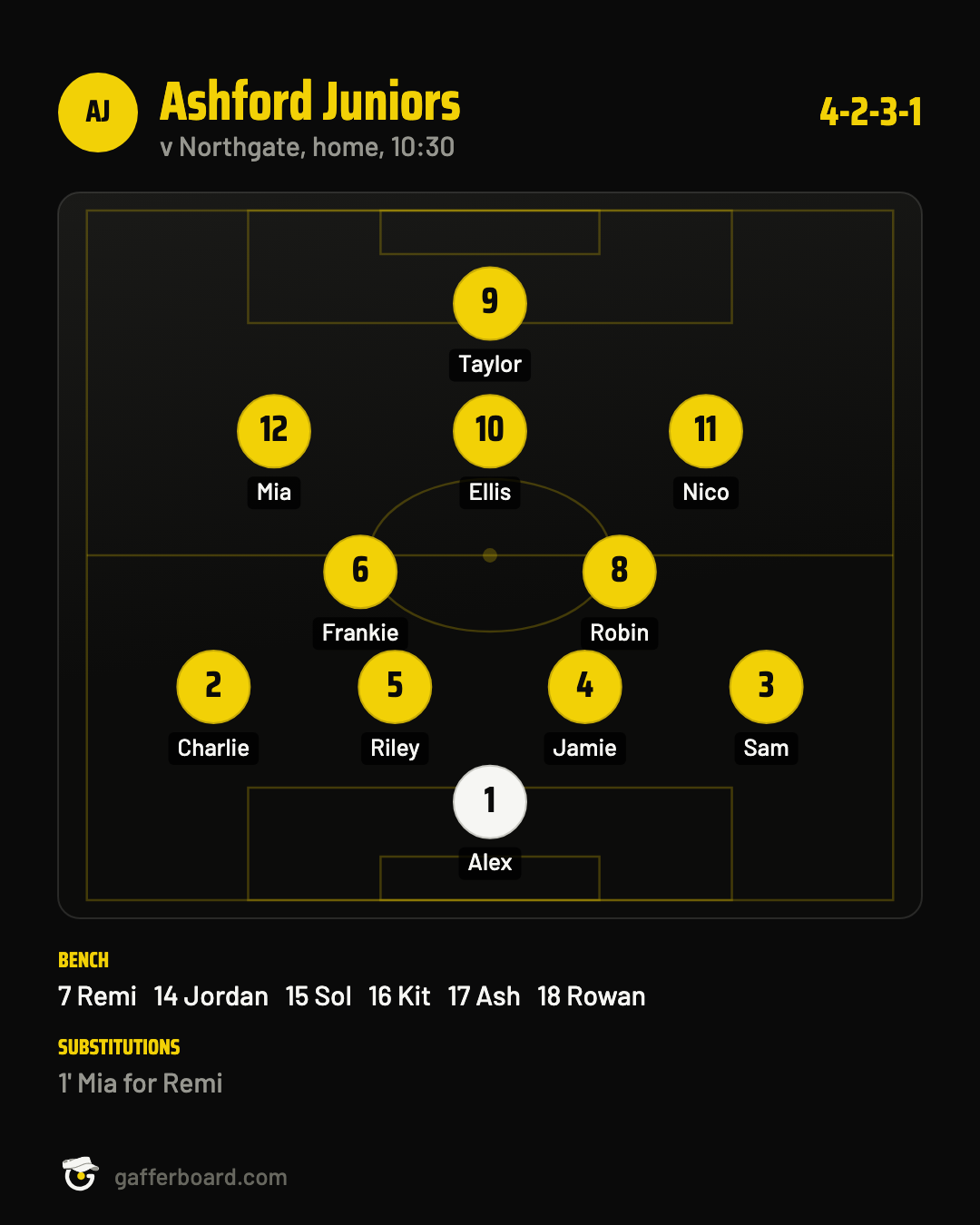
What it never sends is the shape or the injury list. Those are coaching decisions, and they stay with the coach. There is even an option to use initials only, for group chats that include people outside the club.
The call-up goes out before the coffee is finished.
Nothing leaves your phone
That last point says a lot about how the board was built. Gafferboard handles children's names, so it was designed to know as little as possible about them.
There is no database. The squad lives in the browser on the coach's own phone or laptop, and nothing about the players is sent anywhere. No cookies, no advertising, no trackers. If you want to move your board to another device, you export a squad file and open it there. Delete a player and they are gone.
For a volunteer coach who has sat through a safeguarding course and come away nervous about every spreadsheet they own, that is not a small thing.
What happens next
For now, Gafferboard is a website that behaves like an app on your phone. An actual app is on the list for later. Domenghini is also building a version for clubs, with a waitlist open on the site, but the board for a single team stays free.
You can follow how it develops on Instagram at @gafferboard, where the launch posts walk through the board one screen at a time.
He believes nobody else has built quite this. That is a claim worth testing on a cold touchline rather than taking on trust, so here is the test. Next Saturday, leave the magnet board in the boot. Pick the team on your phone. Send the call-up before you have finished your coffee.
Back in that car park, the coach with the cold flask has done exactly that. The team is picked. The parents have the message. The left back is sorted. Somebody has finally moved the car blocking the gate.
Kick-off in forty minutes. Plenty of time.
Declaration of interest
Davide Domenghini, who built Gafferboard, also works on the Striver.Football website. Gafferboard is his own project. It is not connected to Striver, and it is not a project of his club. Striver covers grassroots tools when we think coaches will find them useful, and we would say the same about this one if a stranger had made it.