
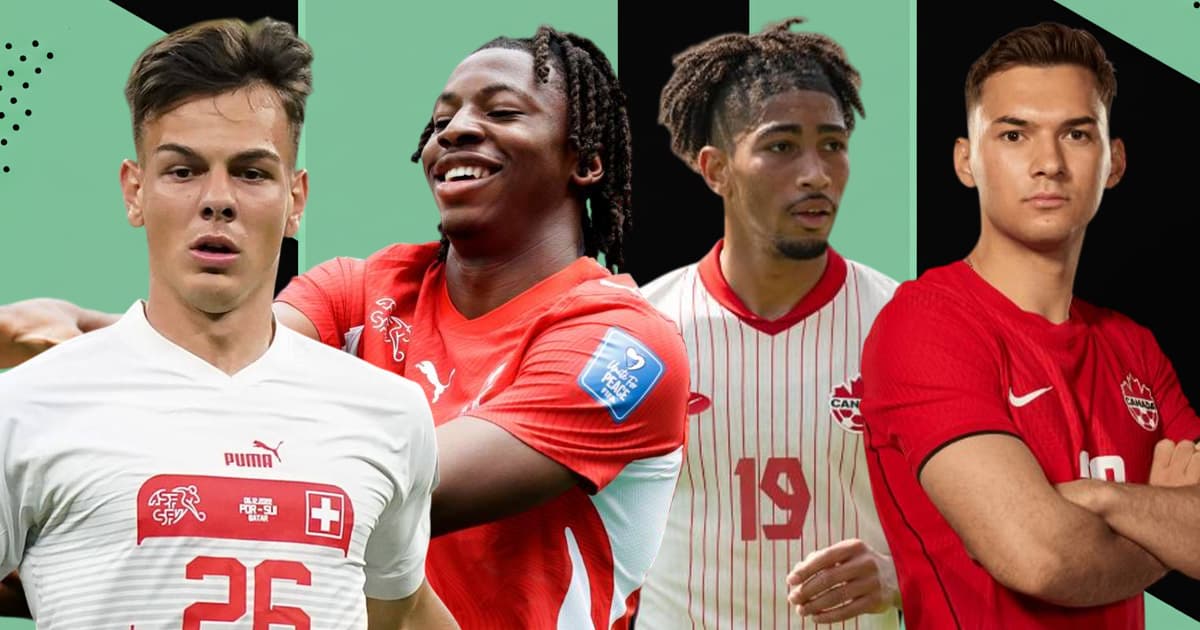
Switzerland will face Canada in a pivotal 2026 FIFA World Cup Group B encounter at the BC place stadium, with six young prospects having the chance to shape history, as both sides are chasing top spot heading into the last pool clash.
Both nations enter this fixture on the heels of statement opening performances. The Swiss systematically dismantled Bosnia and Herzegovina 4-1, while the co-hosts delivered a historic 6-0 rout of Qatar in Vancouver.
Switzerland relies on structural discipline, progressive positional play, and an interior engine room designed to control transitions.
Conversely, Jesse Marsch’s Canada operates with a high-octane verticality that relies on aggressive counter-pressing and immediate central overloads.
Striver.Football profiles the exciting youngsters ready to dictate the tempo of their respective senior setups.
Switzerland's Emerging Core Looks To Maintain Momentum

Johan Manzambi: The Historic Game-Changer
Matchday 1 and 2 Tracking: 20 minutes played, 2 shots, 2 goals.
The 20-year-old SC Freiburg forward wrote his name into Swiss football folklore on Matchday 1, coming off the bench to score a blistering late brace and become the youngest Swiss player to achieve the feat at a major tournament.
As we profiled on our 10 youngsters to watch at the FIFA World Cup piece, Manzambi operates with a lethal combination of vertical line-breaking pace and intelligent box movement.
Rather than waiting for central service, he excels at exploiting the blind sides of tired defenders, a trait that makes him Murat Yakin’s premier weapon to disrupt structured low-blocks.
Aurele Amenda: The Structural Anchor
Matchday 1 & 2 Tracking: Unused Substitute
Standing as a physical powerhouse for Eintracht Frankfurt in the Bundesliga, Amenda provides the defensive foundation that could allow Switzerland's expansive midfield to flourish.
He is a modern, proactive center-back who values front-foot interception over passive containment and will be hoping to get a chance at some point against Canada, with their place in the round of 32 already sealed.
Ardon Jashari: The Interior Metronome
Matchday 1 and 2 Tracking: 1 minute played (Late tactical substitute).
Though limited to a brief cameo during their win against Bosnia, the Milan midfielder remains the tactical brain of Switzerland's next generation.
The former Belgian Footballer of the Year possesses exquisite press-resistance and spatial awareness.
Operating as a deep-lying orchestrator, Jashari’s primary strength is his body orientation under pressure, allowing him to turn away from central traps and feed line-breaking vertical passes into the half-spaces.
Canada's Next Generation Is Driving The Co-Hosts Forward

Nathan Saliba: The Stepping-Stone Metronome
Matchday 1 and 2 Tracking: 2 Games Played (1 Start, 1 Sub), 1 Goal, 1 Assist, 93 per cent Pass Accuracy, 6 Ball Recoveries.
Tactical Profile: When Ismael Kone was forced off early against Qatar, the RSC Anderlecht midfielder stepped into a high-pressure environment and delivered a masterclass.
Saliba altered the texture of Canada's midfield completely, showcasing technical composure alongside an aggressive defensive work rate.
His stunning direct free-kick highlighted a technical ceiling that balances his relentless engine, proving he can orchestrate transitions just as effectively as he breaks them up.
Niko Sigur: The Flexible Screen
Matchday 1 and 2 Tracking: 8 minutes played
Tactical Profile: The Hajduk Split utility man offers Jesse Marsch a crucial tactical safety valve. Capable of operating either as a traditional defensive midfielder or an inverted right-back, Sigur is defined by his defensive discipline and lateral coverage.
In a high-pressing system that leaves significant space behind the midfield line, Sigur's positional intelligence serves as a shield against quick, central combinations.
Owen Goodman: The High-Line Sweeper
Matchday 1 Tracking: 0 minutes played (On the bench).
Tactical Profile: On the books at Crystal Palace, the 1.93m shot-stopper represents the modern archetype required for a vertical, high-pressing team.
Goodman couples explosive reflexes with advanced positioning, comfortable acting as a proactive sweeper-keeper. His command of the penalty area and distribution range make him an ideal backstop for a side that frequently squeezes the pitch and leaves green grass behind the defensive line.
Five Lessons Young Footballers Can Learn From Switzerland vs Canada
Solving the Midfield Void: With Ismael Kone's status uncertain, Jesse Marsch should avoid a straight-swap approach and instead pivot to a double-pivot structure featuring Nathan Saliba alongside Stephen Eustaquio.
Saliba's high press-resistance allows him to absorb the initial Swiss engagement, freeing Eustáquio to orchestrate longer-range switches to Canada’s explosive wingers.
The Half-Space Trap: Switzerland's success hinges on whether Jashari or Manzambi can establish possession in the half-spaces.
If Canada’s front line fails to trigger an immediate counter-press, the Swiss midfield has the technical security to bypass the first wave and pin Canada's full-backs deep.
Amenda vs The Canadian Transition: This will be the ultimate test of Aurele Amenda's recovery pace. Canada’s vertical system thrives on turning center-backs toward their own goal; Amenda will need to rely heavily on his physical positioning to delay transitions rather than diving into tackles.
Manzambi's Role Evolution: After a historic brace from the bench, Yakin faces a classic selection dilemma.
While Manzambi's profile is devastating against tiring defensive lines, his ability to stretch the pitch from the opening whistle could force Canada’s backline into an uncomfortably deep retreat.
The Inverted Full-Back Dynamic: If Niko Sigur is introduced to provide defensive stability, his ability to tuck inside from the right flank could offer Canada a three-man rest defense structure, neutralizing the sudden, central counter-attacks that Switzerland executed perfectly on Matchday 1.