
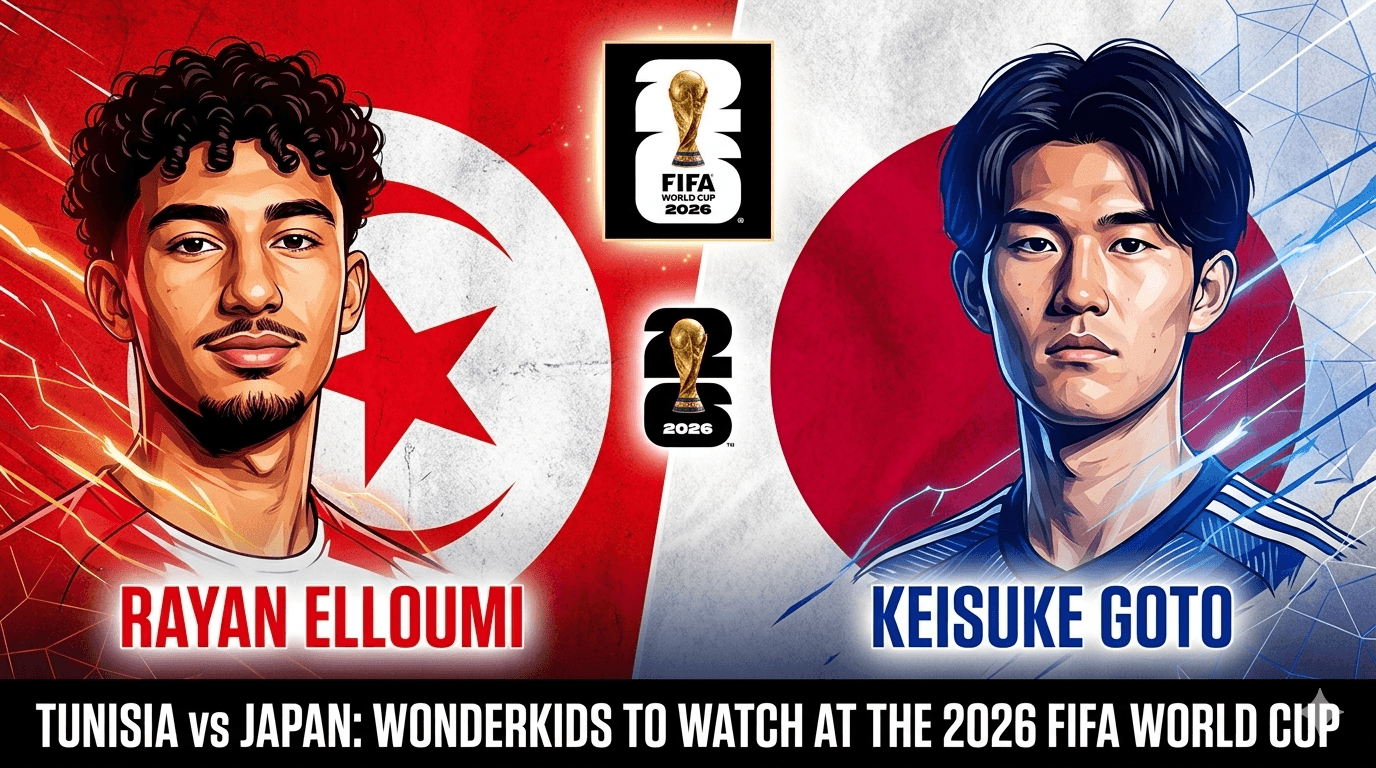
The match between Tunisia and Japan in Group F of the 2026 FIFA World Cup was a decisive encounter for both teams in terms of qualification, as it helped Japan secure their qualification hopes and keep challenging the Netherlands for the top spot, while it officially ended Tunisia’s chances of qualification.
The heavy 4-0 loss was decisive for eliminating Tunisia as the two heavy losses they conceded in the group stage so far mean that Tunisia will have no chances to qualify even if they win their last match against the Netherlands.
That said, the match represented an opportunity for several young prospects to experience the World Cup atmosphere and participate in the tournament with the hope of becoming even more central to their national teams’ projects in the future.
In fact, Japan is considered as one of the countries with the best player development systems in football, while Tunisia keep on generating new talents who have the potential to form the backbone of the senior national team in the near future.
From young strikers breaking through in North America to highly talented Japanese players already getting the attention in the Bundesliga and elsewhere, this clash featured two teams with some of the most promising young talents of the tournament.
Tunisia's Next Generation Still Has Reasons For Optimism
Rayan Elloumi: The Next Vancouver Whitecaps Marksman

Rayan Elloumi has been attracting a lot of attention recently as he is one of the rare Tunisian strikers to start their careers in the MLS.
Second-generation Canadian and product of Vancouver Whitecaps' youth system, the 18-year-old striker has seen his career develop rapidly in the last two years.
Having impressed in the youth and reserve teams, Elloumi was given a chance to play for the senior team in MLS and showcase his abilities at a bigger stage.
The call-up for the Tunisian national team represented a golden opportunity for Elloumi at a young age to further confirm his talent on an international level.
Furthermore, being selected among the 26 players participating in the 2026 World Cup is an additional sign of the increasing conviction that he will represent a key attacking player for the future of the Eagles of Carthage.
Elloumi combines clever movements without the ball and explosive accelerations, in addition to his remarkable finishing skills.
Although physical strength is still an aspect that Elloumi still needs to work on, exploiting spaces at the back of defensive lines represents one of Elloumi’s key traits, especially during counterattacks.
In fact, the 2026 World Cup could mark the breakthrough of a new Tunisian striker, especially if he gets some playing time in the last match.
Adem Arous: Tunisia Promising Defensive Talent

Despite the fact that the attacking players in Tunisia are usually the ones who get more recognition, Adem Arous has been attracting the attention as one of the most talented young defenders in the country.
The 21-year-old defender started his career at Stade Tunisien and then took his game to the next level by joining the Turkish Süper Lig team, Kasımpasa, proving his remarkable development.
Being 1.88m tall, Arous has got the abilities needed to win a large part of the defensive duels and the aerial duels, as he is usually good with decision-making and with the build-up from the back.
These traits helped him play at a senior level quickly and join the Tunisian national team at a young age too.
Arous also showed that he is excellent in terms of anticipations, one-v-one situations, and tactical flexibility.
More importantly, providing vertical passes and accurate passes even when put under pressure and avoiding inaccurate clearances as much as possible makes him a “wanted” modern centre-back.
With Tunisia undergoing a shift in terms of transition between generations, the 2026 World Cup represents the best opportunity for Arous to further showcase his abilities at an international stage.
Khalil Ayari: PSG's Next Attacking Gem

Khalil Ayari can be considered as Tunisia’s most promising talent at the moment.
Why? Simply because he is the only Tunisian playing at a top European team at the moment.
He developed as a right winger at Stade Tunisien before joining Paris Saint-Germain, and he quickly confirmed his talent at PSG within the youth teams, as he is expected to soon participate under the management of Luis Enrique.
Ayari has got the natural talent needed in terms of dribbling, explosive runs, and shooting skills that allow him to disturb any defence.
But just like Elloumi, Ayari still needs to work better on improving his physical strength in order to increase his offensive duels’ wins rates.
The call-up to the national team and the participation in the World Cup can only fasten his development and help him become a more confirmed players, especially if he convinces when he will get the chance to play.
Japan's Development Pathway Continues To Deliver
Zion Suzuki: Parma's Guardian

Despite being almost 23 years of age, which is a little bit over the age limit for a wonderkid, Zion Suzuki remains one of the most remarkable talents for Japan given his high potential in goalkeeping.
Suzuki is a goalkeeper who can be reliable for Japan in the coming years mainly thanks to his confident personality, his reflexes, and his abilities in terms of passing.
Furthermore, his experience and maturity are very remarkable despite his young age, something that can help him become even more reliable on the long run.
Being Japan’s starting goalkeeper at this young age for goalkeepers means that Suzuki has a bright future ahead of him, whether at a club level or with the Japanese national team.
Keisuke Goto: A Striker On The Rise

Keisuke Goto caught the attention of scouts since many years ago given his talent as a striker, and the 2026 World Cup can only represent another opportunity for him to confirm to Freiburg that they have made the right decision.
Earlier in his career, Goto moved from Júbilo Iwata to Anderlecht in Belgium.
After that, he had a successful spell in Belgium where he developed his playing style and increased his goal contribution rates.
His remarkable goal contribution rates helped him in developing quickly and starting to become consistent too.
Goto brings uncommon traits to the Japanese national team, given that he is a 1.91 m striker with exceptional abilities especially inside the box.
One of the traits that make Goto's profile stand out is his combination of physical strength and skilful finishing.
What makes Goto even more special is that he can be useful even outside the box thanks to his playmaking and dribbling abilities, something that not all strikers can master.
Therefore, Goto adds more variety to Japan’s attacking line, providing finishing quality, playmaking support, and ability to create danger from anywhere inside the final third.
Kento Shiogai: Wolfsburg's New Attacking Weapon

Kento Shiogai has been developing very quickly in the last few seasons as he developed at NEC Nijmegen in the Eredivisie and moved to Wolfsburg at the start of 2026.
Although he started his career in Japan, he soon attracted the interest of European teams and is continuing to do so especially after having joined Wolfsburg.
Not many Japanese forwards can claim to have seen their stock rise as rapidly as Kento Shiogai's in the past year.
Characterised by his finishing and his varied goalscoring techniques, Shiogai has the potential to confirm himself even more in Bundesliga and with the Japan national team in the coming years.
Read More: The Next Generation: 5 Japan Wonderkids Ready To Light Up The 2026 FIFA World Cup
What Young Footballers Can Learn From Tunisia And Japan
- Different pathways can lead to the top level.
- International tournaments accelerate development.
- Physical development matters alongside technical quality.
- European moves are not the only route to success.
- Patience is critical for young players.