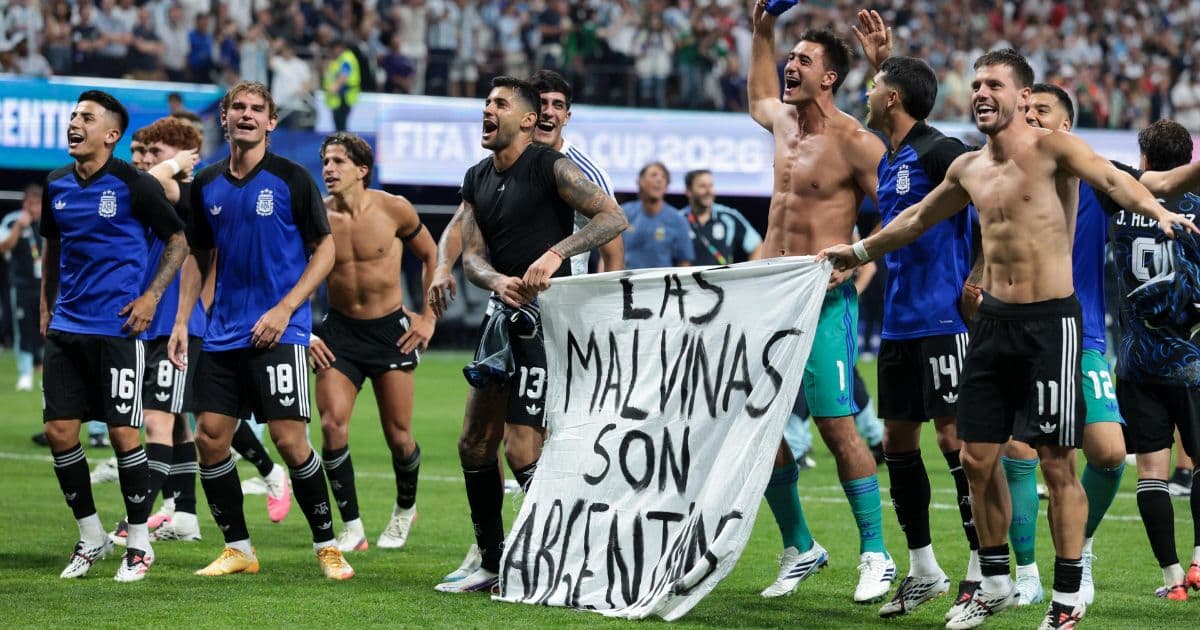
The final whistle in Atlanta had barely blown when the controversy started. Argentina had just beaten England 2-1 in a World Cup semi-final comeback on Wednesday, July 15.
Lisandro Martinez and Giovani Lo Celso were grinning as they held up a banner that read "Las Malvinas son Argentinas," "The Falklands are Argentinian," waving it toward the crowd before leaving it on the pitch. Within hours, the celebrations had given way to political controversy and the prospect of FIFA disciplinary action.
Why FIFA Could Investigate Argentina Over The Falklands Banner
Under FIFA rules, banners, flags, flyers, apparel, and other paraphernalia that are of a political, offensive, and/or discriminatory nature are prohibited inside stadiums. The banner displayed in Atlanta appears to fall within that definition because it makes a direct territorial and political claim about islands.
That remains a live sovereignty dispute between Argentina and the United Kingdom. Argentina boss Lionel Scaloni had said before the game he did not want the fixture to become about the conflict over the British overseas territory.
The banner was taken from supporters in the stands after the final whistle, so it remains unclear whether the display was planned by the squad or was an impulsive act in the heat of the celebration.
The British government responded on Thursday, urging FIFA to investigate. UK Business Secretary Peter Kyle told Sky News: "I had left and gone to bed before the banner came onto the pitch, but I saw the images this morning, and of course, it's entirely inappropriate. They've been punished for it before."
FIFA had not formally responded to multiple press requests by Thursday morning, July 16.
Argentina Were Punished For The Same Banner In 2014
Before a friendly against Slovenia in La Plata on June 7, 2014, Argentina players stood behind a banner carrying the same words: "Las Malvinas son Argentinas." FIFA opened disciplinary proceedings and later reprimanded the Argentine Football Association and fined it 30,000 Swiss francs, worth about £20,000 at the time.
The 2026 incident differs mainly in timing and context. The 2014 banner was displayed before a warm-up match; the latest one appeared after a World Cup semi-final against England itself. FIFA may consider the repeat display of the slogan when assessing any disciplinary response.
What Could Happen Before Argentina Face Spain In The Final
FIFA can open proceedings immediately, seek written submissions from Argentina, and impose a decision through its Disciplinary Committee. Whether it will complete that process before Sunday's final against Spain is less certain.
Disciplinary cases can be handled rapidly during tournaments when player eligibility or match suspensions are involved. Political-message cases have more commonly resulted in fines or warnings than in immediate suspensions.
There is no indication yet that FIFA intends to prevent any of the players involved from facing Spain. A punishment before the final would require the disciplinary body to establish the relevant offence, identify the responsible players, consider Argentina's response, and determine whether the repeat nature of the message is an aggravating factor.
An exclusion from the final, points penalty, or annulment of the semifinal result would be extraordinarily disproportionate to previous political-message cases. Argentina's players prepare for Sunday's final knowing they are defending champions chasing back-to-back World Cup titles.
For them, whatever FIFA decides, the bigger game is four days away.