
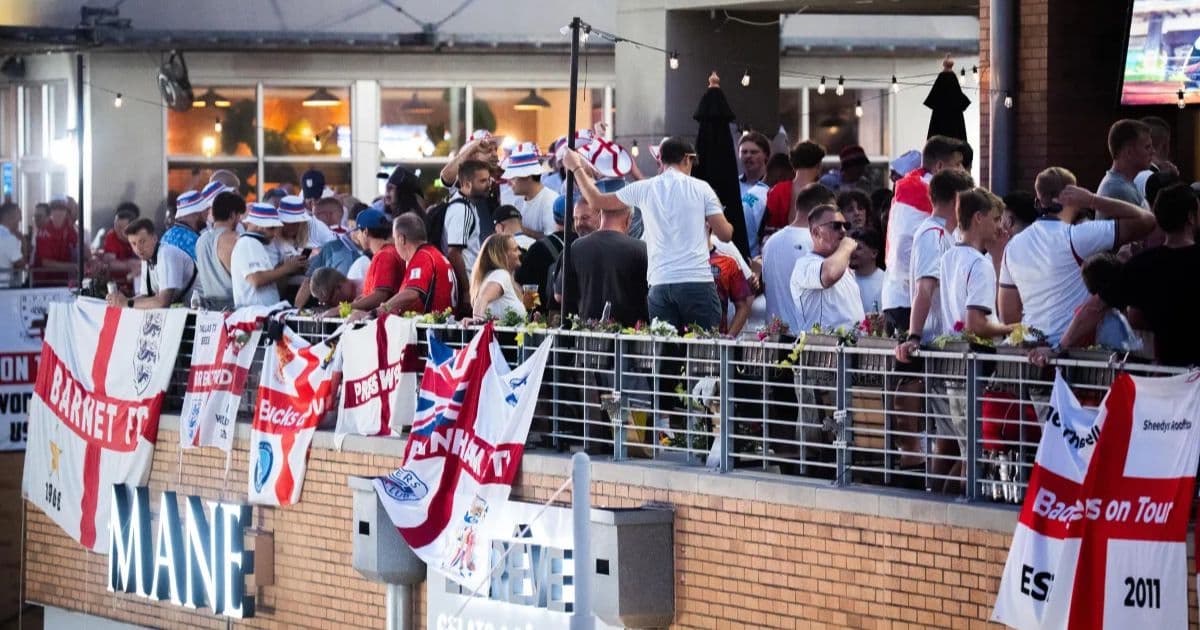
England supporters have barely unpacked their bags in America, yet familiar headlines have already begun to emerge.
Reports of fans being removed from a Dallas pub after spending more than £30,000 and consuming around 5,000 beers quickly spread across news outlets and social media. Images of police vehicles outside the venue added fuel to the story.
For some, it was confirmation of every stereotype ever attached to England supporters.
For others, it raised a different question.
Are England fans still being judged through an outdated lens?
The Headline That Sparked Debate
The story itself was undeniably eye-catching.
Hundreds of England supporters gathered at The Londoner pub in Dallas ahead of the Three Lions' opening World Cup fixture against Croatia. The venue reportedly sold more than 5,000 beers, generating over £30,000 in sales before being forced to close early after reaching capacity.
Police attended the scene and supporters were eventually asked to move on.
On the surface, it looked like another story of England fans causing disruption abroad.
But the details reveal a more complicated picture.
Several reports suggested the closure was linked primarily to capacity concerns and limited security staffing rather than widespread disorder.
Yet many headlines focused on the drinking figures, police presence and fan behaviour.
The question is whether that tells the whole story.
Why England Fans Often Face Different Scrutiny
England supporters carry historical baggage that few other fanbases experience.
For decades, stories involving English football fans were dominated by discussions of hooliganism, violence and disorder. While those issues were very real and caused significant damage to football's reputation, modern England support looks very different from the dark days of the 1970s and 1980s.
Today, thousands of supporters spend significant sums travelling across continents simply to follow their national team.
Many have saved for years to attend a World Cup in North America.
Yet when England fans gather in large numbers, the assumption often appears to be that trouble will follow.
That perception can shape coverage before any incident has even occurred.
What Was Actually Happening In Dallas?
Videos from Dallas showed large groups of supporters singing, socialising and creating the type of atmosphere that has become synonymous with international tournaments.
There were reports of some fans refusing to leave immediately when the pub reached capacity and isolated accounts of minor damage and littering.
At the same time, local businesses benefited from the influx of supporters, with bars increasing stock levels specifically to cater for England's arrival. Some venues had reportedly tripled beer orders in anticipation of the tournament crowds.
The £30,000 figure itself is an interesting example.
In many industries, customers spending tens of thousands of pounds would be celebrated as a commercial success.
In football, it often becomes evidence of excess.
That contrast says as much about perceptions as it does about the supporters themselves.
The Role Fans Play At International Tournaments
World Cups are not only about what happens on the pitch.
They are also about culture, travel and shared experiences.
Supporters bring colour to host cities. They fill restaurants, hotels, bars and public spaces. They create memories for local communities and visiting fans alike.
England supporters are no different.
The scenes in Dallas reflected what thousands of football fans from around the world do during major tournaments: gather together, sing songs, celebrate their identity and support their team.
That atmosphere is one of the reasons people fall in love with international football.
Without supporters, the World Cup would lose much of what makes it special.
Is It Time To Rethink The England Fan Narrative?
None of this means England supporters should be beyond criticism.
Where poor behaviour occurs, it should be reported fairly.
But fairness also means recognising when the reality is more nuanced than the stereotype.
The modern England fanbase is diverse, passionate and overwhelmingly committed to supporting the team rather than causing problems.
Thousands have travelled across the Atlantic, spent significant amounts of money and dedicated weeks of their lives to following England at football's biggest tournament.
That commitment deserves recognition too.
The Dallas story can be viewed in two ways.
One version sees police cars, beer sales and familiar stereotypes.
The other sees hundreds of supporters creating atmosphere, boosting local businesses and embracing the unique experience of a World Cup.
Perhaps the most important question is not what happened in Dallas.
It is why so many people immediately assumed they already knew the story.