As Cristiano Ronaldo chased another World Cup milestone and Portugal's supporters celebrated around NRG Stadium, one familiar figure was missing from the away end.
Michel Nkuka Mboladinga, better known as Lumumba Vea, has become a fixture at DR Congo matches for standing motionless throughout the game with his fist raised. Against Portugal, however, he wasn't there.
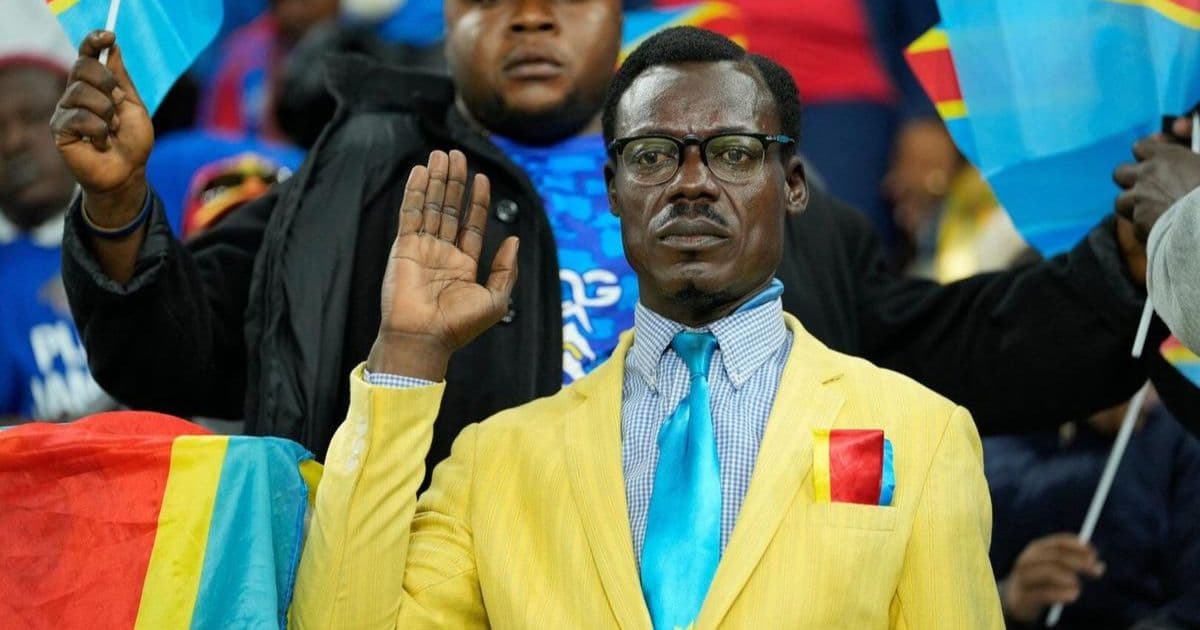
One arm raised. Bright suits in the colours of the Congolese flag. Retro glasses. He never reacts to goals or changes his expression. Yet that stillness has turned him into one of the most recognisable faces of the 2026 World Cup.
The Story Behind DR Congo's Living Statue
Mboladinga does it to honour Patrice Lumumba, DR Congo's first prime minister, who helped lead the country to independence from Belgium in 1960 before being assassinated a year later.
He dresses like Lumumba and recreates the pose of the famous statue dedicated to him in Kinshasa.
That's what makes Vea one of the most recognisable supporters at this World Cup. However, DR Congo's famous "living statue" missed the team's opening match against Portugal after travel restrictions linked to an Ebola outbreak delayed his arrival in North America.
Now, he is expected to return for DR Congo's crucial clash with Colombia in Guadalajara, bringing back a familiar presence that has become part of the team's matchday identity.
How Lumumba Vea Became DR Congo's Most Recognisable Supporter
Across African football, Lumumba Vea has become one of the sport's most recognisable supporters.
Television cameras regularly pick him out during DR Congo matches, with his unique matchday ritual turning him into a cult figure among fans both in Africa and beyond.
What started as a personal tribute has evolved into something much bigger. For many Congolese supporters, Vea represents pride, identity and a visible connection between the national team and the country's history.
His presence has become so synonymous with DR Congo matches that supporters often look for him in the stands almost as quickly as they look for the players on the pitch.
At this World Cup, that recognition has only grown, transforming him from a popular supporter into one of the tournament's most talked-about fan stories.
How Travel Restrictions Kept Him Out Of DR Congo's Opener
Vea first drew attention during the 2025 Africa Cup of Nations, where TV cameras repeatedly picked him out on the touchline whenever DR Congo, known as the Leopards, made progress through the knockout stages.
By the time the team secured qualification for their first World Cup since 1974, his presence had become part of the story around them. Some reports suggested players valued his role so highly that discussions even took place around ensuring he would be included in the travelling squad.
A reported Ebola outbreak in DR Congo complicated travel arrangements ahead of the Portugal match in Houston, with visa and entry restrictions affecting Vea’s ability to enter the United States. As a result, he was unable to attend what was arguably DR Congo’s biggest World Cup fixture in decades.
On the pitch, Portugal took the lead through Joao Neves, but Yoane Wissa levelled before half-time to secure a 1-1 draw, making it DR Congo’s first point at a World Cup.
The underdogs finished with just 25% possession but still created enough chances to trouble Portugal throughout the match. Unfortunately, Vea watched the game from quarantine as his team made history without him in the stadium.
Why His Return Matters Ahead Of Colombia Clash
DR Congo face Colombia at Estadio Akron in Guadalajara on Tuesday night, with kickoff at 10pm ET in what is shaping up to be a decisive Group K fixture.
Colombia began their campaign with a 3-1 win over Uzbekistan and currently sit top of the group heading into the match.
A win for DR Congo would move them above Colombia and strengthen their position in the race for a first-ever World Cup knockout-stage appearance, keeping qualification hopes firmly in their own hands.
Vea is expected to be back in his usual position for the first time in this tournament, standing still on the touchline with his arm raised.
Reports around his earlier absence suggest there had been internal pressure from members of the DR Congo setup to ensure his travel situation was resolved in time for moments like this.
Within the squad, his presence has come to be seen as part of the matchday routine, something the players clearly value on and off the pitch.