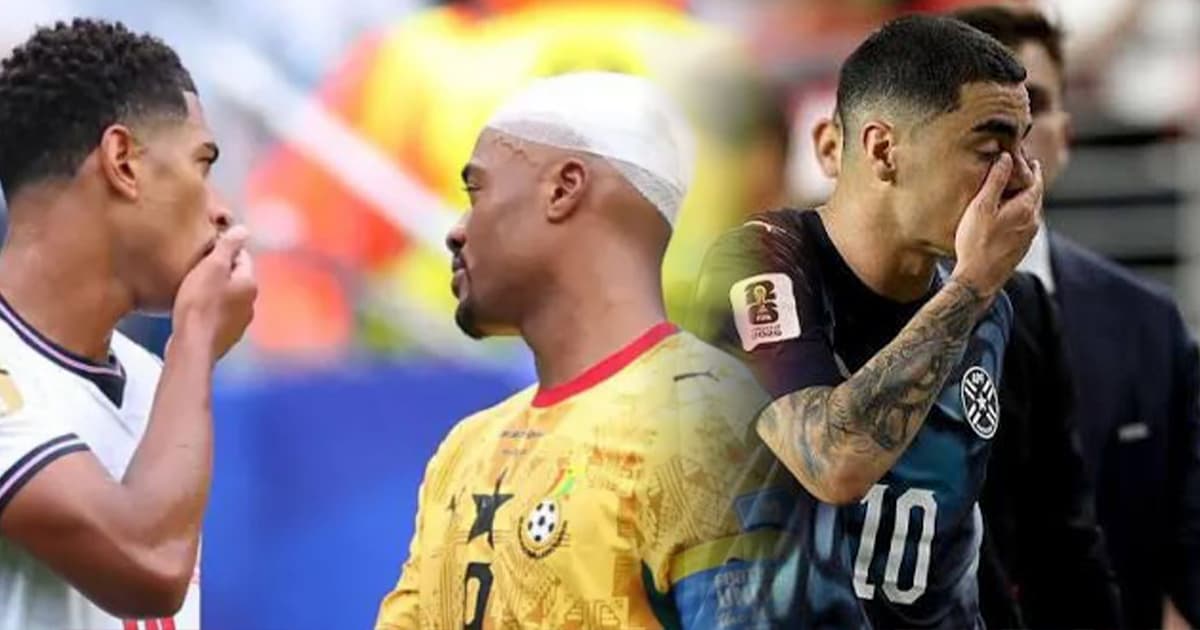
A fierce debate has ignited after an image of England midfielder Jude Bellingham conversing with Ghana captain Jordan Ayew while covering his mouth during their 0-0 World Cup group stage draw in the USA circulated all over social media.
With FIFA implementing a radical new disciplinary law for the ongoing tournament, fans and pundits immediately questioned why the Real Madrid star was not handed his marching orders.
People were left confused considering just days prior, Paraguay’s Miguel Almiron became the historic first casualty of this rule, receiving a direct red card against Turkey after a Video Assistant Referee (VAR) intervention.
To understand why Bellingham remained on the pitch while Almiron was sidelined for Paraguay’s last game, we must dive into the specific criteria that needs to be met for FIFA’s new regulation to be applied.
Why FIFA Introduced The New Mouth-Covering Rule
The introduction of this law marks a dramatic, institutional shift in tournament governance, championed directly by FIFA President Gianni Infantino.
The rule states that a player can be dismissed if they intentionally conceal their mouth while speaking to an opponent.
Infantino requested the mandate following a highly toxic incident in February 2026, where Benfica winger Gianluca Prestianni was hit with a six-match UEFA ban for homophobic conduct directed at Real Madrid’s Vinicius Jr. during a Champions League fixture.
Fed up with players using their hands, shirts, or arms as a tactical shield to shout abuse without camera detection, FIFA fast-tracked the law as an opt-in measure exclusively for this World Cup.
"This thing about covering the mouth is for us a very, very important rule," Infantino told SNTV.
"It's about respect. It's about the example that we should give. If you have nothing to hide, you don't cover your mouth when you speak to somebody. The rules have been made very clear to everyone."
Context is King: Friendly Chat vs Heated Confrontation
However, the reason Bellingham was not sent off was because he was on the safe side of the rule, because FIFA has not banned the act of covering one’s mouth. It has only banned players from doing so in the event of a confrontation.
As was agreed at The IFAB’s Annual General Meeting (AGM) in February, that decision follows thorough FIFA-led consultations with all key stakeholders.
“At the discretion of the competition organiser, any player covering their mouth in a confrontational situation with an opponent may be sanctioned with a red card,” the rule reads.
“Players are entirely permitted to mask their mouths with an arm or jersey when sharing tactical secrets, cracking jokes, or having casual conversations with friends and opponents,” it continues.
Before the tournament kicked off, Pierluigi Collina, FIFA's head of referees, laid down the exact structural guidelines for officials, with that rule set to be followed.
Why Bellingham Did Not See Red
The moment an interaction carries animosity, friction, or occurs during a heated match stoppage, concealing the mouth is viewed as an admission of guilt, an attempt to hide potentially abusive or discriminatory language. The mandatory sanction is a straight red card.
During England’s cagey draw with Ghana, the exchange between Bellingham and Ayew was completely devoid of malice.
It was a standard, amicable mid-match chat between two high-level professionals recycling tactical thoughts. Because there was no underlying hostility, the VAR panel correctly determined there was no structural breach of the law.
Why Almiron Was Punished
During Paraguay’s draw with Turkey, there was a moment of physical pushing and shoving, with the game in an incredibly volatile state.
While Almiron and Turkey's Mert Muldur were not the primary instigators of the confrontation, the incident unfolded during a heated on-field melee.
By choosing to mask his words in the middle of an active, multi-player melee, Almiron triggered the exact disciplinary threshold Collina warned teams about.
Could FIFA's New Rule Create More Controversy?
While the rule aims to eradicate on-pitch discrimination, its debut has raised severe structural questions regarding reliability and potential abuse.
During the Almiron incident, the Paraguayan winger did not display overtly aggressive body language.
However, Muldur instantly spun around to flag the mouth-covering gesture to the assistant referee, essentially weaponising the rule to manufacture a red card, even though Almiron may not have had any intention to discriminate against his Turkish counterpart.
Because of this immense potential for manipulation, alongside the extreme difficulty officials face in maintaining match-to-match consistency, major domestic leagues are highly unlikely to adopt the law post-tournament.