When the Royal Spanish Football Federation (RFEF) appointed Luis de la Fuente in December 2022 to succeed Luis Enrique following a painful World Cup exit to Morocco, the world was stunned.
Critics questioned how a 61-year old who seldom had experience coaching a senior side for the entirety of his managerial career, could take over the keys from a seasoned tactician like Enrique, and somehow thrive.
Three international titles later and De la Fuente has already etched his status as one of the most successful international managers in football history.
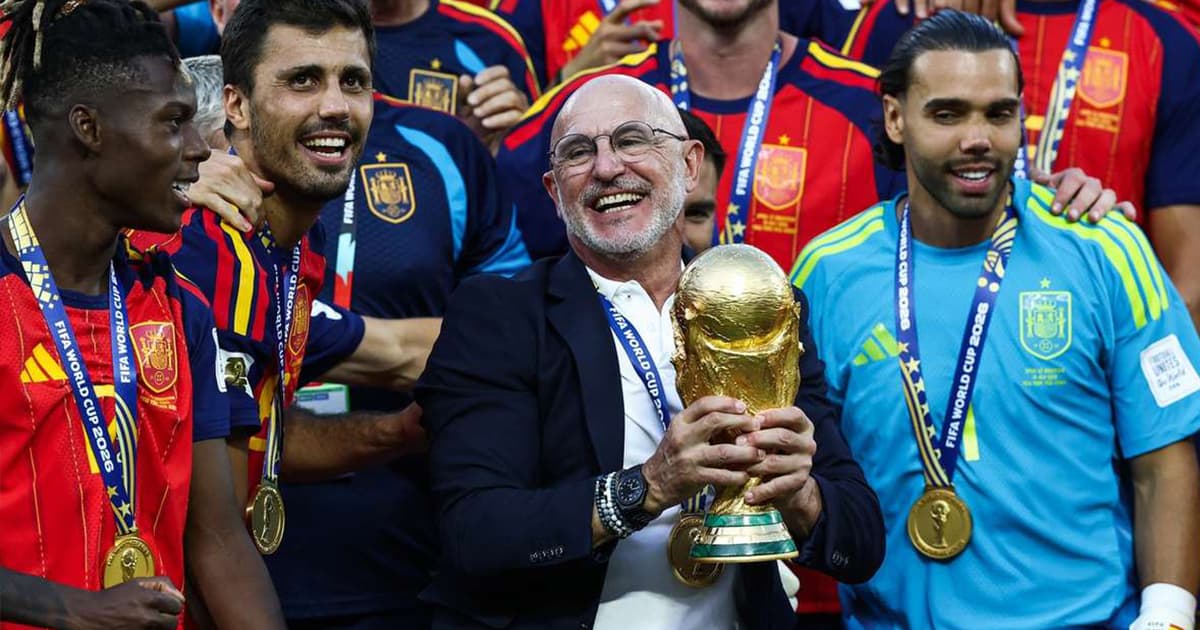
Just like at Euro 2024, De la Fuente just guided La Roja to a 1-0 extra-time victory over Lionel Messi’s Argentina in the 2026 World Cup final, the 65-year-old became the oldest head coach to ever lift the trophy.
But who exactly is he? Striver.Football brings you to grips with who exactly De la Fuente is.
Luis de la Fuente's Playing Career And Coaching Journey
Born on June 21, 1961, in Haro, a small town in the La Rioja region famed for its wineries, De la Fuente’s footballing journey began as a tenacious left-back.
He entered Athletic Bilbao’s academy in 1976 and went on to make 254 La Liga appearances across spells with Bilbao, Sevilla, and Alaves.
During his playing prime at Athletic, he won back-to-back league titles, including a famous La Liga and Copa del Rey double in 1984 under Javier Clemente.
Upon retiring in 1994, De la Fuente immediately transitioned into grassroots management. He cut his teeth with regional sides like Portugalete and Aurrera de Vitoria before directing youth development at Sevilla and taking charge of Bilbao Athletic, Athletic Bilbao’s reserve team.
His lone shot at senior club football came at Alaves in 2011, but he was sacked after just 11 matches due to poor results, a setback that kept him out of coaching for nearly two years.
How De la Fuente Built Spain's New Golden Generation
The Spaniard's career completely shifted in 2013 when the RFEF brought him into its national development setup. Over the next decade, he quietly established a blueprint for modern international coaching.
In 2015, he guided Spain, a side that boasted Mikel Merino, Rodri and Unai Simon to the European U19 Championship title. He was later promoted to U21 coach, and enjoyed more success at that level. In 2019, he led a side that had players like Simon, Fabian Ruiz, Mikel Oyazarbal and Dani Olmo to victory.
He would later guide them to a silver medal at the 2020 Olympic games. Eight of the 26 members of the world cup-winning squad took part at those delayed Olympics in Japan.
These relationships he had forged with the players at that level allowed him to avoid building from scratch when he took charge of the senior set up.
Luis De La Fuente's Tactical Identity
While former managers relied heavily on rigid passing frameworks, De la Fuente transformed Spain into a more direct, adaptable, and ruthless collective without surrendering structural control.
At the 2026 World Cup, La Roja delivered the most watertight defensive campaign in history, conceding just one goal in eight matches, while holding 66.2% possession in the final against Argentina.
De la Fuente leveraged high-volume central passing through Golden Ball winner Rodri and Young Player of the Tournament Pau Cubarsi, while unleashing explosive wing play through Lamine Yamal and Nico Williams.
His calm, paternal approach insulated his squad during high-pressure knockout rounds. As midfielder Alex Baena noted during the tournament, De la Fuente’s intuitive understanding of younger players gave the squad "that calm, that confidence we need in every moment."
De la Fuente's Biggest Off-Pitch Challenge
De la Fuente’s tenure was not without public turbulence. In September 2023, he faced intense public scrutiny after being seen applauding former RFEF president Luis Rubiales during an emergency assembly following the controversial Jenni Hermoso incident at the Women's World Cup.
The Spain coach issued a swift public apology, calling his actions an "inexcusable mistake." In February 2025, he was called to testify as a witness during Rubiales' criminal trial, where he clarified under oath that he was unaware of the scale of the scandal at the time and had focused strictly on football operations.
Throughout the off-field storms, the senior squad maintained fierce loyalty to their coach. During the World Cup campaign, defender Marc Cucurella publicly promised to get a tattoo of De la Fuente's face if Spain won the trophy.
Following the final victory in East Rutherford, a laughing De la Fuente held his full-back to his word, lightheartedly advising him to place the tattoo "where it is not visible."
De la Fuente's Legacy With Spain
By defeating Argentina, coached by Lionel Scaloni (the same Scaloni who once studied under De la Fuente during a UEFA coaching course in Spain), the veteran manager completed an unprecedented four-year sweep.
Under his leadership, Spain holds the men’s World Cup, the European Championship, as well as one UEFA Nations League title from two consecutive final appearances. Luis de la Fuente proved that long-term methodology, institutional trust, and deep player connection will always triumph over short-term fixes.