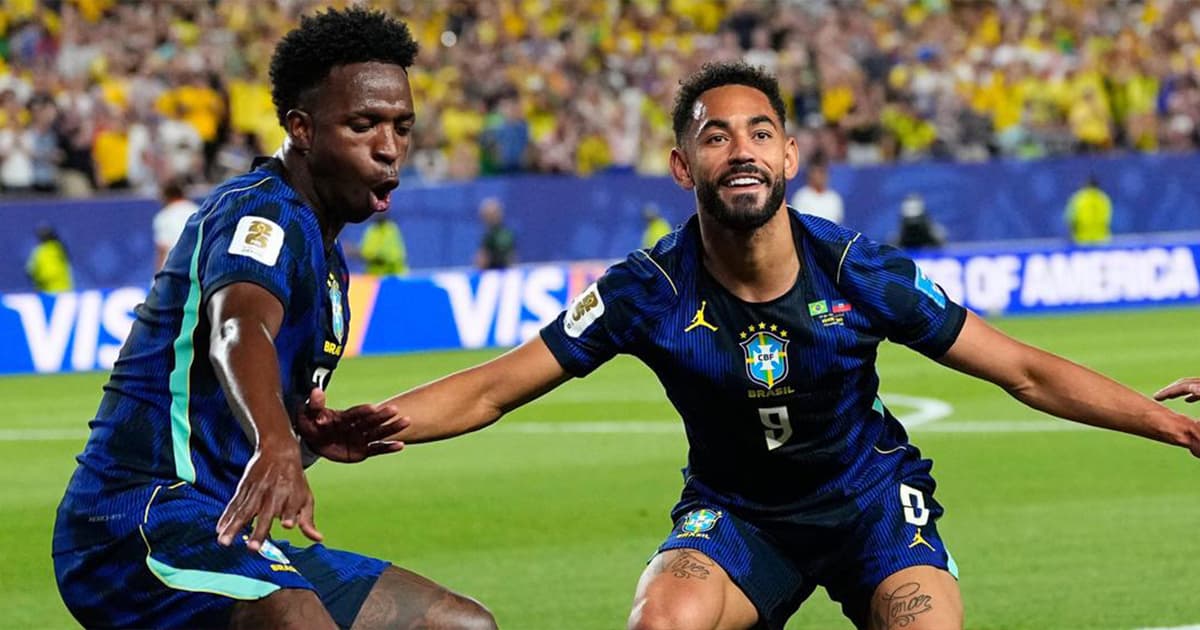
After Brazil’s opening game of group D of the ongoing 2026 FIFA World Cup that resulted in them registering a draw against a strong Morocco side, head coach Carlo Ancelotti found himself getting forced to weather a media storm of criticism.
Concerned parties pointed back to a stagnant offense that left Real Madrid winger Vinicius Junior isolated on the left wing, unable to beat Archraf Hakimi, as well as Igor Thiago’s ineffectiveness upfront, while Lucas Paqueta was locked out of the game completely.
But by the end of their third game against Scotland, it was smiles all over, as Vinicius Jr netted a brace in a convincing 3-0 win to see them finish the group on seven points, level with Morocco, but their superior goal difference sealed top spot for them.
But how exactly did Ancelotti turn around their fortunes? Striver.Football identified a key tactical tweak Ancelotti made after the first game, which involved bringing Man United forward Matheus Cunha into the starting line up, and how it proved differential.
The Opening Game Bottleneck: Igor Thiago’s Limitations
During the game against Morocco at the MetLife Stadium, Igor Thiago struggled to establish the tactical chemistry needed to unlock Vinicius Junior.
While Vini Jr. managed to score a brilliant individual equalizer, the partnership lacked fluidity before Thiago was substituted in the 61st minute.
Analytical details reveal how Thiago’s profile and positioning limited Vini Jr.’s effectiveness:
As a traditional 1.90-meter penalty-box target man, Thiago operated as a static focal point through the middle.
As seen on this heatmap, the Brentford man, fresh off a 23 goals Premier League scoring run, opted to either stay inside the box or roam to the right hand side, which did not force Moroccan defenders out of position often.

At Brentford, a side that plays on the transition more often than not, Thiago often relied on making runs in behind before being fed the ball and scoring, rather than receiving the ball to feet coming shot and holding off his man.
This was evident in the fact he was restricted to just 16 touches of the ball in his 62 minutes on the pitch.
As a result, Vinicius, who often relies on making the runs in behind from the left hand-side channel, seldom got that space in behind.
Morocco's well-organized defense, led by Achraf Hakimi and Chadi Riad, did not have to alter their shape to track a moving striker.
This allowed them to double-team Vini Jr. on the left wing, forcing him to rely entirely on individual brilliance, and the goal against Morocco was curved out of sheer individual brilliance.
Furthermore, Thiago focused heavily on offering a physical presence against Moroccan defenders rather than spearheading an aggressive counter-press.
Thiago’s style at Brentford relies on service in the box rather than turning over possession high up the pitch.
Without a partner actively forcing turnovers deep in the opposition half, Brazil struggled to orchestrate rapid, chaotic transitions. Vini Jr. was consistently forced to receive the ball facing a settled, deep Moroccan low-block rather than sprinting into unregulated space against an unorganized defense.
This mechanical mismatch extended into central clutter in the half-spaces. Because Thiago rarely drifted wide or dropped deep to hold up the ball, the central channel remained highly compressed, keeping Morocco's defensive line strictly intact centrally.
When Vinicius attempted to cut inside or make diagonal underlapping runs into the box, he ran directly into a congested area populated by both Thiago and Morocco's center-backs.
The lack of rotational gravity meant Vini Jr. was isolated on the touchline for most of his 61 minutes alongside the Brentford forward, as seen on his heatmap below.

How Matheus Cunha Changed Brazil's Attack
Recognising the need for more fluid movement to unlock Vinicius Junior and allow him the freedom to get into central areas more often, Ancelotti turned to Manchester United forward Matheus Cunha.
The move to switch to a playmaking number nine, who has created the most chances under Ancelotti since taking charge of the side in 2025 according to Opta, completely reinvented Brazil's identity, generating immediate dividends across subsequent matches against Haiti and Scotland to comfortably secure the top seed in Group C.
As seen in both of his heatmaps against Haiti and Scotland respectively, Cunha was heavily involved in both games, with most of his activity coming within the central areas of the pitch, which naturally dragged his markers out of their positions and allowed the likes of Vini Jr. and midfielders like Bruno Guimares to make more runs from deep.


Cunha possesses a technical swagger about him that contrasts sharply with a traditional immobile striker.
By dropping deep into intermediate spaces and connecting play, the United attacker provides a dynamic link that transforms opponent structural flaws into rapid transition environments.
His integration directly alters how opposition defensive lines must account for central space, completely shifting the defensive coverage away from the flanks.
Vini Jr. has been a big beneficiary of this, considering he was able to move into central areas more often against Haiti and Scotland, which thus allowed him to score three goals in both games as seen on his heatmap below:


Why Cunha's Movement Creates More Space for Vinicius Jr
Cunha’s inclusion also establishes an elite first line of defense that turns opposition mistakes into rapid counter-attacks.
In the fluid 4-2-4 alignment utilised against Haiti, Cunha scored twice on his World Cup debut, demonstrating both anticipation on a ricocheted clearance and an emphatic near-post finish after being slipped through by Vini Jr.
Against Scotland in Miami, his relentless counter-pressing forced a critical interception deep in the opponent's half, immediately destabilizing their defensive shape and allowing Vini Jr to exploit the unregulated space.
This was illustrated in the build up to their second goal in their 3-0 win over Scotland, where Cunha's defensive work winning the ball back created the sequence to it.


Because opponents are aware of Cunha's individual finishing threat as well, exemplified by his goals across both matches, they can no longer afford to isolate or double-team the Real Madrid winger only, which creates for an interesting dynamic.
This also frees up other players like Rayan, Luis Henrique, Gabriel Martinelli and Endrick whenever given the chances, which now allows for Brazil to play in their famed Joga Bonito style.
By balancing the scoring load and demanding direct defensive coverage, Cunha has successfully solved the tactical riddle that previously handcuffed Brazil's most dangerous attacker.