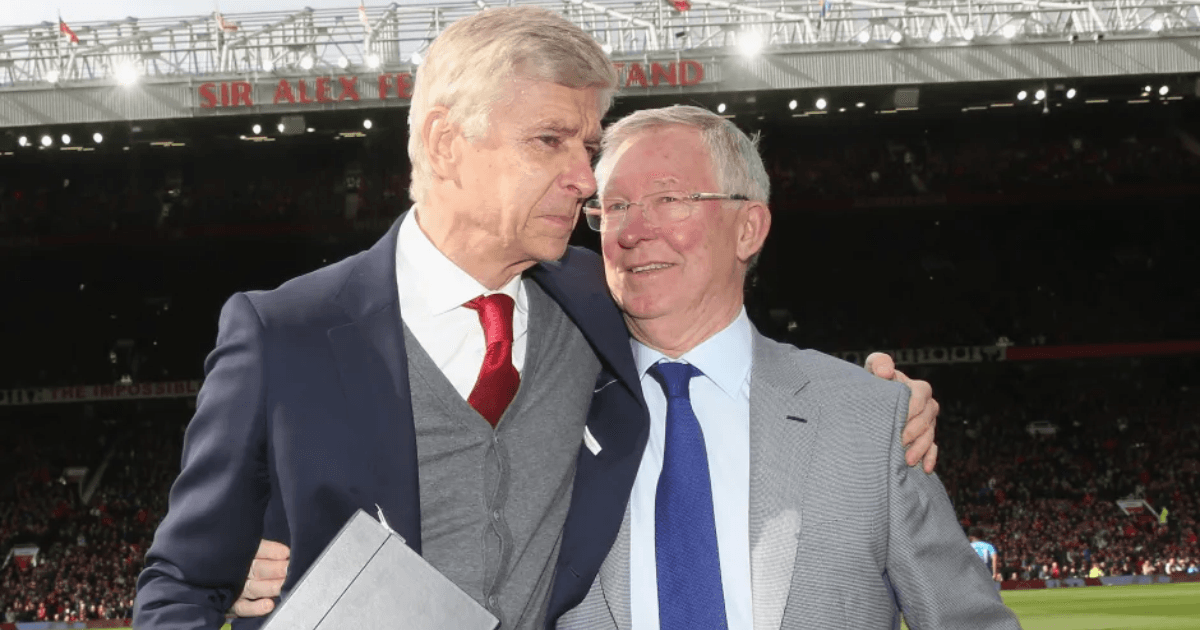
Sir Alex Ferguson has condemned the treatment of Arsene Wenger by sections of the Arsenal fanbase, describing the abuse aimed at his former managerial rival as “a stain on the club’s reputation”.
Ferguson and Wenger were fierce rivals throughout the late 1990s and early 2000s as Manchester United and Arsenal battled for Premier League supremacy.
Yet despite their intense rivalry, the Scot developed an enormous respect for Wenger over the years.
In his latest book, Games of My Life, Ferguson describes himself and Wenger as the “last two monuments in Premier League management”, while reflecting on the way the Frenchman was treated during the final years of his Arsenal career.
Ferguson: Wenger's treatment was ‘a stain’
Wenger's final years at Arsenal were overshadowed by growing frustration among sections of the support.
The Gunners had gone nine years without a major trophy before winning the FA Cup in 2014, before retaining it in 2015.
However, Arsenal's inability to challenge consistently for the Premier League title and their eventual failure to qualify for the Champions League led to increasing calls for Wenger to leave.
That criticism became particularly personal during the final stages of his reign.
Reflecting on the situation, Ferguson believes the treatment of his old rival went too far.
The Manchester United icon described the behaviour of some Arsenal supporters as “a stain on the club’s reputation”, despite the extraordinary contribution Wenger had made during his time in north London.
Ferguson also highlighted the impact of Arsenal's move from Highbury to the Emirates Stadium in 2006, suggesting the financial consequences of the move played a role in Wenger's later struggles.
From fierce rivals to mutual respect
It is easy to forget just how intense the rivalry between Ferguson and Wenger once was.
The pair regularly clashed as Manchester United and Arsenal competed for the Premier League title, with their teams dominating English football during the late 1990s and early 2000s.
Arsenal's 2001-02 and 2003-04 title-winning sides famously competed directly with Ferguson's United teams, with the latter campaign producing Wenger's legendary Invincibles.
Arsenal went unbeaten throughout the 2003-04 Premier League season, becoming the first team since Preston North End in 1888-89 to complete an English top-flight campaign without losing.
There were plenty of fiery moments between Ferguson and Wenger during those years.
But their relationship gradually evolved into one of genuine admiration.
Ferguson now regards Wenger as one of the defining managers of the Premier League era.
Wenger himself called the criticism ‘a disgrace’
Ferguson's comments also echo something Wenger himself said during the most difficult period of his Arsenal career.
In May 2017, with protests against his position intensifying, Wenger described the treatment he had received from some supporters as “a disgrace”.
The Frenchman accepted that criticism was part of being a football manager, but insisted there was a line between questioning his performance and treating someone without respect (via BBC Sport):
“I believe there's a difference between being criticised and being treated in a way that human beings don't deserve.”
Wenger was particularly hurt by the behaviour of some supporters throughout the season.
“The lack of respect from some has been a disgrace and I will never accept that. I will never forget it.”
But perhaps most tellingly, Wenger said the criticism was painful not because it was directed at him personally, but because he believed it damaged the image of the club he had spent more than two decades building.
“It's not my person that is hurt but the impeccable image of the club around the world.”
The banner that summed up the growing frustration
The hostility towards Wenger had become increasingly visible several years before his eventual departure.
During an FA Cup tie against Brighton in 2013, Arsenal supporters unfurled a banner telling their manager:
“Arsene thanks for the memories but it’s time to say goodbye.”
At the time, Wenger had already delivered three Premier League titles and four FA Cups.
He would go on to win three more FA Cups before leaving Arsenal.
The emergence of fan TV and social media in the mid-2010s then gave some of the loudest critics an even larger platform, with Wenger regularly becoming the focus of increasingly personal criticism.
For Ferguson, that treatment failed to properly recognise what Wenger had achieved.
Wenger's Arsenal legacy remains enormous
Whatever frustrations existed during the final years of his reign, Wenger's contribution to Arsenal is difficult to overstate.
He transformed the club after arriving in 1996, introducing new methods around nutrition, training and player preparation while changing the way English football approached the game.
His Arsenal sides won three Premier League titles and seven FA Cups, including two league-and-cup doubles.
The 2003-04 Invincibles remain his most famous achievement.
Wenger also left Arsenal as the club's longest-serving manager, having overseen almost 1,200 matches.
His final years may have been complicated, but his legacy was already firmly established.
Ferguson and Wenger's final Premier League chapter
The story is particularly poignant coming from Ferguson.
For much of their careers, the pair represented opposite sides of one of English football's greatest rivalries.
They fought for titles, traded verbal blows and watched their teams compete for supremacy.
Yet with the benefit of hindsight, Ferguson now sees Wenger differently.
Rather than simply remembering the rivalry, he recognises the longevity, achievements and influence of a manager who helped define the Premier League alongside him.
And perhaps that makes his criticism of the Arsenal supporters who targeted Wenger all the more significant.
For Ferguson, the rivalry was never supposed to erase the respect owed to one of the game's great managers.