
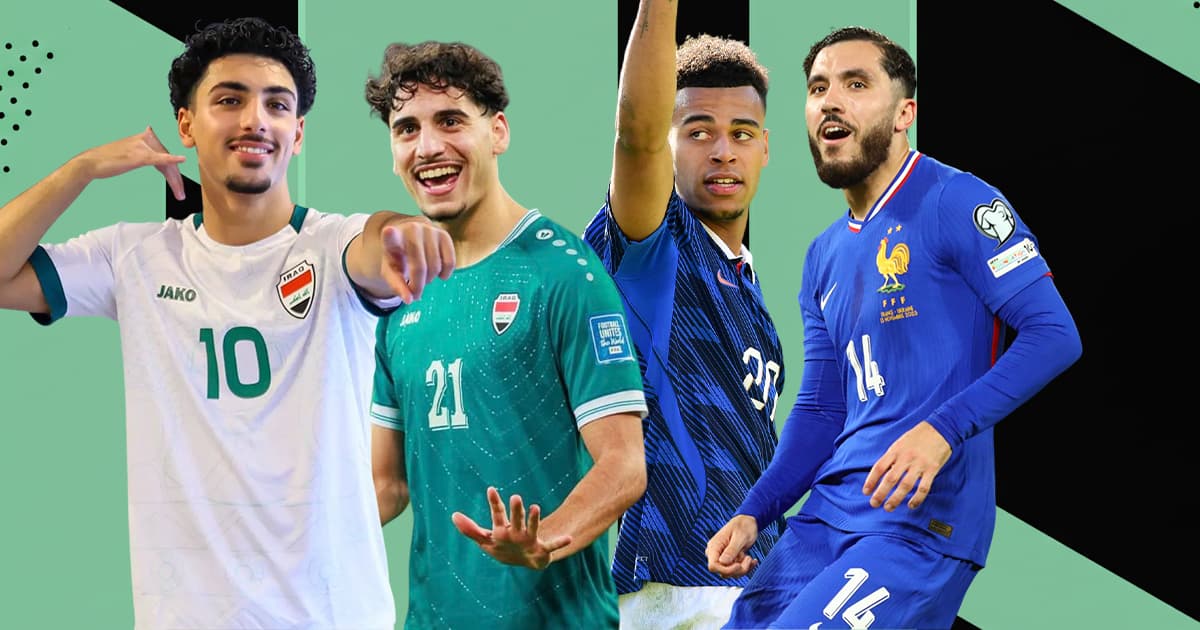
France will be taking on Iraq in their second group I clash of the ongoing FIFA World Cup 2026 on Monday at the Lincoln Financial Field in Philadelphia, USA.
With both sides keen to solidify the status of group I with a round of 32 place up for grabs, it will be a direct clash of two different footballing cultures, as elite European academy products will meet the fierce, technical resilience of Asia’s most exciting emerging talents.
Major tournaments are defined by the exact moment a young player stops being a prospect and becomes an international cornerstone. Striver.Football breaks down the youngsters who might be different for both sides in their quests to achieve glory.
France's Next Generation Is Ready To Deliver
France enters this fixture as arguably the most stacked side on the planet, relying heavily on a young attacking core that relies on absolute technical insolence and spatial destruction.
Bradley Barcola: The Touchline Speed Demon
Few young wingers manipulate isolated 1v1 situations with the same chilling composure as Bradley Barcola.
The Paris Saint-Germain speedster functions as France’s primary vertical threat, specializing in pinning opposing fullbacks deep before exploding past them on the outside.
Barcola’s mature decision-making in the final third allows him to pick out precise cutbacks or curl low-block-cracking efforts into the far corner.
If Iraq leaves their defensive channels uncovered during transition phases, Barcola, who netted his first World Cup goal after coming off the bench in their opening 3-1 win over Senegal, possesses the exact tools to punish them instantly.
Desire Doue: The Press-Resistant Engine
Desire Doue made his World Cup debut starting on the left hand side during their win over Senegal last Tuesday.
Doue excels at receiving the ball with his back to goal, rolling his marker, and igniting direct vertical attacks on his right foot, whilst trying to exploit the left half spaces, while an overlapping fullback - mostly Theo Hernandez - hugs the line on the left.
His defensive work-rate is equally immense, acting as the primary counter-pressing trigger the second France loses possession in the attacking third.
He will be keen to start racking up the numbers against Iraq, having failed to register a goal contribution during the first game.
Rayan Cherki: The Maverick Operator
If football is an art form, Rayan Cherki plays with a canvas entirely his own. The Manchester City playmaker is comfortable striking or creating with either foot.
Cherki operates best in highly congested central areas, utilizing an array of body feints, elasticos, and hidden passing lanes to invent angles that don't seem physically possible.
When the game slows down or faces a stubborn low-block, his pure footballing IQ and creative imagination offer France a completely un-scoutable solution.
He came off the bench during their opening win against Senegal and will be keen for more chances during their second game.
Read More: 5 France Wonderkids Set to Ignite Les Bleus’ 2026 FIFA World Cup Campaign
Iraq's Emerging Talents Ready For The Challenge
Iraq steps onto the pitch carrying a brilliant blend of technical fluidity and structural discipline, ready to disrupt France's star-studded lineup through a cautious approach.
Youssef Amyn: The Transition Engine
Youssef Amyn was an unused substitute during their opening 4-1 loss to Norway but will be keen to show what he can do if called upon during this high-stakes clash against France.
Amyn, who was born in Germany and came through the academies of clubs like Borussia Dortmund, is a highly dynamic winger who plays with an absolute fearlessness when isolated against elite European defenders.
Gifted with an explosive first step and a low center of gravity, Amyn could act as Iraq’s primary outlet to drag the team up the pitch during heavy defensive spells against France.
His spatial awareness also allows him to drift inside seamlessly, acting as an inverted playmaker who can split center-backs with defense-carving diagonal deliveries.
Marko Farji: The Towering Inverted Threat
Norwegian-born Farji is a direct, dynamic weapon in the final third. Standing at a towering 184 cm, Farji offers a rare, physically imposing profile for a modern left winger.
Naturally right-footed, the energetic attacker loves nothing more than isolating fullbacks 1v1, utilizing a quick array of tricks and a devastating burst of pace to cut inside onto his strong foot to unleash shots or craft scoring opportunities.
His versatility allows him to switch across to the right flank or lead the line as a striker, and his willingness to drop deep to help retain possession makes him a highly unpredictable structural nightmare for France's defensive line to track.
Farji came off the bench in the 58th minute against Norway and was fairly impressive, and will be hoping he can make an impact if given the chance against a strong France side.
Read More: Ali Al-Hamadi: From Refugee Family To Iraq’s World Cup Dream
Five Lessons Young Footballers Can Learn From France vs Iraq
Flank Isolation Mechanics: Watching how Bradley Barcola uses subtle alterations in stride length to freeze and unbalance defenders in 1v1 duels.
Two-Footed Spatial Geometry: Analyzing how Rayan Cherki's ambipedal profile forces defenders to compromise their body positioning in the box.
Bypassing the Choke: Maintaining technical security and moving the ball horizontally when trapped against an elite European counter-press.
The Power of the Turn: Utilizing a low center of gravity like Doué to absorb physical contact and spin away into open attacking space.
Sustaining the Block: Observing how Farji and the Ivorian midfield line shift laterally to close passing corridors against high-volume possession teams.