When Esmir Bajraktarevic buried the final, decisive penalty kick in Zenica to defeat Italy and send Bosnia and Herzegovina to North America for the recently-concluded 2026 FIFA World Cup, the heartbreak hit far deeper than standard athletic disappointment.
It confirmed an unthinkable, historic disappointment: four-time world champions Italy missed a third consecutive FIFA World Cup, and that is despite the tournament’s expansion to 48 teams for the first time in history.
As world football braces itself for the next four-year cycle ahead of the 2030 tournament, the Italian Football Federation (FIGC) is currently in a deep hole that will take some effort to really climb out of.
The national team’s failure is not a run of bad luck or an unlucky bounce off the post; it is the ultimate breakdown of a sport that has allowed its economic, structural and tactical foundations to erode for thirty years.
Striver.Football breaks down four ways football in that country deteriorated, and what can be done to fix it as the country braces itself to co-host Euro 2032 alongside Turkey.
1. Leadership Chaos At The FIGC
When Italy failed to qualify for the 2026 World Cup, FIGC President Gabriele Gravina, who had stubbornly clung to power after Italy missed the 2022 World Cup in Qatar, finally bowed to overwhelming public outrage and political pressure.
Delegation chief Gigi Buffon and head coach Gennaro Gattuso, who themselves are Azzurri legends, followed him out the door.
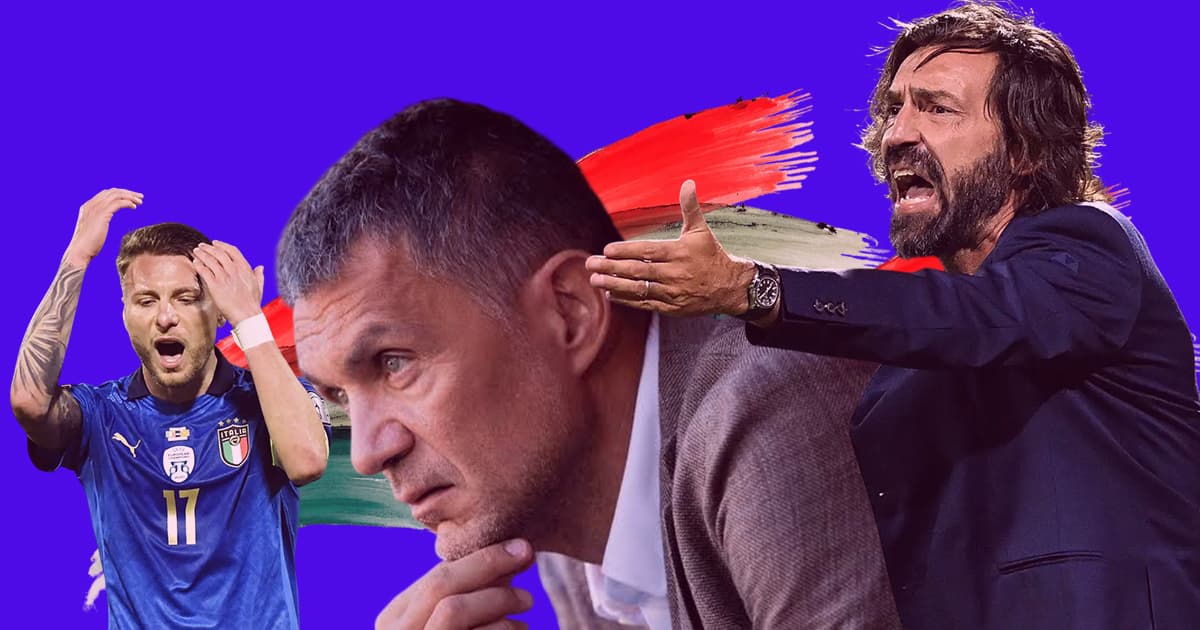
In a desperate bid to restore credibility, the federation turned to Giovanni Malago, the man who successfully delivered the Milano-Cortina Winter Olympics. Malago quickly installed AC Milan legends Paolo Maldini and Leonardo to direct football operations.
It was pitched as a revolutionary "dream team." Instead, within three weeks, it devolved into public humiliation without Italy even stepping onto a pitch:
Maldini publicly targeted Pep Guardiola and Carlo Ancelotti to be the headcoaches to bring Italian Football back to the top. Guardiola is a free agent after ending his successful 10-year stint at Man City last May.
However, he turned down the job. Ancelotti by contrast, has already been in charge of Brazil for nearly a year, and even extended his contract to 2030, and that is an agreement he intends to see through. In the end, the FIGC missed out on both.
The executive team then resorted to type by offering a four-year contract to Andrea Pirlo.
Pirlo’s managerial CV is an interesting one. He was sacked by Juventus in 2021, dismissed by second-tier Sampdoria, and managing FC United Dubai in the UAE, hardly represented a fresh, progressive tactical era.
The move for Pirlo collapsed in disgrace when his personal commercial ties exploded in the press. Pirlo served as a global ambassador for Fonbet, Russia’s largest sports betting operator, even traveling to Moscow’s Luzhniki Stadium for marketing events.
With Italy’s government firmly aligned with Ukraine, appointing a national team manager commercially tied to a Russian gambling firm caused instant political uproar.
Amid allegations of ethical conflicts and executive infighting, Pirlo pulled his name from consideration. Maldini and Leonardo were left considering their own resignations after less than a month on the job.
2. How Serie A Lost Its Financial Advantage
To understand why the Azzurri are no longer in the upper-ecchelons of global international soccer - even though they did win Euro 2020, one must look into the league that feeds it.
During its 1990s glory days, Serie A was the centre of the footballing world. The world transfer record was broken seven times that decade, five times by Italian clubs.
The planet's elite talents shunned English shores to play under the Italian sun. But beneath the glamour, Italian football built its success on a fatal economic flaw: greed over collective sustainability.
As reported by Tifo Football, Italian clubs negotiated television broadcast rights individually throughout the 1990s. Top-tier giants like Juventus, Milan, and Inter pocketed massive fortunes, while smaller clubs struggled to survive.
The wealth gap was so destructive that the start of the 2002-03 season was delayed when eight smaller sides refused predatory broadcast contracts worth just €4.5 million, while Juventus and Milan signed deals worth roughly ten times that amount.
Contrast this with the Premier League, which instituted an equitable revenue-sharing model (50% equal split, 25% facility fees, 25% merit-based).
By lifting the financial floor of its entire division, middle-tier English clubs attracted elite talent, raising overall standards and sending international broadcast value skyrocketing.
Furthermore, English football benefited from the language factor. Across the world, the English language is spoken 15 times more than Italian, something the Premier League took full advantage of and monetised it across North America, Asia, and Africa.
When Italy’s Melandri Law finally mandated collective bargaining in 2008 following the reputational damage of the Calciopoli scandal, the English league was already out of reach.
In 2007, Serie A was generating €1.4 billion (£1.2 billion) in total revenue while the Premier League hit €2.4 billion (£2.06 billion).
By 2021, Serie A’s foreign broadcast rights brought in a meager €210 million (£179.91 million) after failing to secure a primary broadcast partner in the Middle East and Africa. The Premier League collected €1.7 billion (£1.4 billion).
To make things worse, the Melandri Law restricted foreign television deals to rigid three-year cycles, forcing overseas viewers to jump from channel to channel and destroying brand consistency.
By the time the law was amended, the Premier League signed a single six-year US deal with NBC worth €2.4 billion (£2.06 billion).
For a long time Italian clubs also relied on wealthy patriarchs like the Morattis at Inter or former Prime Minister Silvio Berlusconi at Milan, who personally poured over €2 billion into transfer fees.
But when sovereign wealth funds, state-backed entities, and American private equity entered English football, the Italian model crumbled. Club debts across Serie A spiraled from €2.4 billion (£2.06 billion) to €5.5 billion (£4.71 billion) in the twelve years leading up to the COVID-19 pandemic.

3. Italy's Stadium Infrastructure Crisis
The financial divide is exacerbated by Italy’s decaying venue infrastructure. Over half of Serie A's stadia were built during Benito Mussolini’s fascist regime in the 1930s, receiving only cosmetic updates for Italia '90.
Unsuited for modern corporate hospitality, luxury boxes, or multi-use entertainment, these municipal facilities severely restrict matchday income.
While Arsenal built the privately owned Emirates Stadium in three years to generate €110 million (£94.24 million) in seasonal matchday revenue, Inter produced barely €51 million (£43.5 million) at the San Siro in the same season, despite drawing significantly higher average attendances.
Studies show that clubs opening modern, privately owned stadia enjoy an average 119% increase in matchday revenue and a 60% boost in commercial income, something Juventus incidentally has managed to capitalise with their Turin-based Allianz Stadium.
Yet, trapped in layers of local politics and administrative inertia, other Italian clubs cannot modernise their homes.
As Italy prepares to co-host Euro 2032 with Turkey, stadium renovation has become a matter of national survival rather than luxury.
4. Why Italy's Youth Development Has Stalled
Italian football's economic struggles have unsurprisingly had a knock-on effect in restricting their managerial appeal to pragmatic, domestic managers who are constantly recycled from club to club.
This fear of foreign methodology has left Italian teams wedded to rigid 3-5-2 systems, producing players built for low-block defensive battles rather than high-intensity, counter-pressing European football.
Nowhere is this structural failure clearer than in youth development. Following Italy's group-stage exit at the 2010 World Cup, legendary icon Roberto Baggio was appointed president of the FIGC technical sector.
According to The Athletic, Baggio spent two years consulting youth academy directors across the peninsula, compiling a comprehensive 900-page strategic blueprint to overhaul grassroots and youth football development.
"I presented a 900-page report aimed at renewing our entire youth structure from the bottom up. I waited five hours outside an FIGC board meeting to present it, only to get 15 minutes to speak. It was treated as a dead letter."
In 2013, Baggio resigned in frustration after realising the establishment had zero intention of implementing real reform. Thirteen years later, the consequences of burying his work are visible across the national landscape.
Although Italy have won some international youth tournaments recently, such as the UEFA Under-17 (2026) and Under-19 (2023) European Championships, young talents rarely transition into senior Serie A line-ups.
Clubs import foreign journeymen rather than give their youngsters chances in the first team, which leads to them struggling for opportunities in the lower leagues.
On top of that, academy systems prioritize physical positioning and tactical discipline over individual dribbling, flair, and improvisational skill.
At senior level, the lack of continuity from the youth set ups means national team managers regularly restart build-up projects from scratch rather than inheriting a unified development philosophy across age groups.
Can Italian Football Recover?
Italian football does not need another performative committee, nor does it need to wrap its deep-seated structural failures in standard-issue Armani suits.
As the rest of the world prepares for the next four year cycle, the FIGC must cut through its bureaucratic politics, address Serie A's stadium crisis, and embraces the youth development blueprints it discarded a decade ago to become a first-rate football nation once again.