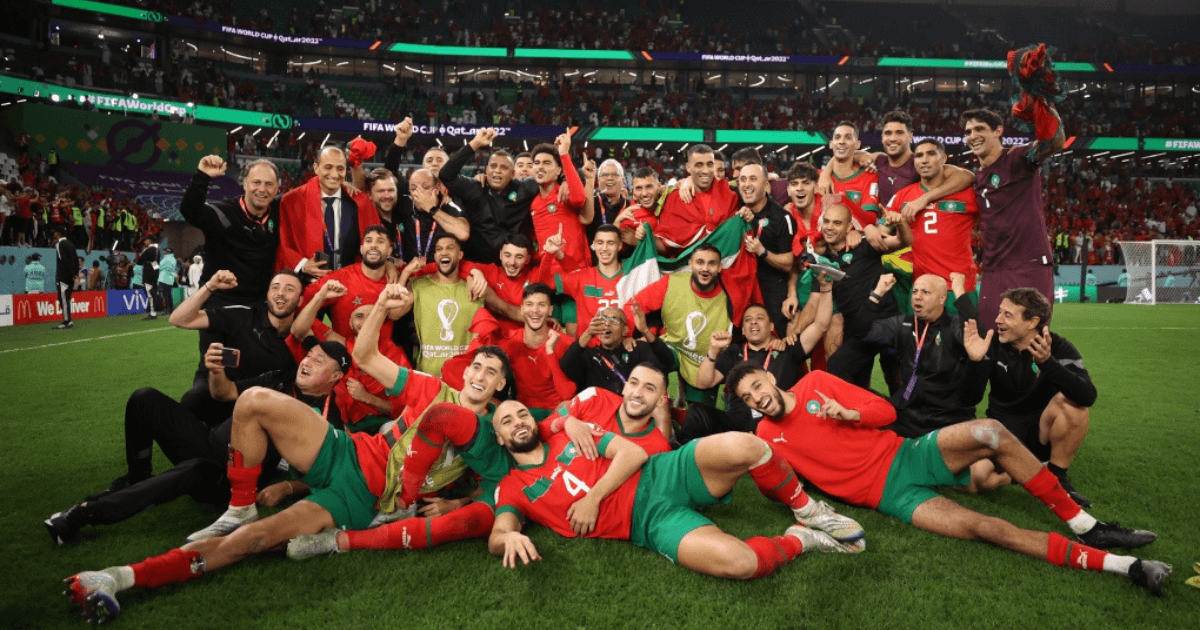
In 2022, Morocco made history by becoming the first ever African side to reach the semi finals of a FIFA World Cup after stunning Cristiano Ronaldo’s Portugal 1-0 in Qatar to set up a semi-final date against France.
Many called it a fairytale, pointing aggressively to the squad’s heavily European-born diaspora as the reason they got all the way to that stage. That their success was merely borrowed from the academies of France, Spain, and the Netherlands.
They were completely wrong.
Morocco has established itself as a modern footballing powerhouse thanks to a very intentional approach to invest into the sport all over the country.
Their system has managed to marry raw, unadulterated passion of urban street culture with state-of-the-art national talent pipeline and infrastructure unmatched anywhere else in the continent.
But to really get to grips with how the Atlas Lions became a permanent global superpower ahead of the 2026 World Cup, Striver.Football analyses the genesis to how they got there.
Inside Morocco's Medinas: Where Football Education Begins
When future Moroccan footballers are growing up, their footballing identity is forged in between the alleyways of Medinas. These alleyways are tight and sandwiched between several concrete plazas in cities like Casablanca, Marrakech, and Tangier.
In these alleyways, football is a fast-paced game of survival and tight spatial geometry. Space is a luxury.
Playing on hard asphalt, surrounded by concrete walls and parked cars, forces players into natural technical evolution.
More importantly, it breeds Grinta—a local adaptation of the gritty, fiercely competitive Mediterranean passion. On top of that, games in environments like these foster mental resilience among the players.
You cannot rely on long, booming balls or physical galloping strides or else you would risk breaking vessels and windowpanes.
This thus forces players to develop hyper-close ball control, rapid one-touch passing combinations, as well as harness their spatial awareness.
As a result, before players are able to step into academies, the streets already make work easier for youth coaches, whose job now mostly involves teaching tactical fundamentals to the players, rather than teaching them the basics of football technique.
Losing a match within these alleyways means losing the pitch to the next waiting neighborhood crew. As a result, every street game is played with the psychological stakes of a cup final.
The Mohammed VI Academy: Building Morocco's Future
There is a facility just outside Rabat where every Moroccan kid dreams of developing their game to stand a chance of making it professional. That facility is the Mohammed VI Football Academy.
The academy stands as the undisputed crown jewel of African sports infrastructure.
Opened in 2009 after a massive $16.8 million personal investment by King Mohammed VI, the academy was built to solve a historic problem.
Although they still snap up foreign-born players eligible to play for the nation, this facility ensures that they do not sorely rely on the diaspora alone.
The facility boasts eight FIFA-standard pitches (including one climate-controlled indoor arena), a cutting-edge sports science medical center, and top-tier educational facilities.
Even more impressive is the scouting system. The academy scouts hunt for kids who still possess the raw, unpredictable instincts of the street, then place them in an environment of elite European tactical discipline.
The results are remarkable. Players like Azzedine Ounahi, Nayef Aguerd and Youssef En-Nesyri are some of the graduates from that set up.
On top of that, Morocco have clinched three African Nations Championship (CHAN) titles, a competition purely dedicated to giving domestic-based players international experience biannually. They also won the FIFA Arab World Cup, as well as the final of the 2025 Africa Cup of Nations (AFCON) - they were declared champions in April by CAF pending a verdict by the Court of Arbitration for Sports (CAF).
Add in the fact their U17 set up finally won the AFCON U17 title in 2025, underpinning the start of a sustained pipeline at youth level.
How Fouzi Lekjaa Transformed Morocco's Youth Pathway
What truly sets Morocco apart from the rest of the continent, however, is how the Royal Moroccan Football Federation (FRMF) has decentralized this youth development.
Under the aggressive leadership of Fouzi Lekjaa, the federation didn't just build one luxury academy in the capital and call it a day; they cloned the blueprint nationwide.
The FRMF established 12 distinct regional academies across the country’s provinces ensuring that a talented kid born in the remote southern desert of Laayoune receives the exact same elite footballing education as a kid born in Rabat.

The FRMF established 12 distinct regional academies across the country's provinces, ensuring that a talented kid born in the remote southern desert of Laayoune receives the exact same elite coaching, nutritional monitoring, and tactical education as a kid born in wealthy Rabat.
Furthermore, the federation funds a network of over 200 regional scouts who spend their weekends watching local street tournaments and school games.
This has also forced the local clubs to also adapt to the changing landscape. Local Botola Pro clubs like Raja Casablanca, Wydad, and FAR Rabat have been forced to upgrade their own youth systems, as well as professionalize their institutions.
These clubs have also helped raise Morocco’s reputation as a hotbed for fan culture. The ultras scene in Morocco grew out of these two clubs. With the Green Boys of Raja Casablanca founded in 2005. Wydad Winners formed just a few months later.
Further ultras groups around the nation have popped up since. And during the 2010 Arab Spring, they started using the stadiums to voice dissent.
“We are a political group. We sing about politics, about culture, about social situations here in Morocco. About struggles,” sociologist Abderahim Boukira told DW.
Despite its shining exterior dazzling tourists from across the globe, everyday Moroccans are struggling with inflation, unemployment, and rising gas and food prices. Stadiums are viewed as sanctuaries where disenchanted fans can speak out.
“The stadium for them is a space of freedom, a space of expression. And they use it as they want. Everything is permitted in the stadiums. But outside the stadium you can’t really talk about many things,” Abderahim said.
And through their elaborate songs and intricate Tifos, Moroccan fans truly rival any other Ultras scene found across the world.
But above all else, Moroccan football mostly mirrors Moroccan values - it’s about love, family, and respect.
“They sing mostly about love, love of the country, love of the family, love of the club,” said Boukira.
What The Rest Of Africa Can Learn From Morocco
Morocco will be going into the 2026 World Cup with their narrative completely evolved. Although they might set up pragmatically in their attempts to try and go on another sensational run in America under Walid Regraghoui, they remain a fundamentally strong football machine.
That is the story of how they have become a football powerhouse. The rest of Africa needs to borrow a leaf.