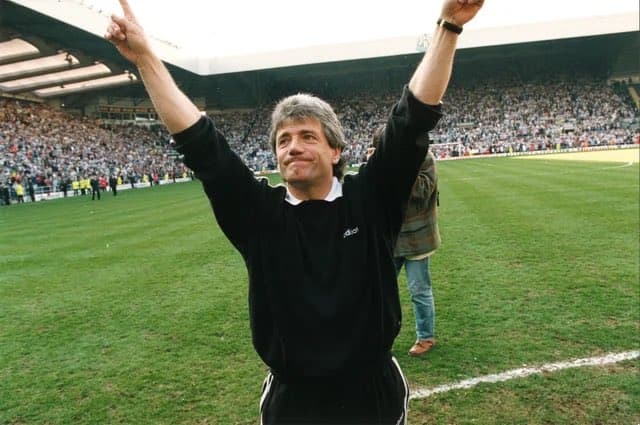
Kevin Keegan was a double Ballon d'Or winner, and no English player has matched that since. He remains the only British player to have won the award twice, collecting it back-to-back in 1978 and 1979 while at Hamburg.
No other English player has come close to matching that record, and that fact alone separates him from almost every footballer England has ever produced. His family confirmed his passing on Monday, July 20, 2026.
A statement read: "Kevin had been battling cancer and was surrounded by his wife and daughters in his final moments. A double Ballon d'Or winner, Kevin was a much-loved husband, father and grandfather."
How Kevin Keegan Built One of British Football’s Most Decorated Careers
Keegan began at Scunthorpe United before Liverpool signed him in 1971. He quickly became one of the driving forces behind Bob Paisley's great side, helping the Reds win three First Division titles, two UEFA Cups, the FA Cup and, in 1977, their first European Cup.
What made Keegan unusual for his era was the decision to leave Liverpool at the peak of his powers. In 1977, he moved to Hamburger SV in Germany, a transfer that carried genuine risk for an English player at a time when the Bundesliga was far less familiar territory.
The move paid off in a way nobody anticipated. He won the Ballon d'Or in 1978 and retained it in 1979, becoming the first player since Johan Cruyff to win consecutive awards, and the only Englishman in history to do so.
He reached another European Cup final with Hamburg in 1980, losing to Nottingham Forest, before returning to England with Southampton. A final spell at Newcastle followed, where he brought an illustrious playing career to a close in 1984.
On the international stage, he scored 21 goals in 63 England appearances and played at the 1982 World Cup. He captained his country and remains one of England's most decorated forwards across any generation.
How Kevin Keegan’s Newcastle United Reign Still Defines Him
As a manager, Keegan took charge of Newcastle in 1992 and led them into the Premier League. What he built at St James' Park across the following years was one of the most exciting teams English football had seen.
By January 20, 1996, Newcastle were 12 points clear of Manchester United at the top of the Premier League table. They had Peter Beardsley, David Ginola, Les Ferdinand, and Faustino Asprilla. They were scoring goals from everywhere, and a first league title since 1927 looked inevitable.
By February, it was starting to slip away. Newcastle managed just two wins from eight Premier League games between late February and early April, collecting only seven points from a possible 24 as Manchester United, powered by Eric Cantona’s return from suspension, wiped out the gap.
What followed became one of the most replayed moments in Premier League history. With the title race in its final weeks, Ferguson publicly questioned whether teams would compete as hard against Newcastle as they would against his side.
Keegan, live on television after a win against Leeds, responded with a fury that was entirely unscripted. "I will love it if we beat them. Love it," he said, a sentence that was later voted the most memorable quote in Premier League history.
Keegan himself reflected on it years later: "Sir Alex crossed a line, and therein lays the difference between me and him, that's how he won 13 league titles, and I won none."
Why Keegan’s Legacy Matters to Young Players Who Never Saw Him Play
Keegan took Newcastle from the second division and built them into a side that took Manchester United to the final day. He managed England between 1999 and 2000, taking the national team into qualification for Euro 2000.
He also managed Fulham and Manchester City, winning promotion at both clubs, a record that is easy to overlook given the Newcastle narrative. he was promoted as champions in his first full season with every club he managed.
What Keegan represented, in an era long before social media, personal branding, or carefully managed public images, was a footballer who was entirely himself in every moment. The Hamburg move was brave. The rant was spontaneous.
The passion was real. Young players growing up now, in a football environment where almost everything is controlled and curated, rarely see that kind of authenticity from someone operating at that level.