
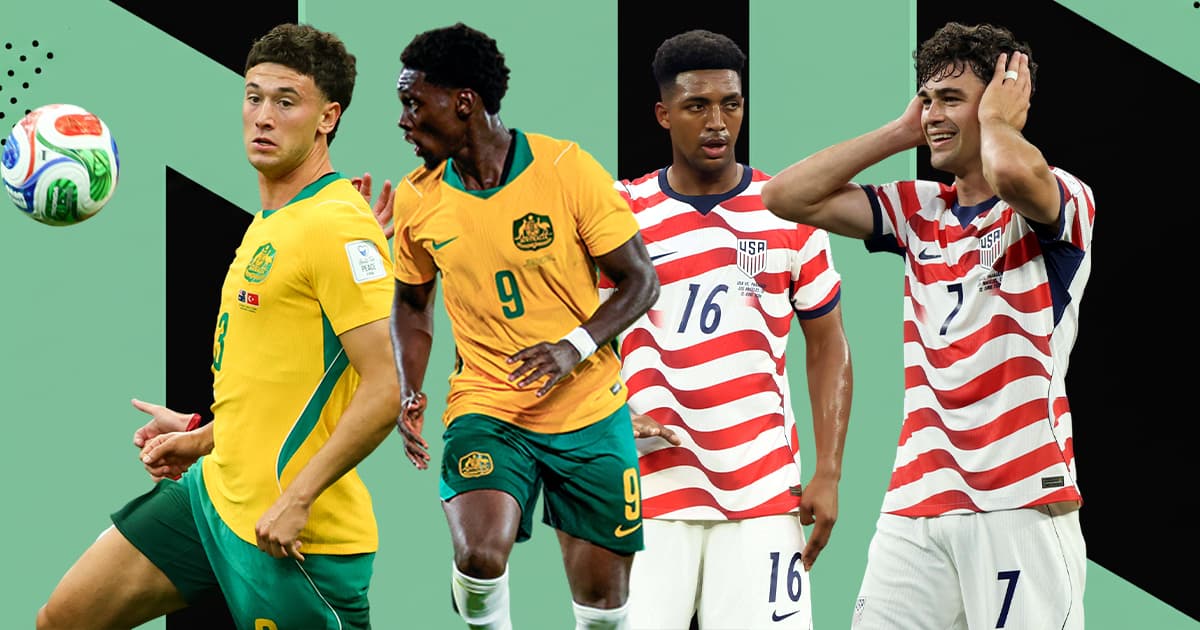
The United States will be facing Australia in their second clash of group D at the ongoing FIFA World Cup 2026 hoping to maintain their momentum following a brilliant start to their campaign against Panama, having thrashed them 4-0 last Sunday.
The Americans will not have it easy, as they will be facing a Socceroos side who are full of confidence following a 2-0 win over Turkey in their opening encounter as well.
Although both sides will be keen to get a result, young footballers watching around the world will be keen to gain more.
Both nations have built strong reputations for producing talented young players, and this fixture could provide a glimpse of the stars who may define the next decade of international football.
World Cups have a habit of creating breakthrough moments. One performance, one contribution or one moment of composure can change a player's career forever.
For several young talents on both sides, this is an opportunity to show they belong on football's biggest stage.
USA's Next Generation Is Ready
Ricardo Pepi: Built For The Big Occasion
At just 23 years old, Ricardo Pepi has emerged as one of the USA's most progressive offensive assets, given he combines clinical blind-side movement, explosive poaching instincts with the technical gifts to offer Mauricio Pochettino a handful attacking option within the team.
Although Folarin Balogun is the main man upfront, Pepi’s tactical versatility could be key as the tournament progresses for USMNT, as he can peel off the shoulders of center-backs seamlessly or drop deep to link possession, making him a press-resistant nightmare for opposing backlines.
Giovanni Reyna: Leading Beyond His Years
Giovanni Reyna’s goal against Panama was the icing on the cake, as he delivered an audacious outside-foot curler to make it 4-0 to the USMNT to cap off a good opening weekend for the hosts.
Although he has struggled to live up to the promise he showed in his early years at Borussia Dortmund, the creative midfielder is still a capable tool for the Americans given his tactical intelligence, work-rate, and absolute composure under immense pressure.
Possessing the rare vision to unlock rigid defensive lines with single-touch passes, Reyna will be keen to carry on with his creative responsibility for Pochettino’s outfit.
Capable of drifting between the half-spaces or sitting deeper to sustain possession, his adaptability gives his manager an invaluable chess piece.
Alex Freeman: The Modern Flank Engine
Stepping onto the global stage with immense athletic pedigree, Alex Freeman is a high intensity fullback.
Combining explosive raw recovery pace with the tactical maturity to anchor the right flank, the young defender plays with a boldness that defies his international experience.
Freeman is capable of giving the Americans width down the flank, as he is capable of transitioning into a secondary winger during attacking overloads or tracking back effortlessly to suppress counter-attacks.
For developing outside backs, his balanced performance demonstrates that elite modern defending requires equal parts physical resilience and disciplined positioning.
Australia's Future Is Arriving
Australia have proven themselves to be a country that punches above its weight at international level, having shown it in 2022, but this World Cup is also an opportunity to showcase the next generation hoping to carry that legacy forward.
Given their ideal blend of players developed on domestic A-League pitches and those in Europe, the Socceroos' young stars have a chance to continue showcasing themselves on football's biggest stage.
Lucas Herrington: The Player Who Changes Games
Not every young player develops at the same speed. Lucas Herrington's rise has been built through patience, consistency, and an unmatched capacity to anchor defensive structures.
The 18-year-old breakout center-back has quickly become one of Australia's most reliable defensive weapons, relying on aerial dominance, clean tackling, and sharp distribution to kickstart transitions from deep.
Often deployed to marshal the penalty box and absorb heavy pressure, Herrington gives Australia a completely stable dimension at the back. He was an unused substitute during the side’s win over Turkey, but will be hopeful he can make an impact for the side sooner or later, and that chance could come against USMNT.
His ability to inject pure composure and unpredictability into high-stakes defensive states could prove vital over the course of a long tournament.
Alessandro Circati: Ready For The Next Step?
Few young Australian players have generated as much international excitement in recent years as Alessandro Circati.
Comfortable operating across multiple defensive zones, the dynamic center-back represents the modern, ball-playing anchor. His relentless energy, physical resilience, and willingness to progress the ball through tight spaces under heavy pressing traps have quickly made him the structural heartbeat of the next generation.
Having impressed on the right side of a back three against Turkey in their opening clash, another good performance against the tournament co-hosts could be the exact catalyst that takes Circati's development to an elite global tier.
Mohamed Toure: The Explosive Dynamic Catalyst
After enjoying a brilliant start to his Norwich career, during which he scored nine goals in 11 Championship appearances after signing from Randers, Mohamed Toure gives Australia an unpredictable attacking element to Australia’s front line given his sheer directness.
The dynamic forward excels at manipulating tight defensive structures, pulling center-backs out of position, and creating dangerous overloads on the break.
It is his telepathic partnership with fellow speed merchant Nestory Irankunda—the player Toure famously dubbed "Houdini" for his magical escapology on the pitch—that makes Australia's transition phases so deadly.
Nestroy Irakunda: Australia's X-Factor
Few young players carry the raw, boundary-breaking excitement of Nestory Irankunda. Born in a refugee camp in Kigoma, Tanzania, after his parents fled civil war in Burundi, the Watford winger has seen his life's trajectory entirely altered by the beautiful game.
At just 20 years old, he exploded onto the global stage in Australia's group opener against Turkey, combining a brilliant first touch, terrifying pace, and absolute composure to slice through the defense and slot home a low, precise finish.
By doing so, he etched his name into the history books as the Socceroos' youngest-ever World Cup goalscorer.
Recreating Tim Cahill's signature corner-flag shadow-boxing celebration, Irankunda represents the ultimate X-factor—an unpredictable, explosive asset whose right foot is a genuine weapon capable of changing a match in a single heartbeat.
What Young Footballers Can Learn From USA vs Australia
The Weight of the Stage: Observing how young profiles handle extreme psychological pressure and hostile atmospheres on a global broadcast.
The Utility Weapon: The structural importance of adaptability, positional versatility, and tracking back to solve complex tactical puzzles.
Decision-Making in Key Moments: Evaluating micro-decision-making under high-intensity pressing traps in key transition moments.
Leadership Through Actions: Demonstrating maturity through off-ball work-rate, strict structural positioning, and clear communication.
Confidence When Facing Elite Opposition: Maintaining technical composure, directness, and spatial confidence when isolated against world-class opposition.