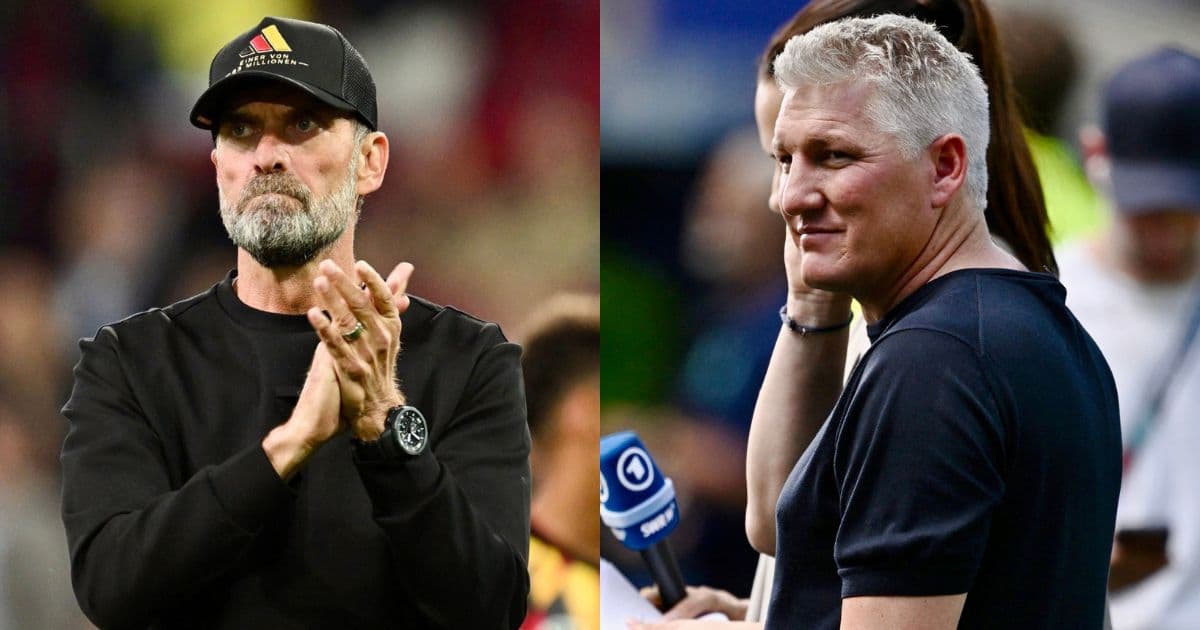
Taking a new job off the back of a major disappointment can be risky, especially in international football, and Jurgen Klopp has already experienced that challenge during his early stint in charge of Germany.
The new Germany boss has failed to hit the ground running, drawing 1-1 with Xavi's Netherlands before losing 1-0 to Greece in his second game in charge.
Germany legend and 2014 FIFA World Cup winner Bastian Schweinsteiger was critical of what he saw from the team.
The former midfielder delivered an honest assessment after the 1-0 defeat at home to Greece, praising Klopp's approach of assessing a wide pool of players while admitting that Germany are no longer a top team.
What Did Bastian Schweinsteiger Say About Klopp's Germany?
Schweinsteiger spoke with ARD presenter Esther Sedlaczek after the game in Augsburg, arguing that Germany had slipped into mediocrity.
Per LiveScore, he stated that Die Mannschaft have settled into mediocrity, failing to really take the game to their opponents and cause problems for them.
"We're no longer a top team, we've settled into mediocrity. We haven't managed to put the pressure on the opponent in a way that would cause any problems.
He also argued that the Germany team lacks game-changers who can make the difference in important moments.
"We no longer have players who make the difference. Even Greece have (Konstantinos) Karetsas, (Christos) Tzolis, (Vangelis) Pavlidis — for me those are players who make the difference.
"We don't manage to use our best players in the way they dominate at club level. Take [Karim] Adeyemi as an example: he was good today, but at Barcelona he is currently specifically put into situations where he can use his speed to put his stamp on the game and score. That doesn't work for Germany yet."
He absolved Klopp of the blame for the side's performance, pointing out that he had done everything right by inviting 44 players and deciding to look at them by himself.
"Jurgen Klopp – and it's the right thing to do – has to look at everyone who could be considered, in order to develop a team that will then play Jurgen Klopp's style of football. Hopefully, we'll see that in November.
"Jurgen Klopp is still finding his feet. This is only his second international match. These things take time. He's not a magician. You can't expect the team to leave the pitch here with a 4-0, dominant victory against Greece. This is hard work," he concluded.
Why Has Jurgen Klopp's Germany Struggled to Make an Impact?
Former Liverpool coach Klopp invited 44 players for this set of UEFA Nations League games, hoping to extract a reliable squad from the pool of players invited.
The plan is to have a group play the first two games against the Netherlands and Greece, and another group to take on Serbia and Greece in the final two games.
In their first game against a Netherlands side also under new management, Klopp's team scored first through Felix Nmecha and could have been two goals up shortly after, as Karim Adeyemi missed a good chance shortly afterwards.
Their profligacy would come back to haunt them, as Cody Gakpo scored a stoppage time equaliser to hand a much-deserved point to the Oranje.
Netherlands had more possession, five big chances to Germany's two, a significantly higher xG, and 22 shots to Germany's 10.
Klopp's side looked very subdued as they struggled to find any rhythm throughout the game.
Against Greece, there was a marked improvement, as Die Mannschaft managed to control much of the game.
There was no hiding place for them, however, when substitute Dimitrios Kourbelis fired home via a wicked deflection in the 74th minute, and they found no answer afterwards.
Germany are playing like the side that lost to Ecuador and Paraguay at the 2026 FIFA World Cup, even if it's early days in Klopp's reign.
Klopp now has two games to begin changing perceptions of his team among the German public, starting with a clash against Serbia at the Allianz Arena in Munich on Thursday, October 1.