
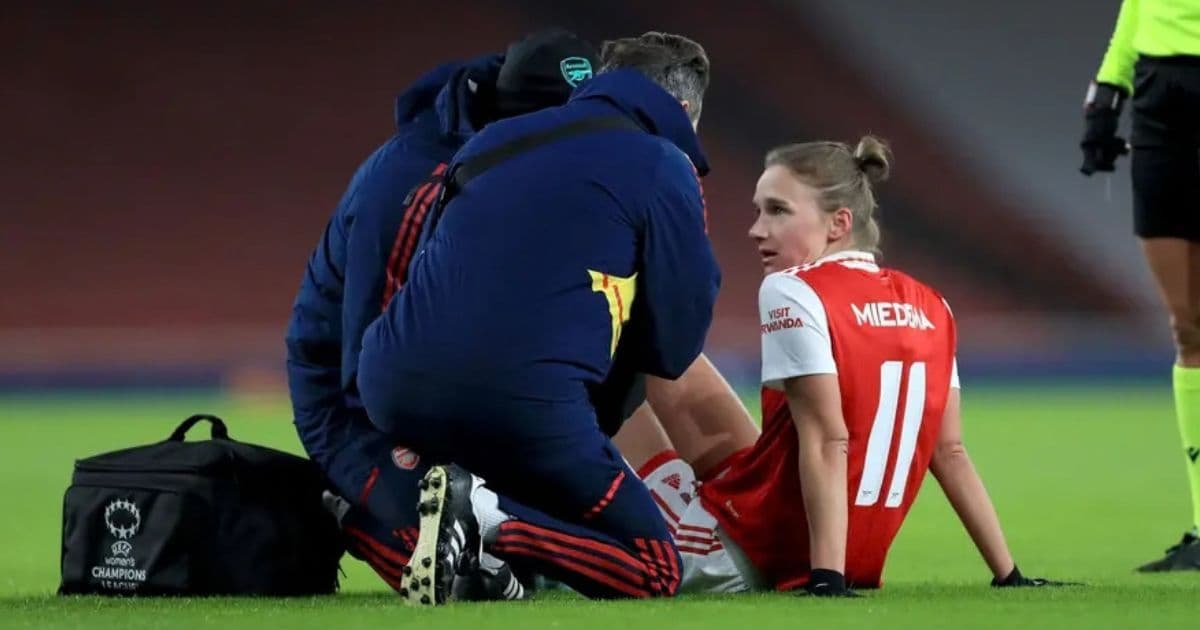
ACL injuries have become one of the biggest talking points in women’s football.
From elite players missing major tournaments to young footballers facing lengthy spells on the sidelines, the impact of an ACL injury can stretch far beyond the moment the ligament ruptures.
But according to Dr Karli Richards, understanding ACL injuries means looking at much more than the knee itself.
Following our first conversation about football boots, studs and female-specific equipment, Striver.Football spoke to Karli again to explore what happens further up the body — and what players, coaches and clubs can do to reduce the risk of injury.
Her message was clear: there is no single reason why an ACL injury happens.
“It’s multifactorial,” Karli explained. “There’s not, I don't think, one thing that puts women at higher risk.”
Instead, anatomy, biomechanics, strength, movement, fatigue, workload, equipment and potentially hormonal fluctuations can all form part of the wider picture.
Why Is The ACL So Important?
The anterior cruciate ligament, better known as the ACL, sits inside the knee and connects the femur to the tibia.
Its role is to help stabilise the knee — something that becomes particularly important for footballers constantly sprinting, turning, stopping and changing direction.
“When the ACL isn't there, that knee joint is very unstable,” Karli said.
“It really affects any person, especially high-level athletes, in movement control and strength of their lower extremity.
“Without that ligament, it's difficult to perform those high-level tasks, like sprinting and turning and shooting.”
When the ligament is ruptured or torn, the athlete loses stability and control around the knee, making a return to high-level sport significantly more difficult.
Karli also stressed that ACL injuries are not exclusive to professional athletes.
Her own sister-in-law tore hers during a recreational football match despite not being a professional player.
“She was playing pick-up soccer against high school girls, because it was an alumni game,” Karli said.
“And within the first 10 minutes, she tore her ACL.”
For Karli, it demonstrates how quickly an injury can happen and why prevention matters at every level of the game.
Why Are Female Athletes More At Risk?
Female athletes experience ACL injuries at higher rates than their male counterparts, but Karli says the reasons are complex.
“We're starting to get more data on it, but again, like we talked about in our last interview, we still don't have all the data behind what's causing these injuries.”
One factor is anatomy.
“Some things that are different with women is we're anatomically different,” she explained. “Our hips are a little bit wider.”
Those differences can influence the way forces are distributed through the lower body.
“Biomechanically and anatomically, we're different,” Karli said. “We put a little bit more strain on our knee because of the way we're built.”
Strength and neuromuscular control can also play a role.
Karli explained that female athletes can sometimes be “quad dominant”, where the quadriceps are relatively stronger than the hamstrings.
That can affect how an athlete lands.
“Without doing proper strength and conditioning, and proper reception training, a lot of times girls can tend to land more with an extended knee.”
Landing mechanics are therefore crucial.
“You want a soft bend in the knee when you land,” Karli said.
“When you land with a bend, it protects the ACL, but if the knee's hyperextended, it stresses that ligament.”
Can We Train The Body To Reduce The Risk?
The good news is that movement mechanics can be trained.
Karli pointed to the FIFA 11+ injury-prevention programme as an example of evidence showing that structured strength and conditioning can reduce ACL injuries.
In women's football, research has found that multicomponent exercise-based prevention programmes can reduce ACL injuries by 45%.
Karli stressed, however, that consistency is key.
“You can't just do it once a week, or after someone on your team has already had the injury,” she said.
“You need to start it in the beginning of the season, do it two to three times a week, for 20 minutes, before your practice.”
The programme combines strength and conditioning with balance, core strength and landing techniques.
For Karli, this type of education should start young.
“I think it needs to start at a younger age,” she said.
“Especially with the girls, if you can teach a young girl at the age of 10 how to land appropriately, then you're not having to teach them when they're 16.
“It's much easier to learn these things when you're younger.”
Fatigue And The Growing Problem Of Workload
ACL prevention also extends beyond what happens during a single training session.
As the women's football calendar becomes increasingly congested, Karli believes workload and recovery need greater attention.
“Load and fatigue can affect all injury risk,” she said.
“If the body doesn't have time to repair itself… it just becomes more and more fatigued in that area, and eventually, it tears.”
Fatigue can also affect how an athlete moves.
“If a player is fatigued, that can lead to poor landing mechanics,” Karli explained.
“That can lead to increased risk of slipping or not doing what they normally would do on the field, and that can increase the ACL risk.”
Karli highlighted FIFPRO's Player Workload Monitoring Platform, which allows workload and recovery data to be tracked across a player's schedule.
The wider message, however, is simple.
“Rest is so important,” she said.
“And most of the professional players are just not getting it.”
What About The Menstrual Cycle?
The menstrual cycle is another area Karli believes deserves greater attention, although she was careful not to overstate the current evidence.
“Menstrual cycle may or may not play a role in it,” she said. “But there is a lot of research being done on that right now.”
“We don't have sufficient data to make recommendations with that yet.”
Rather than claiming that a particular phase of the cycle causes ACL injuries, Karli believes athletes should develop greater awareness of their own bodies.
“I found that body awareness is really helpful for female athletes,” she said.
“Just knowing what phase they're in and how their body feels during that phase, and then they can adapt to their play and their training appropriately.
“Because everyone's different at different phases.”
For Karli, menstrual health should also become a normal part of conversations between players and their support teams.
“We're talking about menstrual cycle being a vital sign, meaning it's like breathing. It's like your heart rate,” she said.
“It needs to be treated like that, and not a taboo, because it really does affect a player's performance and fatigue.”
The Boots Still Matter
Our first interview with Karli focused on football boots, and the conversation showed why equipment cannot be separated entirely from ACL prevention.
Karli described a “plant and turn” injury, where the boot becomes stuck while the rest of the body continues to rotate.
“If the stud's too long, especially on an artificial grass playing surface, the stud can get caught in the surface, and then the foot stays planted,” she explained.
“And then what happens if this lower leg is planted, and then you keep turning?
“That's when it pops.”
The aim isn't necessarily to have as much traction as possible.
“You want a little bit of slide with your boot on the surface,” Karli said.
“I know there's a fine line between not enough traction and too much traction.”
That is why she believes players should consider the playing surface when selecting their boots.
And, as discussed in our first interview, she believes female-specific equipment is important.
“Female equipment is paramount,” Karli said.
“Girls and women should be wearing boots based on their anatomy.”
Prevention Is Everyone's Responsibility
For Karli, reducing ACL injuries cannot simply be placed on the shoulders of players.
Clubs and coaches have a major role to play through strength and conditioning, education and equipment selection.
“I think all clubs need to be doing the strength and conditioning, the FIFA 11+,” she said.
She also believes players should know what surface they are playing on.
“I think all clubs and coaches need to be telling their players what pitch they're going to play on each day,” Karli explained.
“Just having the education behind it, I think, is helpful.”
At the same time, players need to feel comfortable speaking up.
“I think for the players, it's important for them to empower themselves to speak up about the menstrual cycle,” Karli said.
“To feel comfortable talking to their coaches about it and their physiotherapist.
“I think that has to be an open dialogue.”
Four Things Every Female Footballer Can Do
After discussing anatomy, strength, fatigue, menstrual health and equipment, Karli finished with four practical pieces of advice for female footballers.
Get strong.
“Do this FIFA 11+ programme.”
Get rest.
“Listen to your body, and take rest in between matches and practices. It's okay to take a day off.”
Be aware.
“Be aware of your menstrual cycle, understand your hormones, understand your body, know where you're at in different phases.”
Be educated.
“Educate yourself on your playing surface, and also on the shoes that you're wearing.”
Then came one final word:
Be empowered.
For Karli, ACL prevention isn't about finding one perfect solution.
It is about understanding the athlete as a whole — and giving players the knowledge and support to make informed decisions about their bodies.
“You know, those are the sorts of things that I think could go a long way of female footballers being able to understand.”
The research into ACL injuries in women's football continues to develop. But while scientists work to understand exactly why female athletes face greater risk, Karli's message is something players can act on now.
Get strong. Get rest. Be aware. Be educated. And understand your body before it tells you something is wrong.