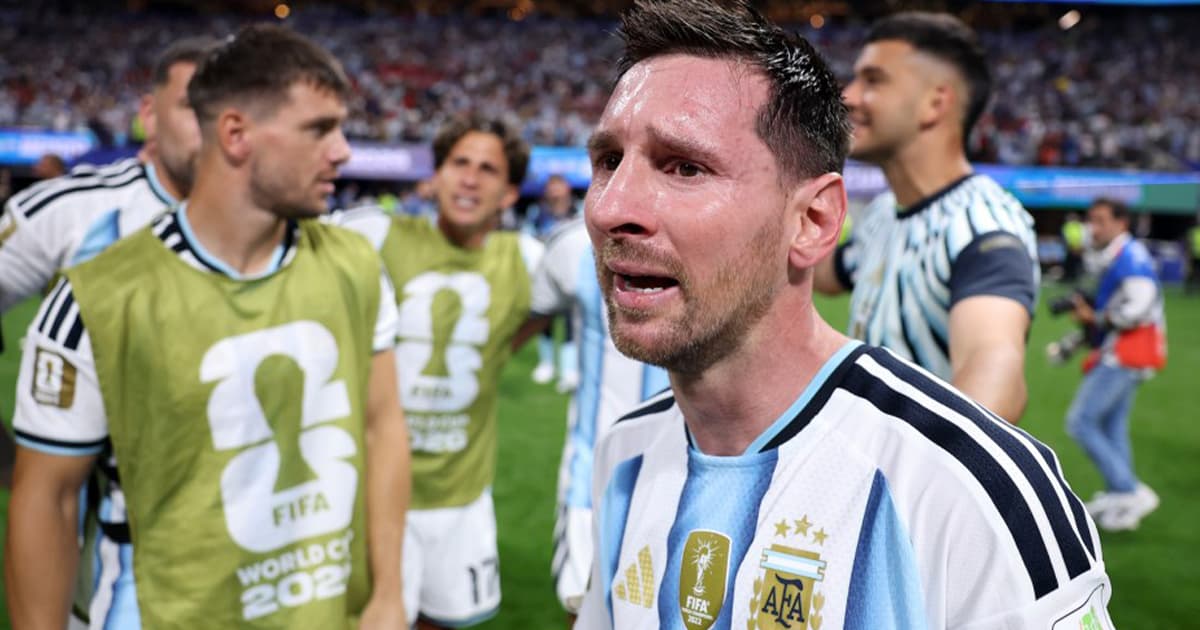
When the referee blew the final whistle during Argentina’s 3-2 comeback win over Egypt during their 2026 FIFA World Cup Round of 16 Clash, Lionel Messi could be seen weeping uncontrollably.
He was not crying out of sadness or even joy, but rather, relief, as 19 minutes earlier, the Albiceleste were on the brink of exiting the FIFA World Cup stage, as Egypt were leading 2-0, and could potentially even have been leading by three goals were it not for another disallowed goal intervened by the VAR.
For a time in the second half, Messi looked dazed, unable to comprehend the tactical collapse unfolding around him. He had just missed a crucial penalty earlier in the first half, and there was a feeling of “what if”. But then, something clicked. He gave them a lifeline after 79 minutes, whipping in an open-play cross that was headed home by center-back Cristian Romero.
Four minutes later, he smashed home a magnificent first-time shot off the crossbar to claim his eighth goal of the tournament, cementing his place at the peak of the Golden Boot race.
While he played no direct part in Enzo Fernandez’s stunning 92nd-minute counter-attacking winner, it was the undeniable "Messi effect" that dragged a shambolic Argentina performance out of the abyss.
In the post-match mixed zone, Messi admitted to feeling "a lot of anger" over his missed penalty—his second failure from the spot in this tournament. "I felt like I had let the team down at an important moment," he revealed as quoted on The Athletic. "But fortunately, fate had something special for me at the end."
Watching in the studio for U.S. broadcaster Fox, Thierry Henry highlighted the switch that occurs when the Inter Miami forward is backed into a corner.
"You do not want to wake up the beast," Henry warned. "When he goes into that mood, it’s very difficult to stop him. The penalty miss reminded us that he is human. What he produced in the closing stages reminds us again that he’s not human."
Yet, as Lionel Scaloni wept tears of pure emotional exhaustion on the pitch, the underlying reality of the match papered over a brewing crisis. Striver.Football attempts to demystify what exactly is going on with the Argentina side.
Egypt Exposed Argentina's Tactical Weaknesses
Argentina’s results across this four-year cycle look pristine on paper. They have registered 12 straight wins and also managed to win back-to-back Copa America titles, with a World Cup sandwiched between them, but major cracks are starting to show.
The tactical blueprint Scaloni has deployed in North America is a narrow, wingerless 4-4-2 designed entirely to construct passing lanes into Messi’s feet, with Nicolas Tagliafico trying to offer width as a left back, while Miguel Molina drops back on the other flank as a right back.
Without the verticality of the retired Angel Di Maria, Argentina relies on a box midfield to overload central zones, and asking Tagliafico to provide width. While this structure allows Messi license to roam and orchestrate, it strips the team of open-play solutions when opponents successfully disrupt the center.

Egypt exposed this structural rigidity ruthlessly. Operating in a disciplined mid-block, Egypt coach Hossam Hassan deployed tight man-marking traps in central midfield, tasking center-back Rami Rabia with stepping up aggressively whenever Messi dropped to receive.
Out of possession, Argentina's lack of athleticism was laid bare. To conserve Messi’s energy, the Albiceleste rarely deploy a sustained, high-intensity press. Instead, they defend reactively, ranking near the bottom of the remaining knockout teams for final-third regains.
When structural moves broke down, Egypt shredded Argentina on the counter-attack. A rapid transitional break saw Mohamed Salah split two defenders to feed Mostafa Ziko for a chipped finish, which was highly controversially disallowed by VAR for an early foul.
Unfazed, Egypt executed the exact same pattern minutes later: an inswinging Messi corner was cleared, Salah spearheaded a four-vs-three overload, and Haissem Hassan isolated the defense before cutting back for Ziko to hammer home a legitimate second goal.
Faced with structural paralysis, Argentina resorted to a metric they avoided all through the group stage: high-volume crossing.
Scaloni’s side attempted 26 crosses in total—18 in open play, their highest tally in a major tournament fixture under his tenure. With no natural wingers on the pitch to unlock the block, the crossing burden fell squarely on Messi, who delivered the looping balls that generated Romero's header and the chaotic sequence leading to his own half-volley equaliser.
Can Argentina's Youngsters Ease The Burden On Messi?
During the tournament, Scaloni has seldom relied on his youngsters within the squad. The highly celebrated Nico Paz has been limited to two appearances.
Unless one of the two advanced midfielders either side of deep lying playmaker Enzo Fernandez, Rodrigo De Paul and Alexis Mac Allister is dropped, it is unlikely Paz will get enough minutes, as Messi, who plays in his preferred right advanced playmaker position, is dropped.

So step forward Giuliano Simione, who could help restore the Di Maria verticality and defensive intensity. Although Thiago Almada has done okay when called upon on that left wing slot given his one-vs-one sense, Giulano, who is the son of Atletico Madrid coach Diego, could provide the exact explosive pace as a lethal wide attacker who thrives in 1v1 isolation scenarios.
Simeone’s willingness to directly drive at fullbacks forces defensive lines to retreat, automatically creating structural depth and opening up central pockets for Argentina's midfielders.
Crucially, Simeone addresses the team's reactive defensive vulnerabilities. Armed with a relentless, high-volume tactical work rate, his presence ensures that Argentina can transition from attack to defense instantly.
When possession is lost in the final third, Simeone serves as the primary engine to trigger a cohesive counter-press, protecting an aging midfield and choking off opposing fast breaks before they can isolate Argentina’s exposed center-backs.

The Striver Verdict
Argentina's tactical reliance on Messi to remain unstoppable rather than unpredictable is working strictly because of his individual perfection in high-pressure moments.
Even their 3-1 group-stage win over Jordan relied entirely on direct free-kicks from Messi and Giovani Lo Celso alongside a penalty. This is an emotionally volatile, heavily strained way to navigate a World Cup knockout bracket.
The defensive vulnerabilities that saw them ship two goals to Egypt, and twice throw away leads against Cape Verde in the Round of 32, will be punished with far less mercy as the caliber of opposition rises.
Up next is the Switzerland side in Kansas City.
Scaloni must be thinking of ways to avoid the same situations against a structurally disciplined side that boast athletic profiles, including their impressive young star Johan Manzambi.