
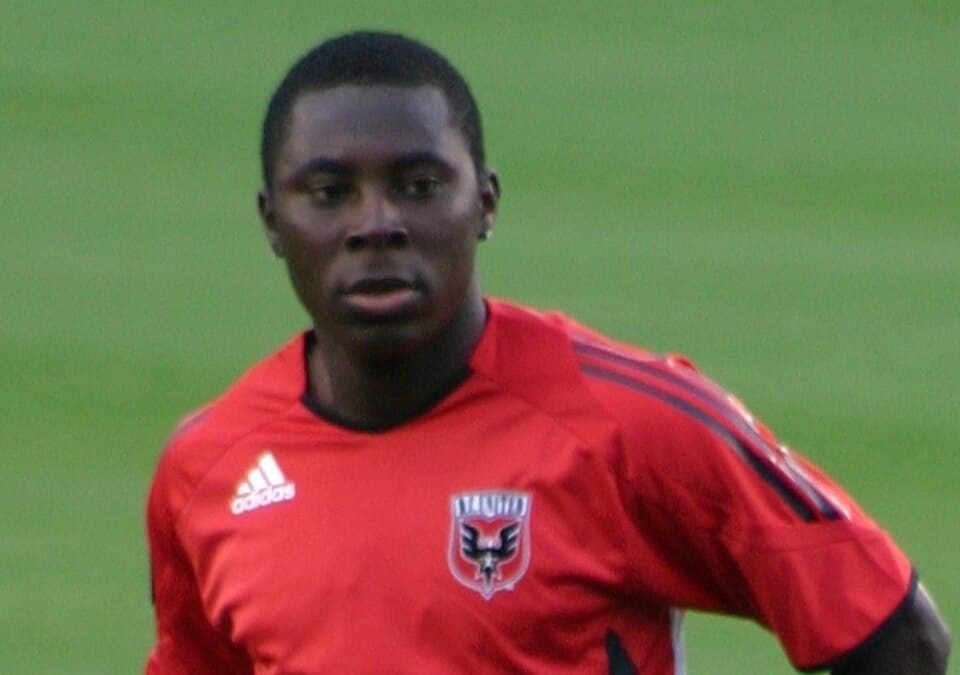
Freddy Adu entered Major League Soccer at 14, became the face of a new generation of American soccer and was repeatedly described as “the next Pelé.” His professional debut in 2004 was presented as the beginning of a global career.
Two decades later, his name is invoked less as a future superstar than as a reference point whenever an unusually young player attracts major attention. The question that has followed him ever since is: What happened to the player who was supposed to transform American soccer?
What Happened To Freddy Adu?
Freddy Adu did build a genuine professional career. He won 17 caps for the United States, scored at youth World Cups, made 87 regular-season appearances for D.C. He moved to Portuguese giants Benfica in 2007.
But the career that followed fell far short of the extraordinary expectations attached to him as a teenager.
Adu struggled to find sustained continuity during a crucial stage of his development. His 2007 move to Benfica became a major turning point: he made limited appearances, experienced a change in coaching, and was sent out on loan repeatedly.
By the time he returned from his first loan spell, the path of his career had already begun to change. Adu later described the Benfica move as a mistake and acknowledged that talent alone was not enough to guarantee success.
His career was shaped by a combination of early pressure, difficult decisions, limited consistent playing time, and repeated changes of environment. He also acknowledged that he did not always make the most of his ability.
His career did not collapse after one mistake. After leaving Benfica, he returned to MLS with Philadelphia Union, played in several countries, and continued playing into his late twenties.
Transfermarkt lists him as retired as of February 16, 2021, although no formal public retirement announcement has been verified.
Why Freddy Adu Was Rated So Highly
Adu’s early reputation was built on genuine achievements. D.C. United selected him first overall in the 2004 MLS SuperDraft, and he made his league debut against the San Jose Earthquakes on April 3, 2004, aged 14 years and 306 days.
He became the youngest player to appear in MLS at the time, a record he held until 2024.
He scored his first MLS goal against the MetroStars on April 17 and helped D.C. win the 2004 MLS Cup. He finished his rookie season with five goals and three assists in 30 regular-season appearances.
According to FBref, Adu made 87 MLS appearances for D.C. United, starting 59, playing 5,448 minutes and scoring 11 league goals before turning 18.
At the youth international level, he captained the United States at the 2007 FIFA U-20 World Cup and became the first player to score a hat-trick at both the U-17 and U-20 World Cups, doing so against South Korea in 2003 and Poland in 2007.
He later earned 17 senior caps for the United States and scored twice. He was an exceptionally talented young player who made a significant impact in MLS and delivered at major youth tournaments.
His record as the league’s youngest debutant stood for more than 20 years before Philadelphia Union’s Cavan Sullivan broke it in July 2024, debuting at 14 years and 293 days, compared with Adu’s 14 years and 306 days.
Why The Benfica Move Became Freddy Adu's Turning Point
The most significant shift in Adu’s career came in 2007, when he left MLS for Portuguese giants Benfica. UEFA reported on July 31, 2007, that Benfica had reached an agreement in principle with MLS to sign the 18-year-old for around €1.4 million after his impressive U-20 World Cup.
The move placed Adu at a major European club, where he later said the pressure to succeed immediately and three coaching changes during his first year made the situation difficult.
In a 2012 BBC interview, Adu said: "Going to Benfica was not a good decision for me. As an 18-year-old, there was too much pressure to win right away, and I went through three coaches in one year."
His limited league involvement reflected those difficulties. FBref records 11 Primeira Liga appearances, 143 minutes, and two goals during the 2007-08 season. Transfermarkt records 21 appearances and two goals for Benfica across all competitions.
The figure also includes cup and European matches.