
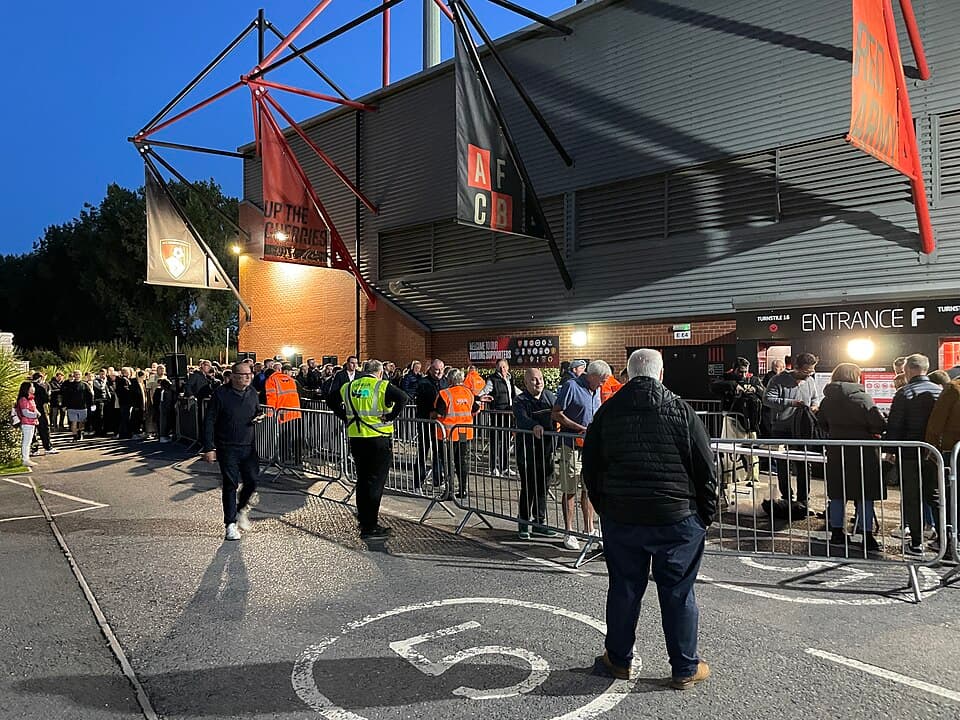
Bournemouth will host Sturm Graz at the Vitality Stadium on 15 October. With a capacity of around 12,300, it is set to become the smallest English ground to host a match in a major European competition.
The match will be the Cherries' first European home game. The previous record belonged to Fulham, who played their European fixtures at Queens Park Rangers’ Loftus Road in 2002-03 while Craven Cottage was being rebuilt, and UEFA listed the capacity at 19,148.
Bournemouth qualified for Europe for the first time in their 127-year history after finishing sixth in the Premier League. They opened their Europa League campaign with a 2-1 away win over Real Sociedad, while Sturm Graz drew 0-0 at home against Rennes.
Thursday’s match kicks off at 8 pm BST.
What Is the Vitality Stadium’s Capacity for Bournemouth vs Sturm Graz?
The Premier League recently listed the Vitality Stadium’s capacity at 12,357, up from around 11,300 before this season’s building work. Bournemouth and UEFA have yet to confirm the stadium’s final capacity for the match.
This will depend on safety checks and operational approval.
Two new corner sections have been added, with around 360 seats each. Block 24C, in the south-east corner, is reserved for Sturm Graz supporters, while another 200 seats between the 18-yard boxes have been allocated to the Austrian club’s sponsors and guests.
The north-west corner could also open for the match, but this depends on the outcome of testing, according to a club spokesman.
How Does Bournemouth’s Ground Compare With Previous European Venues?
Fulham played their 2002–03 UEFA Cup home matches at Loftus Road while Craven Cottage was redeveloped. Millwall’s Den hosted European fixtures in 2004–05, followed by Portsmouth’s Fratton Park in 2008–09.
Both grounds had capacities of just over 20,000. Unlike Fulham, who played at QPR’s Loftus Road during the redevelopment of Craven Cottage, Bournemouth will host their European home match at their own ground.
QPR’s 4-0 win over KR Reykjavik on 2 October 1984 drew just 6,196 spectators. The UEFA Cup tie was played at Arsenal’s Highbury because UEFA would not allow QPR to use Loftus Road’s artificial pitch for European matches.
Liverpool beat Dundalk 1-0 at Anfield on 28 September 1982 in front of 12,021 spectators. The win completed a 5-1 aggregate victory in the European Cup first round.
Why Did Bournemouth Need Stadium Work for European Football?
Stadium capacity was not the main hurdle for Bournemouth. The Vitality Stadium already met UEFA’s stated minimum of 8,000 seats for its category, but upgrades to its facilities were still needed.
UEFA granted Bournemouth a provisional stadium licence in the spring. The required work included upgrades to hospitality and broadcast facilities, a new outside-broadcast compound, a secure perimeter, new turnstiles, and a new pitch.
The wider £85 million redevelopment is set to increase the Vitality Stadium’s capacity from around 11,300 to 20,196. Bournemouth, Christchurch and Poole Council’s planning committee unanimously approved the plans in May.
The redevelopment will take place in stages, with capacity expected to reach around 17,000 before work begins on a new South Stand with approximately 7,000 seats.
An additional upper tier behind the Ted MacDougall Stand is planned for the 2026–27 season, with the full redevelopment expected to be completed in time for the 2028–29 season.