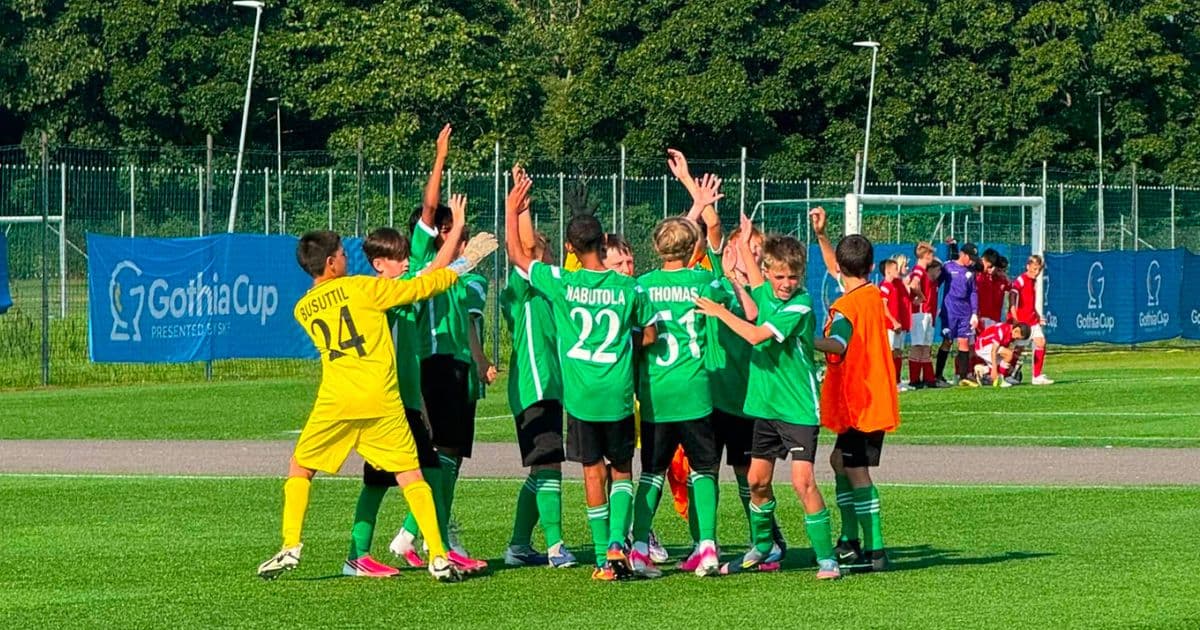
There is no other week in the football calendar quite like the Gothia Cup. 1,956 teams from 78 nations, 45,300 players and leaders, approximately 4,900 matches across 124 pitches spread across Greater Gothenburg.
Since 1975, it has been the place where the future of the game reveals itself, not in boardrooms or broadcast deals, but in group stage matches played at 8am on a Tuesday morning by kids who have travelled thousands of miles for the privilege. This year, more than ever, it felt like a genuine map of where football is going.
What The Gothia Cup Reveals About Global Youth Football
When you look at the Gothia Cup’s nations list, you are not just looking at which countries play football. You are looking at which countries believe in the game’s future enough to invest in it at youth level. You are looking at infrastructure, pipeline, ambition.
Sweden sent 960 teams. As the host nation, that number carries context, but it also speaks to a culture in which youth football is not an afterthought.
Norway sent 148. Germany 142. England 171, with France on 50 and Iceland, a nation of fewer than 400,000 people, sending 53. Iceland’s number alone is remarkable. Per capita, it may be the most invested footballing nation on earth, and anyone who has watched their senior game over the last decade will not be surprised.
The winners came from Sweden, France, Japan, Nigeria, Norway, Ghana, Germany, Tanzania, England, Spain, Kenya, India and Iceland, with titles spread across three continents. That is not a list of traditional football powers alone. That is a list of countries doing the work.

Minerva Academy Shows India's Youth Football Revolution
The story of the tournament is Minerva Academy. The Chandigarh-based academy’s Under-12 boys retained the Gothia Cup title with a 2-1 victory over Brazil’s RS Sports Yellow in the final. An Indian academy, defending a title, beating Brazil, in Sweden. India sent 7 teams in total. Every single one of those 7 mattered.
Minerva’s recent record is extraordinary. They have become the first Indian team to win both the Norway Cup and the Dana Cup, defeated Liverpool’s Under-15 side at the Mediterranean International Cup, and this year added the Helsinki Cup before returning to Gothenburg to defend their crown. This is what structured, serious investment in youth development looks like.
India has 1.4 billion people, a generation growing up watching the Premier League, and academies like Minerva finally giving talented young players somewhere to channel it. The market is not coming. It is already here. Anyone serious about the future of football needs to be paying attention.
Why The Nordic Countries Continue To Produce Elite Talent
Sweden dominated the winner’s list at home, as you might expect, but the numbers across the Nordic bloc tell a bigger story. Jitex BK won the G12. Hammarby IF won both the G14B and G14. IK Uppsala Fotboll won the G15. Bjarreds FF took the G16 title in a penalty shootout against Iceland’s Stjarnan. Norway’s SK Haugar won the G18, defeating Fredrikstad FK 8-7 on penalties in an all-Norwegian final.
148 Norwegian teams. 53 Icelandic. The investment is systemic, the pathways are clear, and the results are downstream of decisions made years earlier about what youth football deserves.
The Nordic countries have not stumbled into producing excellent players. They have built the conditions in which excellent players become inevitable.

Spain And Italy Show Two Very Different Youth Football Pathways
Spain sent 29 teams and delivered accordingly: Madrid Panthers won the G13, Imperial Future won the B15 with a 4-0 demolition of Hamarkameratene, and Spanish clubs featured in multiple finals. The conveyor belt continues to turn.
Italy sent 5.
Five teams. From a country that gave the world Pirlo, Totti, Del Piero, Buffon, and some of the greatest club football ever played. Five, compared to Spain’s 29, Brazil’s 21, Portugal’s 19. Those are not just numbers. They are a statement about where Italian football currently places its faith in the future.
Italy has not qualified for a World Cup since 2014. The 2018 failure was a humiliation. Missing out again in 2026, while the tournament played out without them for the third time in succession, should be the moment of reckoning that finally forces structural change.
Five teams at the world’s largest youth tournament suggests that reckoning has not yet arrived. Where are the academies? Where is the pipeline? Where is the belief that the next generation is worth the investment?
It is not a verdict. But it is a data point that deserves an honest conversation.
Read More: Inside Gothia Cup 2026: Why This Is the Greatest Youth Football Tournament on Earth
Read More: From Gothia Cup To Global Glory: The Football Icons Who Started Their Journey In Sweden
England's Youth Football System Continues To Deliver
England sent 171 teams. That number sits comfortably at the top of the non-Swedish list and it reflects something real about the grassroots and academy ecosystem that has been quietly rebuilt over the last decade.
Skouted FC brought that investment home, taking the B16 title at Gamla Ullevi with a composed 2-0 win over Jersey Futbol Club Nsoromma of the USA. Horsham FC reached the B17 final. English clubs were present across age groups, across the draw, across the week. The volume was matched by the depth of performance.
171 teams is a number with intent behind it.
A Personal Note
I came to Gothenburg this year with two sons and left with a story that captures everything the Gothia Cup is, the joy, the growth, and the particular cruelty that makes football the game it is.
My younger son played for Prep School Lions in the U11s, his first experience of the tournament, and at that age it is non-competitive, which is exactly right. It is about the experience. The opening ceremony. The pitches. The realisation that football is a language spoken by thousands of kids from dozens of countries who have all made the same journey to the same city for the same reason. You cannot put a competitive result on what that does to a young player. The seed it plants is enough.
My older son’s experience with Josh Evans Academy had a different arc. They were extraordinary. Having conceded just one goal throughout the entire tournament, they played every game with discipline, intelligence, and real heart. They made the semi-finals. And then came the penalty shootout.
There is nothing in sport quite as cruel. A week of teamwork, tactics, early mornings and tight wins, reduced to a series of single moments. One at a time. One player. One goalkeeper. The whole week held inside ten seconds. They went out. They didn’t deserve to. These things are not connected.
But I have been in and around football long enough to know that the penalty shootout is not just a cruel mechanism. It is one of the great teachers. Every player who walks up to that spot and feels that particular weight is learning something about themselves that cannot be learned any other way. Pressure. Resilience.
The gap between preparation and execution under the highest stakes available to a youth player. These boys will be stronger for it. Not immediately. Maybe not this summer. But they will carry that experience forward, and one day it will matter in ways they cannot yet imagine.
Two sons. Two different experiences of the same tournament. Both exactly what Gothia Cup is supposed to be.
The Bigger Lesson From Gothia Cup 2026
1,956 teams in a time of global uncertainty, economic downturns, and conflict chose to come to Gothenburg. That is not nothing. That is an enormous collective act of belief in football’s capacity to matter.
The game is expanding, into India, into Africa, into markets that the European establishment has historically underinvested in. The Gothia Cup nations list is an annual state of the union for global youth football, and this year’s edition was one of its most diverse and most revealing yet.
The countries winning titles here are not all the countries you would expect. The countries sending 5 teams when they should be sending 50 are being quietly exposed.
The future of the game is being written on pitches across 78 countries. This week, a small part of it was written in Gothenburg. One of my sons got a taste of it at its most joyful. The other ran into it at its most unforgiving.
That’s the game. And next year, they’ll both want more.