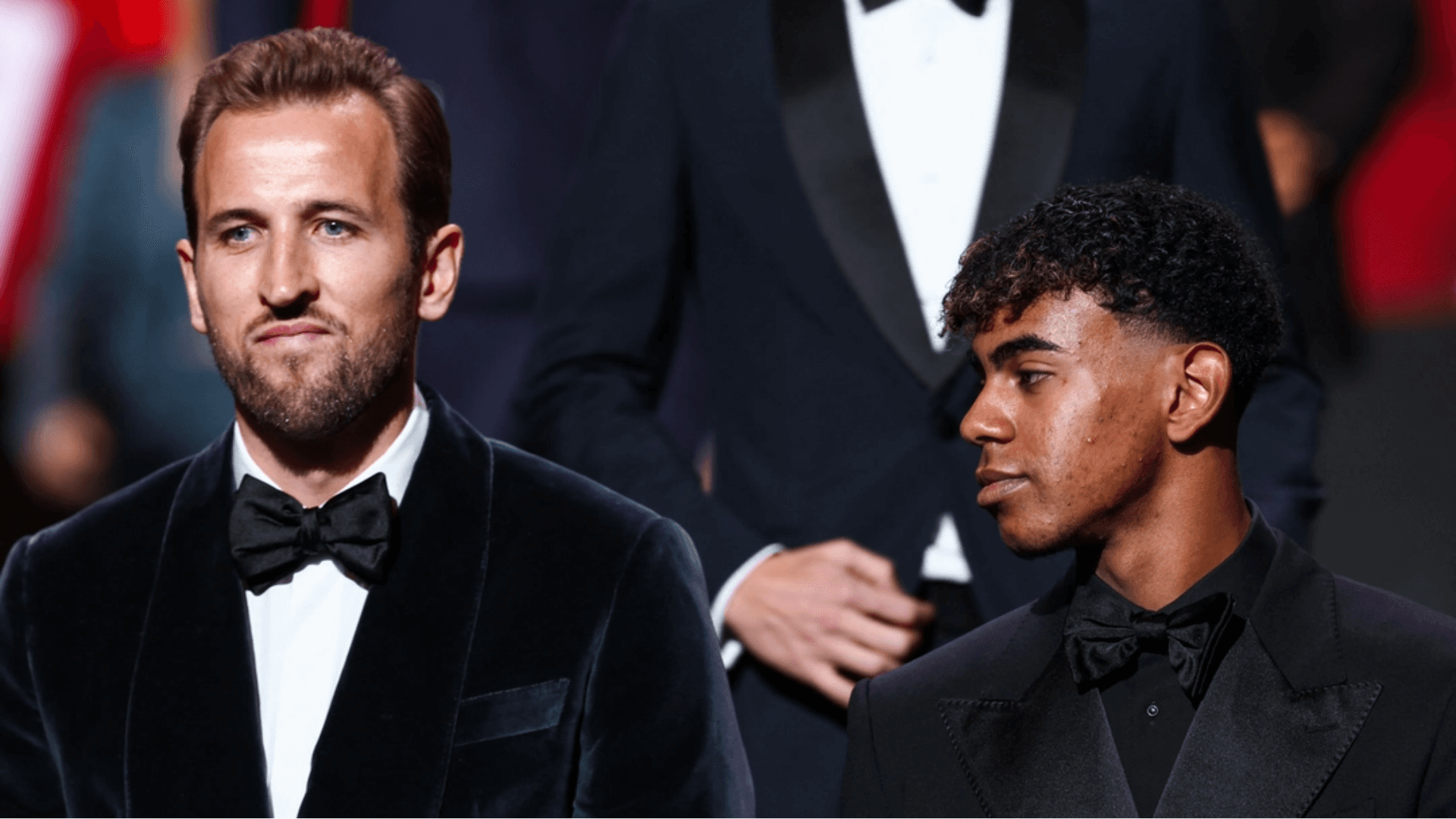
The 2026 Ballon d’Or race is heading towards its conclusion, with Harry Kane, Kylian Mbappé and Lamine Yamal among the leading contenders for football’s most prestigious individual honour.
The ceremony will take place at the London Palladium on Monday night, marking the first time the event has been held outside Paris. With the final result approaching, a late shift in the betting markets has added another layer of intrigue to an already closely watched contest.
But with a defined points system determining the winner, there is also a specific rule that could become crucial if two players finish level.
How does the Ballon d’Or tie-break rule work?
If two or more players finish with the same total number of points in the Ballon d’Or voting, the winner is determined by the number of first-place votes received.
If the players remain level, the tie-break moves to the number of second-place votes, followed by third-place votes and then the remaining positions until the tie is resolved.
The system means that the overall points total is not necessarily the only factor that matters. The order in which voters rank the leading candidates could prove decisive if the final scores are identical.
The 2026 Ballon d’Or voting process involves a jury of 100 specialised journalists, with one representative from each of the top 100 nations in the FIFA world rankings.
Each journalist selects their top 10 players from a 30-player shortlist. Points are allocated according to the following scale:
- First place: 15 points
- Second place: 12 points
- Third place: 10 points
- Fourth place: 8 points
- Fifth place: 7 points
- Sixth place: 5 points
- Seventh place: 4 points
- Eighth place: 3 points
- Ninth place: 2 points
- Tenth place: 1 point
The player with the highest cumulative total wins the award, with the tie-break rules providing a way to separate candidates who finish level.
Voters assess performances across the 2025-26 season, from August 3, 2025, to July 19, 2026. The criteria include individual performances, decisive contributions, collective achievements and trophies, as well as class and fair play.
Kylian Mbappé threatens Harry Kane and Lamine Yamal
The Real Madrid forward’s odds have shortened dramatically in recent days, reportedly moving from 14/1 to 2/1 with some bookmakers. Oddschecker figures cited over the weekend also showed his price shortening from 12/1 to 11/4 following his brace against Barcelona.
The movement has coincided with reports that Real Madrid will end its boycott of the Ballon d’Or awards, while a report from Free Bets suggested Mbappé had attracted almost as many bets as Kane over the preceding seven days.
However, a shortening of the odds reflects changing expectations in the betting market rather than confirmation of the voting outcome.
Yamal, who had held second-favourite status for weeks, has seen his price drift. Three of the 15 bookmakers tracked reportedly lengthened their odds over a 48-hour period, with Paddy Power moving from 9/4 to 5/1.
Kane remains the leading contender in the market at reported odds of 4/7, but Mbappé’s late momentum has added uncertainty to the final standings.
Harry Kane’s season gives him a strong case
Kane’s individual output provides a significant argument in his favour. The Bayern Munich striker reportedly finished the campaign with 73 goals for club and country, compared with Mbappé’s 58 in all competitions.
Mbappé’s tally included 10 goals at the World Cup, adding to the strength of his case during a season in which individual performances and decisive contributions form part of the Ballon d’Or assessment.
Kane also received a boost shortly before the ceremony by winning the ‘100 MARCA’ award, which is decided by an international jury of journalists.
He finished with 3,962 points, just 25 ahead of Yamal, who collected 3,937. Although the award is separate from the Ballon d’Or, the result provides another indication of how closely the leading candidates have been judged by a panel of journalists.
Yamal remains part of the conversation despite his drifting odds, with the Barcelona forward having challenged Kane for the leading position in the market throughout the build-up to the ceremony.
Ultimately, the Ballon d’Or winner will be determined by the journalists’ votes rather than the bookmakers’ predictions. If the leading candidates finish level on points, the number of first-place votes could provide the decisive difference in a race that has become increasingly difficult to call.