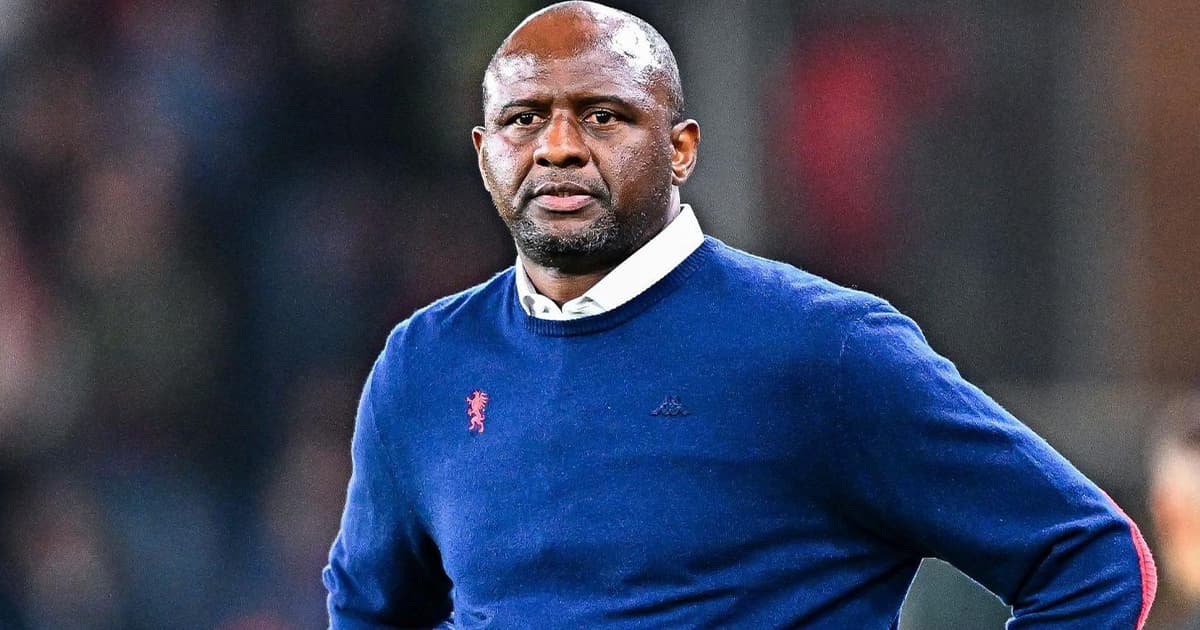
It is official, Patrick Vieira is the new Senegal National Team Coach after taking over from the sacked Pape Thiaw following the 2026 FIFA World Cup that saw them crash out in the round of 32 to Belgium.
Vieria, who was born and raised in Dakar, Senegal for the first seven years of his career before his family moved to France, will be experiencing some sort of homecoming after years playing and coaching at the very highest level, earning over 100 caps for the latter country and lifting numerous titles along the way.
Now, returning to lead the nation of his birth on an international bench, Vieira's appointment could be an important moment for both Senegal and African football management.
Why Patrick Vieira's Senegal Return Is a Homecoming
When Vieira lined up for France against Senegal in the iconic opening match of the 2002 FIFA World Cup in Seoul, he found himself at a strange cultural intersection.
France lost 1-0 to Papa Bouba Diop's famous goal in one of the biggest upsets in World Cup history.

Although Vieira represented France 107 times, Senegal remained an important part of his identity. His father, who he never knew, hailed from Gabon, his mother was raised in Cape Verde, and his earliest memories were formed playing football under the Dakar sun.
"When I played for France against Senegal in the World Cup, it was a privilege... But Senegal is also part of who I am," Vieira told The Athletic last June.
"In my head, I’m really clear who I am as a person, as a human being. I was born and grew up in Senegal. My education, my family, the Senegalese culture, the African culture, that is all part of me."
Taking charge of the national team completes a personal circle that began over two decades ago when he first reconnected with his birthplace.
How Vieira's Diambars Legacy Connects Him to Senegalese Football
Unlike other high-profile coaches hired by African nations with little prior connection to local structures (remember Clarence Seedorf and Cameroon in 2019?) Vieira returns with deep-rooted structural credentials.
In 2003, alongside former France teammate Bernard Lama, Vieira co-founded Institut Diambars in Saly, south of Dakar.
The academy was established with a dual focus on world-class athletic development and formal education.
Diambars has trained and educated hundreds of young Senegalese athletes, combining football development with formal education.
Four members of Senegal’s 2026 World Cup squad (Idrissa Gueye, Abdoulaye Seck, Pathe Ciss, and Bamba Dieng) are proud graduates of the academy.
Everton midfielder Idrissa Gueye was among the academy's first intake, exemplifying the sustained elite standards the program has pumped into European leagues for over two decades.
Because Vieira personally helped construct an important institution in Senegalese player development, his long-standing connection with Diambars gives him a perspective on Senegalese player development that few international appointments would bring to the role.
Why Vieira's Background Makes Him a Unique Appointment
For decades, African nations faced a binary choice when appointing national team managers. Often, they appoint foreign coaches with vast European experience but limited cultural or structural investment in the local grassroots.
Homegrown legends (such as Aliou Cisse) with deep cultural authority who often struggled to access top-tier European elite club positions due to systemic barriers.
Vieira brings together qualities that are rarely found in one international appointment. He possesses elite UEFA coaching credentials, Premier League experience with Crystal Palace, Ligue 1 tenures with Nice and Strasbourg, a solid background with the Manchester City Football group as a director and then a coach for New York City FC and Serie A experience with Genoa.
At the same time, he enjoys the privilege of actually being born and raised into Senegalese culture. His appointment is proof that African nations can now attract proven high-level managerial talent without sacrificing cultural foundations.
Vieira's Challenge: Rebuilding Senegal for a New Era
Vieira inherits a squad rich in elite talent, boasting the likes of Nicolas Jackson, Pape Matar Sarr, Lamine Camara, and Kalidou Koulibaly, but one coming off a turbulent six-month period.
Pape Thiaw’s tenure ended abruptly following public scrutiny over tactical rigidity during their Round of 32 World Cup elimination against Belgium.
Furthermore, Senegal remains embroiled in a Court of Arbitration for Sport (CAS) appeal regarding the controversial 2025 AFCON final walk-off incident against Morocco, with a ruling set for October 8.
Vieira will now have the opportunity to shape Senegal using the ideas and experience developed during his coaching career in England, France, Italy and the United States.
With Sadio Mane retiring from international football, Vieira will also need to oversee Senegal's transition towards a new generation of leaders. In his place younger talents like Ibrahim Mbaye and Assane Diao will be the face of a new Senegal.
He will also have to guide Senegal smoothly through the upcoming AFCON 2027 qualifiers and build a squad capable of reclaiming the continental crown at the tournament, which will be co-hosted by Kenya, Uganda and Tanzania.