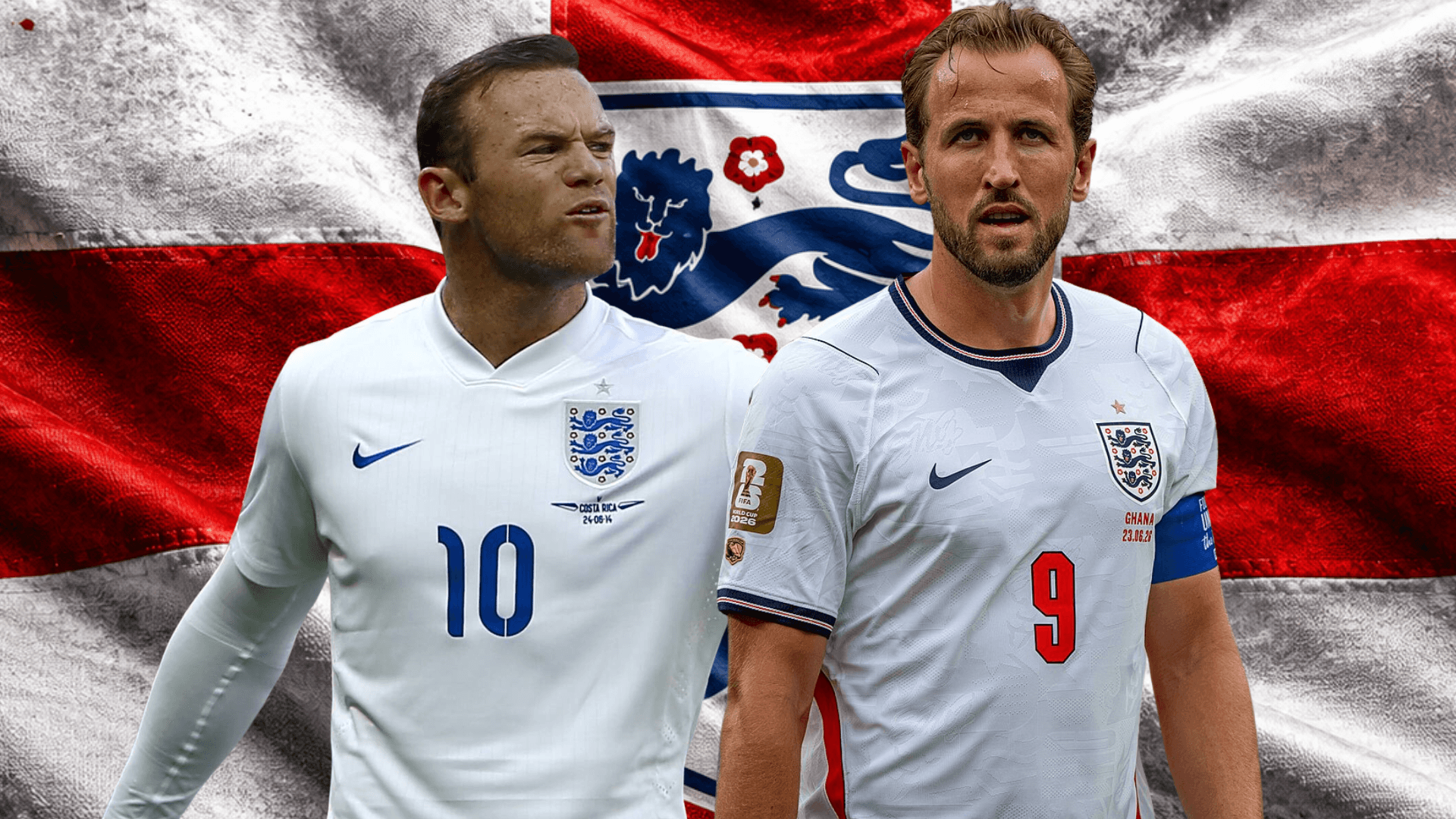
Selecting England’s greatest-ever XI will always spark debate. Harry Kane’s 129 caps and 97 goals strengthen his case, while the 1966 World Cup remains the benchmark for England’s greatest team achievement.
Choosing the XI is about more than picking the biggest names. The team needs a dependable goalkeeper, a balanced defence, midfielders who can control games and forwards who work well together.
This is an opinion-based selection, judged on England performances, individual quality, longevity, major-tournament impact, and tactical balance. Here is how the team lines up in a 4-3-3 formation.
Goalkeeper
Gordon Banks
Gordon Banks gets the goalkeeper’s position ahead of Peter Shilton. His performances in England’s 1966 World Cup-winning campaign and his reputation as one of football’s finest goalkeepers give him the edge.
His famous save against Pelé at the 1970 World Cup remains one of the most memorable moments in international football, showcasing the reflexes and positioning that made him so highly regarded.
Shilton’s 125 caps and 66 clean sheets make him an outstanding alternative, but Banks’ role in England’s greatest international achievement earns him this place.
Defence
Right-back: Gary Neville
Gary Neville takes the right-back position for his consistency, defensive reliability, and long service to England.
He was never the most glamorous player in the squad. Still, his understanding of the role and ability to perform at the highest level made him one of England’s most dependable defenders.
Centre-back: Bobby Moore
Bobby Moore is the captain and one of the easiest selections in this team. His leadership, composure, and understanding of defending made him one of football’s greatest centre-backs.
Moore captained England to their only World Cup triumph in 1966 and became an enduring symbol of that achievement. His defending relied on intelligence and timing rather than physical strength alone.
His reading of the game and ability to organise a defence would remain valuable in any generation.
Centre-back: Rio Ferdinand
Rio Ferdinand partners Bobby Moore at centre-back, brings pace, composure and excellent distribution to the defence.
While Moore was renowned for his reading of the game and leadership, Ferdinand offered the mobility and technical ability needed to deal with modern attacking threats. Their contrasting strengths make them a complementary partnership, despite playing in different generations.
Left-back: Ashley Cole
Ashley Cole is arguably England’s finest modern left-back. His defensive intensity, recovery speed, and ability to handle elite wingers made him one of the country’s most reliable defenders.
Alongside Neville, he gives this XI a strong defensive foundation, with both full-backs capable of handling one-on-one situations against top-level attackers.
Midfield
Defensive midfielder: Steven Gerrard
Steven Gerrard provides energy, passing range and leadership in central midfield. His 114 England appearances reflect his importance to the national team across several generations.
He could score, create chances, drive forward and provide defensive cover, making him a natural partner for Bobby Charlton in midfield. His intensity also complements Beckham’s creative qualities in midfield.
Central midfielder: Bobby Charlton
Bobby Charlton is the creative force in midfield. He scored 49 goals in 106 England appearances and held the national team’s goalscoring record from 1968 until Wayne Rooney surpassed him in 2015.
Charlton was a central figure in the 1966 World Cup-winning side, combining technical quality, intelligence and attacking threat. His ability to influence matches from midfield makes him one of the strongest selections in this team.
Attacking midfielder: Wayne Rooney
Wayne Rooney completes the attacking trio alongside Hurst and Kane. His 53 goals in 120 England appearances make him the country’s second-highest scorer. Rooney’s versatility strengthens his case.
He could operate as a centre-forward, play across the front line or drop deeper to create chances for teammates.
That flexibility is particularly valuable in a team featuring Kane, whose goalscoring record makes him an automatic choice in attack.
Attack
Right winger: David Beckham
David Beckham earns his place on the right side of midfield because of his crossing, passing range and exceptional set-piece delivery. His 115 England caps also place him among the country’s most experienced internationals.
His selection is not without debate. Beckham was not the most naturally gifted dribbler or the most defensively complete midfielder, but his ability to create chances and deliver in important moments gives this XI something different.
Few players have offered England the same quality from wide free kicks, corners and crossing positions.
Striker: Harry Kane
Harry Kane leads the attack as England’s all-time leading goalscorer, with 97 goals in 129 appearances. He has also moved beyond Peter Shilton’s previous appearance record of 125 caps.
His scoring record is not simply the result of longevity. Kane is also England’s leading scorer at the FIFA World Cup, having surpassed Gary Lineker’s previous record of 10 goals.
He is also the first England player to score at least 10 goals in three different calendar years.
The biggest complication in Kane’s case is silverware. He has yet to win a major international trophy with England, unlike Moore, Charlton and Hurst, who were part of the 1966 World Cup-winning team.
However, his individual achievements, consistency and goalscoring record make him the strongest choice to lead this all-time XI.
Left winger: Geoff Hurst
Geoff Hurst takes the left-sided attacking position, although he was primarily a centre-forward. His inclusion is largely based on his contribution to England’s 1966 World Cup triumph.
Hurst scored a hat-trick in the final as England defeated West Germany 4-2 after extra time, becoming the first player to achieve that feat in a World Cup final.
His performance on football’s biggest international stage makes him difficult to leave out of an all-time XI.