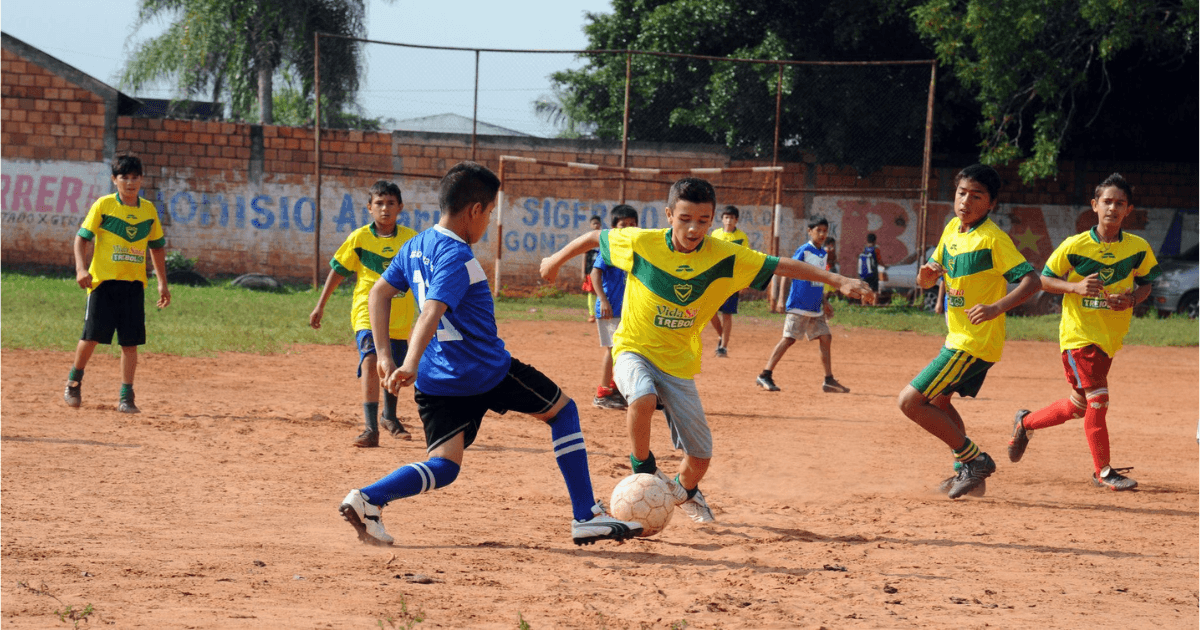
Like most South American countries, the lines between street football and organised sport are blurred in Paraguay. Football’s omnipresence in dense neighbourhoods, particularly in Asunción and other Central areas means that there is a consistent pipeline of progress.
Informal tournaments are common, around major days in the calendar and consist of token prizes, but the real bragging rights are the respect within the neighbourhood. Football’s social role in Paraguay heavily ties into the working-class and rural life.
The potrero - a dusty, uneven dirt pitch becomes a battleground to establish dominance. Improvised goals come via large rocks, bundled shirts or strategically positioned sticks. It’s certainly not for the faint-hearted. No quarter is given, even at the youngest age.
The virtue of grit (garra) is embedded from the very start and helps to mould players that are both technically brilliant, but also physically resilient and tough. Games can start at dawn and run long into the night, only interrupted for refreshment breaks.
Every single barrio and rural town boasts at least one of these pitches and their prevalence has only increased as football the less economically fortunate urban and rural population because they often possess a very different skillset than those arriving through traditional pathways. But more commonly, the top talents are discovered through pruebas - massive open trials.
Pruebas: The Ruthless Open Trials That Shape Futures
Pruebas is brutal and competitive. The trade-off for no entry fee and no agent fee means that hundreds, if not thousands of young players will have the rule run over them.
Player judgements are often swift and second chances are rarely given. For the chosen select few that impress, they will find themselves courted between the biggest clubs in the league, such as Cerro Porteno, Olimpia or Libertad for an initial contract.
From an academy perspective, it’s very different from Europe. Informal lightning tournaments do still attract scouts. It’s not uncommon to find their interests piqued by talent arising from the urban and rural landscape.
The other option is impressing through the neighbourhood club ladder. Football has become the most popular sport within Paraguay. And so reputation can mean everything, impressing in local and regional leagues, or via clubes de barrio is the key to getting noticed by the right person.
Whereas other European leagues might have expensive barriers to entry, being seen by the right person can be the ticket to the start of a professional career in Paraguay.
Academy staff will have strong connections with neighbourhood clubs and town clubs and will rightly know who the top talents are when they emerge. The strongest capital is social credit, not coins.
Read More: La Garra Guarani: What Football Means to Paraguay
The Academy Dream And The Cost Of Opportunity
However, even though a player may have been discovered and invited into a professional pathway, there are still plenty of obstacles which do disrupt development.
The main academies in Paraguay tend to be located in either Asuncion or Central. This can mean long travel distances for teenagers whose family also have to juggle the opportunity cost of them not earning any money for the household until they sign professional contracts.
With the economic disparity in Paraguay being significant, this can be a huge burden and is often the main reason why players fall out of the pathway.
There is always the option of club housing, but for the majority of players coming from poorer backgrounds, this carries an additional cost anyway.
Resultantly, families are forced to either relocate to help their teenagers follow their dreams, or have to accept an early split. This itself is mentally taxing and further contributes to the rate of players dropping out.
Clubs like Cerro Porteno, Olimpia and Libertad have tried to combat this, enlisting sponsors and benefactors to raise money to assist youngsters within their academy structure, but again this support is finite. Social mobility is still a massive issue once you are within the structure as football has been geared towards the middle and upper classes.
It’s viewed as a high risk pursuit, sacrificing education and other opportunities. Even then, at age 17 or 21, the majority of players find themselves discarded and are back at the very start, albeit with less time on their side.
Why So Many Talented Players Fall Out Of The System
The academy pipeline is also inherently geared towards being able to sell young talents abroad, as soon as possible to get more money back into the club to invest in trials and repopulating the pipeline. Some would call this good business, others would call it predatory.
Younger professionals in Paraguay find themselves on very low wages when they turn 16, leaving them barely able to support themselves and thus putting the onus on them to impress whilst either out on loan, or in the reserves to force opportunities.
From Cerro Porteno To Europe: The Miguel Almiron Blueprint
One of the most famous examples of this is Miguel Almiron, who barely featured initially for Cerro Porteno. Once he forced himself into the first team, he impressed and Club Atletico Lanus swooped in to sign him for just under £600,000. Whilst this might look like a decent return initially, 18 months later Almiron would join Atlanta United for $8 million.
It’s often the poorest players that find themselves with the least leverage in Paraguay. They have the hardest pathway to football - either through the narrow funnel of pruebas or the grinding climb through club de barrios - before having to come up with the financial support to facilitate their development.
For the absolute best 1%, the dreams of a move to another giant South American club, opportunities within the MLS or even a transfer to the top leagues in Europe is a possibility. For the other 99%, they have to contend with the grim reality of a difficult, arduous road to glory which may in fact lead to nothing at all.