

When Tottenham Hotspur finalised an initial loan move for Omar Marmoush, incorporating an obligation to buy for £50 million plus £10 million in add-ons,they addressed two long-standing vulnerabilities in a single stroke.
For years, Spurs have wrestled with finding dynamic attacking quality capable of operating alongside or filling in for traditional target men especially since the departure of Harry Kane.
Meanwhile, Manchester City found themselves in an all-too-familiar dilemma: possessing an elite forward far too talented to sit on the bench, yet unable to fully impose himself there due to Erling Haaland’s central dominance.
By taking reference from tactical analysis by The Athletic and statistical profiling from Opta, here is a deep-dive breakdown of how Marmoush’s movement versatility under Roberto De Zerbi can fix Tottenham’s offensive stagnation.
Read More: The Omar Marmoush Blueprint: What Young Attackers Can Learn From His Game
Why Marmoush Needed to Leave Man City
Marmoush arrived at Manchester City off a staggering half-season at Eintracht Frankfurt, where he posted 20 goals and 13 assists across 26 matches in all competitions.
His debut against Chelsea instantly highlighted his relentless ability to kill teams with his off-ball movement in transition.
Marmoush registered 12 runs in behind the defensive line that day, the highest tally by any City player other than Haaland in over eight months.
However, given Haaland’s dominating presence at the club, his long term impact at the club was always going to be limited.
At Frankfurt, 63.6% of Marmoush’s runs in behind were targeted with a pass. At Manchester City, playing against deeper defensive low blocks, that figure plummeted to 51.1%.
Blocked from playing as an out-and-out central striker due to Haaland, Marmoush was frequently pushed out to the left flank, receiving the ball in congested half-spaces rather than sprinting into open channels.
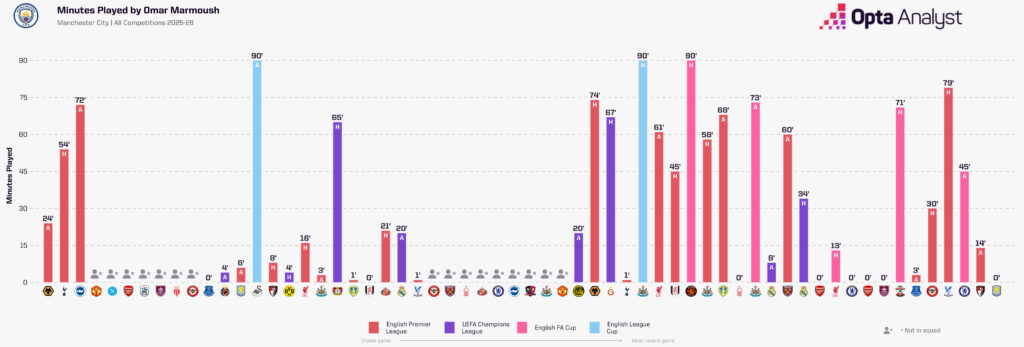
Despite scoring 5 goals in 6 domestic cup starts during the 2025/26 campaign, Marmoush logged just ~700 Premier League minutes, making only 8 league starts.
Read More: Why Omar Marmoush Is Becoming One Of Striver’s Most Talked-About Players
How Marmoush Compares to Solanke, Richarlison
Opta's per-90 Premier League metrics demonstrate why Roberto De Zerbi prioritized Marmoush over relying solely on Dominic Solanke or Richarlison.
Receiving 5.9 progressive passes per 90—the highest mark at City—proves Marmoush constantly makes himself available for ambitious, line-breaking passes forward
His 6.82 touches inside the opposition box per 90 and 3.86 shots per game bring directness to a Spurs side that frequently struggled with slow, sterile possession in opening matches.
How Marmoush Fits at Tottenham Under De Zerbi
Roberto De Zerbi’s tactical system relies on drawing opponents out through patient build-up play before executing rapid, vertical attacks through the central axis
At the time of writing, Marmoush has already made two appearances for Spurs against Newcastle United and Nottingham Forest. His debut against the Magpies, despite their 2-0 loss, showed glimpses and what he is capable of offering this side.
After an initial 15-minute adjustment period where he struggled to find his footing, Marmoush ignited Spurs' attack precisely through De Zerbi’s preferred mechanism.
He received a line-breaking pass between the lines from new signing Jan Paul van Hecke before releasing Tel down the left flank. For the remainder of the contest, the Egyptian was a constant menace, dropping deep to receive possession and driving straight at Newcastle center-backs Malick Thiaw and Sven Botman.
His off-ball spatial intelligence shone on set-piece routines, twice peeling away at the back post from Andy Robertson corners first striking a volley into the side netting, and later combining with Tel via a throw-in restart to execute a clever reverse pass into Robertson to carve out a goalscoring opportunity.
Marmoush continuously forced individual duels, notably picking up the ball near the halfway line to nutmeg former City teammate Nico Gonzalez before whistling a right-footed effort wide, and testing Newcastle goalkeeper Lukas Hornícek late in the match.
His ability to drop deep, link play, and attack space directly proved that while De Zerbi still has significant work ahead to forge a cohesive unit, Marmoush’s individual profile fits the tactical blueprint seamlessly.
Read More: Why Omar Marmoush’s Rise Is A Reminder That There Is No Single Path To The Top
Could De Zerbi Use Marmoush Alongside Solanke?
While De Zerbi generally uses a single-striker setup, Marmoush played his absolute best career football at Frankfurt alongside a physical focal point in Hugo Ekitike.
A pairing with Dominic Solanke allows Marmoush to float in the second-striker role, overloading wide channels before driving inside.
Furthermore, Marmoush scored 4 goals from outside the box at City (including the 2024–25 Premier League Goal of the Season) This long-range striking capability gives Spurs a vital tool to unlock stubborn defensive blocks.
Key Lessons for Young Players
If you are a young striker or winger trying to improve your game, Omar Marmoush’s career journey offers five simple rules to follow:
Time Your Runs: Running fast is not enough. Marmoush makes over 11 runs behind defenders every game because he waits for the right moment. Pretend to step toward the defender first to trick them, then quickly sprint into the open space behind them.
Learn More Than One Position: Don't limit yourself to playing as a central striker. Marmoush gets playing time because he can play as a main forward, a left winger, or an attacking playmaker. The more positions you can play, the easier it is for coaches to put you in the starting team.
Learn to Protect the Ball Under Pressure: When your defenders pass you the ball, keep your body between the ball and the opposition player. Lay the ball off to your teammates with quick one-touch passes instead of trying to dribble through everyone every time.
Practice Shooting From Outside the Box: Defenders will try to block the penalty box. Developing a powerful shot from long distance forces defenders to come out and tackle you, which opens up space for your teammates to run into.
Work Hard Even When You Don't Have the Ball: When Marmoush did not get many passes at Manchester City, he kept his stats high by pressing defenders, making smart runs, and taking quick shots whenever he got a chance.