
The debate around expanding the FIFA World Cup to 48 teams centred on one question. Would adding more nations improve the tournament, or simply create more mismatches?
After the opening round of group-stage fixtures, the answer may already be emerging.
Four countries have scored their first-ever FIFA World Cup goals during the opening week of the tournament, turning long-held dreams into lasting memories. While another debutant, Cape Verde, came within touching distance of its own historic moment.
For players, supporters and future generations back home, these moments matter far beyond the final score.
For emerging football nations, these are more than statistics. They are milestones that can inspire generations to come.
Read More: 10 Things You Need To Know About Cape Verde
Jordan Celebrate Their First World Cup Goal
Jordan arrived at their first-ever World Cup determined to prove they belonged.
Against Austria, that belief became history.
Ali Olwan's equaliser was Jordan's first goal at a FIFA World Cup, giving supporters a moment they had waited decades to experience.
Although Jordan ultimately fell to defeat, the significance of that goal will outlast the result.
Every young player kicking a ball in Amman now knows a Jordanian has scored on football's biggest stage.
Uzbekistan's Historic Breakthrough Moment
For years, Uzbekistan came close to qualifying before falling just short. Their maiden World Cup appearance in 2026 was already a landmark achievement.
Scoring their first tournament goal elevated it further.
Abbosbek Fayzullaev scored in the 60th minute against Colombia, becoming the first Uzbek player to find the net at a FIFA World Cup.
The 22-year-old midfielder, who played a key role in qualification, offered a glimpse of the talent driving football's rapid growth in Central Asia.
It was a reward for decades of investment in youth development and a reminder that persistence can eventually open new pathways.
Curacao Add Another Chapter To Their Incredible Rise
No nation at World Cup 2026 has travelled a more unexpected road than Curacao.
The smallest country ever to qualify for the men's World Cup celebrated another historic first by finding the net on their tournament debut.
Their first tournament goal came through Livano Comenencia, who stunned Germany by equalising in the 21st minute of a 7-1 defeat in Houston.
For a country of fewer than 160,000 people, the result mattered less than the moment itself.
Comenencia's goal ensured Curacao would leave their World Cup debut with a piece of history that can inspire the next generation.
For a nation of fewer than 160,000 people, every milestone carries extra significance. Their journey is proof that footballing ambition is not defined by population size.
Yoane Wissa Ends DR Congo's 52-Year Wait
For DR Congo, this was not just a first goal. It was the end of a drought stretching back more than half a century.
Competing as Zaire, they became the first sub-Saharan African nation to qualify for a World Cup in 1974 but failed to score in any of their three matches.
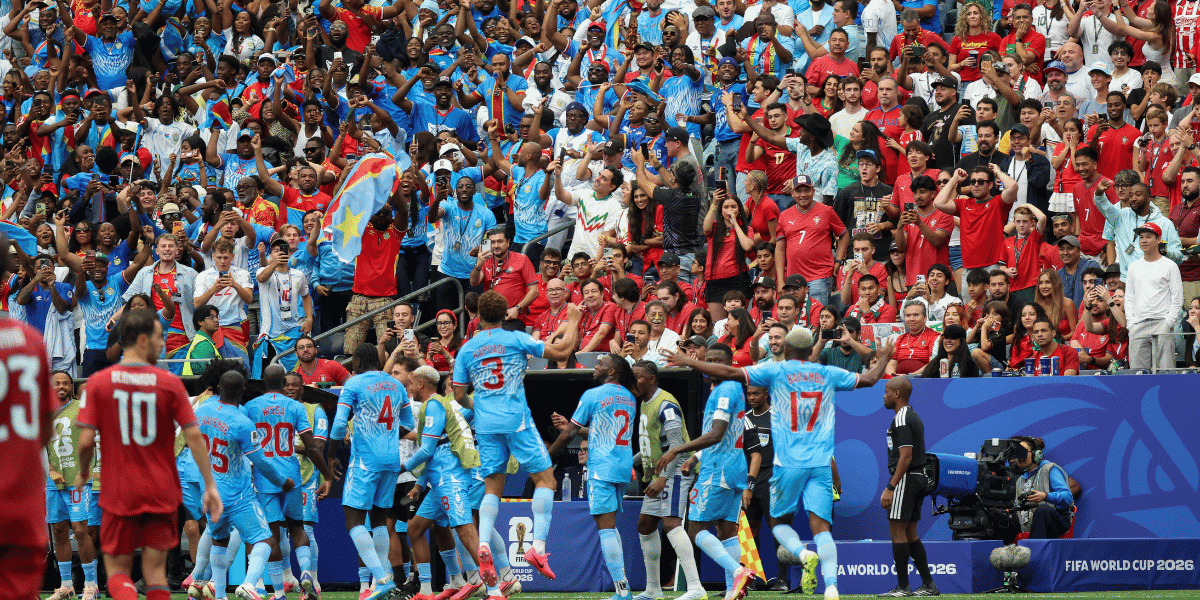
That changed when Yoane Wissa found the net in a 1-1 draw against Portugal.
His equaliser secured DR Congo's first World Cup goal and first World Cup point, ending a 52-year wait in the process.
For a new generation of Congolese players, it was a powerful reminder of how far their footballing story has come.
Read More: What Football Means in DR Congo: The Lingala Rhythm, Ritual, and Unifying Factor
Cape Verde's Historic Goal Can Still Come
Four nations arrived at World Cup 2026 for the first time: Jordan, Uzbekistan, Curacao and Cape Verde
Three of them have already celebrated their first World Cup goals - Cape Verde are the only nation yet to score.
However, their goalless draw against Spain was significant in its own right.
Cape Verde frustrated one of the tournament favourites with an organised and disciplined defensive display, showing they belong on football's biggest stage.
They became the first World Cup debutant since Iceland in 2018 to keep a clean sheet in their opening match against a former world champion.
The Blue Sharks now have another opportunity to make history when they return to action.
The question is no longer whether Cape Verde can compete at this level.
It is who will score the goal that completes their World Cup story.
Why These Moments Matter For Future Generations
The expanded World Cup was designed to create more opportunities. In its opening week, it has already done exactly that.
Every first goal creates a new reference point for young players watching at home.
A child in Tashkent, Willemstad, Kinshasa or Amman can now dream a little bigger because someone from their country has already done it.
Cape Verde still await their breakthrough moment.
If the first round of matches taught us anything, it is that history at World Cup 2026 is no longer reserved for traditional football powers.
The next unforgettable story could come from anywhere.