
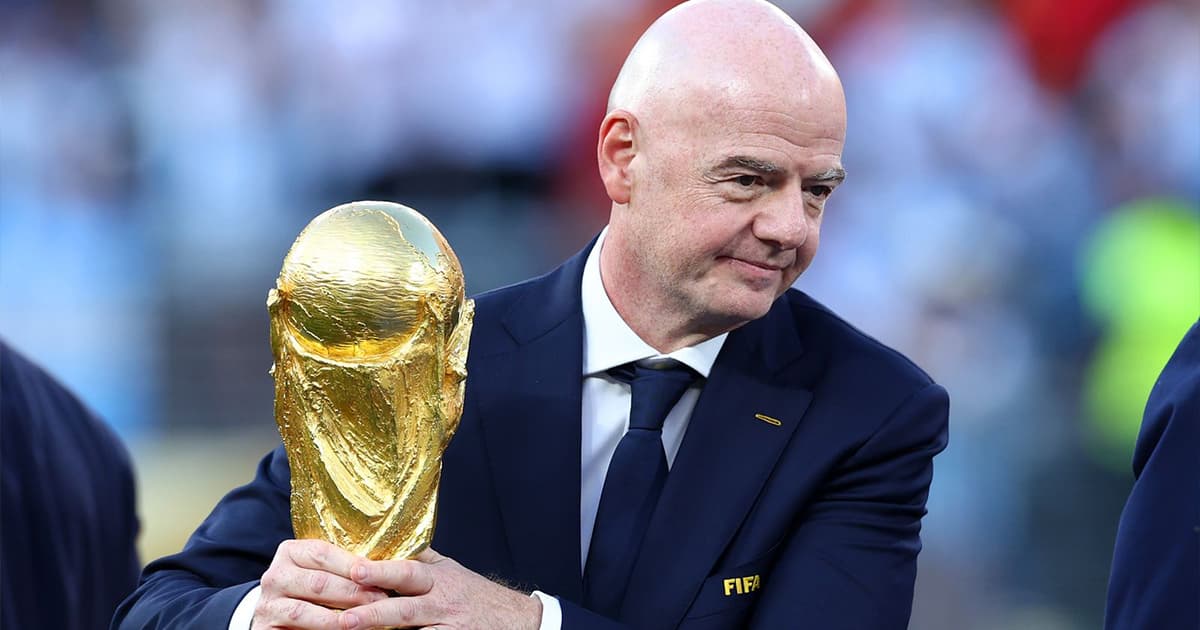
Gianni Infantino is at it again. Just as the dust settles on the 2026 FIFA World Cup which was co-hosted by the USA, Canada and Mexico, the FIFA president has rolled out his most audacious play yet.
Infantino, who has been head of FIFA since 2016, has a plan to put FIFA’s entire commercial operation into a new company and sell a 20% stake for around $4.2 billion (£3.15 billion) to private investors.
The proposal has naturally polarised opinion and split global football into two. To smaller national associations, such as those in Africa and Asia it is a life-changing financial windfall.
To critics, it is a cynical corporate cash grab that risks selling off the soul of the World Cup.
What Is FIFA's $4.2bn Proposal?
To understand this latest proposal, Striver.Football sought to bring you into the know with what Infantino’s scheme actually is.
The Italian’s plan centers on creating a commercial subsidiary called FIFA Forward Enterprise (FFE). Under the proposal, FFE would take total control of FIFA’s highest-earning assets, including broadcasting rights, corporate sponsorships, and ticketing for both the men’s and women’s World Cups, as well as the expanded Club World Cup.
Breaking it down further, FIFA would keep an 80% controlling stake, with the body’s President chairing the FFE board.
The remaining 20% share would be sold for $4.2 billion (£3.15 billion) to an investor group led by Thrive Eternal, an investment firm founded by Joshua Kushner (brother of Jared Kushner, who happens to be US President Donald Trump’s son in law).
Why FIFA's Member Associations Could Benefit
Infantino is dangling a major financial incentive directly over FIFA’s 211 member nations. If approved by September 19, member associations will receive $40 million (£3 million) each over the next four years via the new FIFA Fast-Forward Programme (FFFP). If they vote "No," they revert to the standard $10 million grant.
What exactly would be the pros and cons of this new proposal by FIFA?
The Pros
For the vast majority of FIFA’s 211 member nations, Infantino’s proposition looks like an absolute no-brainer.
Game-Changing Funding for Developing Nations
For smaller football federations mostly in Africa and Asia, including World Cup surprise package Cape Verde or Uzbekistan, a $40m payout is genuinely transformative.
These funds, if used transparently, would fund national training centers, as well as grassroots and youth football development. They would also cover travel for international qualifiers, and professionalise local leagues.
Guaranteed Financial Stability
By locking in an upfront $4.2 billion cash injection from private capital, FIFA effectively hedges against future economic volatility.
Not every World Cup cycle can hit the $15 billion high-water mark achieved in North America. Private equity helps smooth out the financial peaks and valleys between host cycles.
A Bigger Business and Commercial Opportunity for FIFA
Separating sports governance (rules, discipline, politics) from commercial execution allows a dedicated corporate board to aggressively scale television rights, digital media products, and emerging sports markets without being bogged down by football bureaucracy.
The Cons
Despite the eye-watering numbers, European governing bodies, player unions, and domestic leagues are lining up to oppose the move.
UEFA has publicly spoken out against this move in a statement, dismissing the proposal as a plot to “enrich themselves and their friends”.
Private Equity Demands Returns
Private equity firms do not hand over $4.2 billion out of goodwill, they expect maximum returns on their investment.
To generate those profits, FFE will face constant pressure to extract more revenue. This will lead to more bloated schedules by doing things like expanding tournaments like both the FIFA World Cup and FIFA Club World Cups in order to generate more broadcast inventory.
Furthermore, FIFA will risk pricing out regular fans to games, as the North American world cup recently showed, by hiking ticket prices which left a lot of regular supporters behind. Broadcasters will also try to take advantage of longer, intrusive ad breaks mid-match to squeeze extra revenue out of media partners.
Backroom Politics & Lack of Transparency
The speed and secrecy of the proposal have infuriated major stakeholders. As reported by The Athletic, key confederations like UEFA, CONCACAF, and the Asian Football Confederation (AFC) were caught completely off guard, discovering the plan through an exclusive story by The Times rather than formal FIFA Council consultations.
Furthermore, questions remain over how Thrive Eternal and its financial advisors were selected without an open, competitive tender.
Player Fatigue and Competition Dilution
With top players already protesting saturated match calendars, adding commercial pressure to expand international fixtures puts athlete health at extreme risk.
European clubs, who pay the players' wages while FIFA profits off their availability, are increasingly resistant to letting their elite assets be overused for commercial exhibition.
Who Could Block FIFA's Proposal?
On paper, Infantino holds all the cards. FIFA operates on a one-nation, one-vote system, meaning a vote from a small island association carries the same weight as football powerhouses like England, Germany, or Brazil.
Because the financial proposition is so lucrative for smaller nations, Infantino almost certainly commands the votes required to pass the measure before the September 19 deadline.
However, a serious pushback is forming on several fronts, majorly from UEFA as well as the European Club Associations (ECA).
Europe provides the vast majority of the world's top talent and broadcast value. Just like in 2021 when the body, led by Alexander Ceferin stopped the proposed European Super League from ever seeing the light of day, their influence might inhibit FIFA.
If both organisations team up alongside FIFPro, the global players’ union, they hold immense leverage, ranging from legal challenges regarding market dominance to the nuclear option of boycotting FIFA tournaments.
What about political intervention from Europe’s influential figures? They might play a role considering the European Commission is now scrutinising FIFA's market position, citing a lack of consultation with domestic leagues whose schedules are directly disrupted by FIFA's expanding calendar.
The Bottom Line
Infantino’s proposal might be a classic case of divide and rule, and while it might lead to the growth of the game in most of the developing nations, it could also end up devaluing some of FIFA’s most prestigious competitions while severing ties with European clubs permanently.
Whether European resistance can force FIFA to pause and consult remains to be seen, but September 19 will be here before you know it.