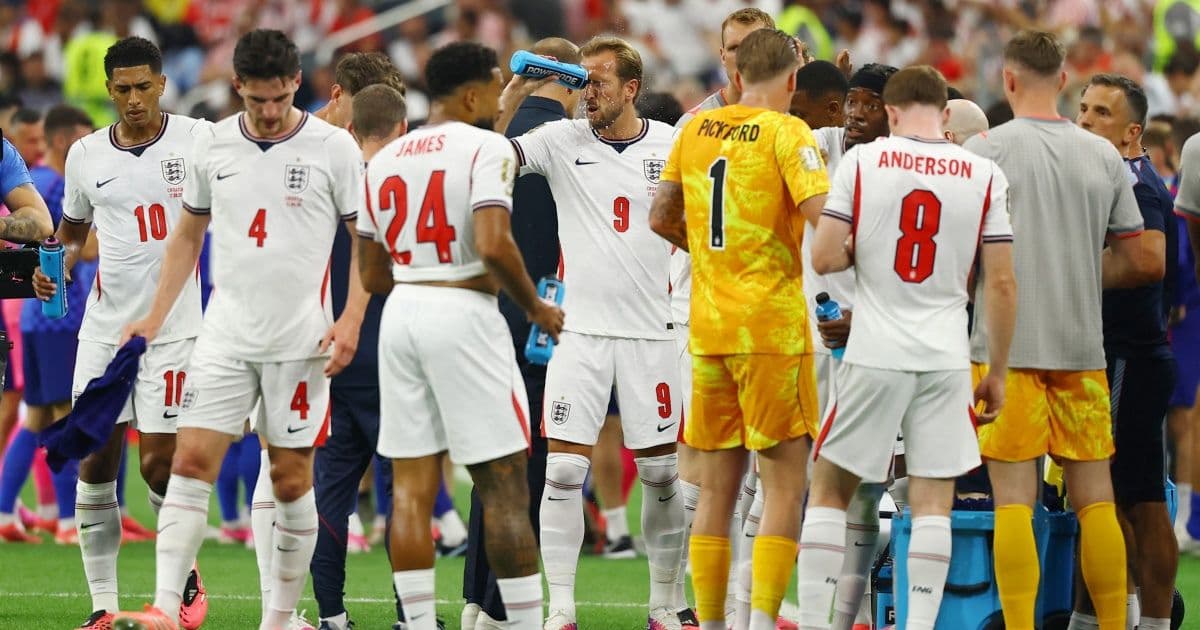
FIFA's decision to introduce mandatory three-minute hydration breaks at the 2026 World Cup has quickly become one of the tournament's most debated talking points.
The rule, introduced to help players cope with summer conditions across the United States, Canada, and Mexico, requires play to stop midway through each half regardless of the weather or venue.
While FIFA has framed the policy as a player welfare measure, reactions have been mixed. Some coaches have welcomed the additional recovery time, while others argue that the breaks disrupt the rhythm of matches. Supporters, meanwhile, have voiced frustration at stoppages during key moments of games.
The first player to say it out loud on the biggest stage was Netherlands captain Virgil van Dijk. After his side's 2-2 draw with Japan, he became the first major name to publicly challenge FIFA's approach.
The debate has also extended beyond football. Sports scientists remain divided over whether mandatory breaks are necessary in every match, particularly in stadiums where temperatures are significantly lower than those expected during the tournament's hottest fixtures.
As the competition progresses, the discussion is shifting from whether the breaks help players stay hydrated to how much they change the flow of the game itself.
Coaches Are divided on FIFA's Mandatory Hydration Breaks
Uruguay head coach Marcelo Bielsa has been one of the most outspoken critics of the rule, arguing that the stoppages disrupt the pattern of games and effectively divide them into four periods instead of two.
"They add nothing and take away a lot," Bielsa said. "I'm saying that before this decision, football had one characteristic and now it has a different one. People fall in love with the game because of its characteristics."
Bielsa is not alone. France coach Didier Deschamps believes the breaks have effectively turned football into a game of four quarters rather than two halves.
"It's not two half times, it is four quarter times basically that we've got. This is what's been decided, and so the players and the coaches adapt to this new reality," he said.
Norway coach Stale Solbakken raised a different concern, the breaks are affecting substitution planning. Many coaches tend to make second-half substitutions between the 60th and 70th minute, and the second-half hydration break starts at the 67th minute, cutting directly into that window.
One of the most striking moments came early in the tournament, when Curacao equalised against Germany in the 21st minute, only for the referee to signal a hydration break moments later, allowing Julian Nagelsmann to regroup his players.
Germany regained control after the restart and eventually went on to win 7-1. The timing of the stoppage fuelled fresh debate about the impact of the new rule.
The Real Reason Behind the Hydration Break Backlash
Much of the growing anger from fans has been aimed at something more pointed than game flow. Some fans have questioned whether the breaks bring commercial benefits as well as sporting ones.
Broadcasters are able to insert additional advertising into these breaks, at a time when World Cup airtime remains among the most valuable in sport.
According to industry estimates, a 30-second advertising slot on Fox Sports can cost between $200,000 and $300,000, rising significantly for United States matches and the latter stages of the tournament.
Former Ireland international Roy Keane put it bluntly on The Overlap podcast: "We're in America, right? So, it's like it' i's a timeout. We love football because of the pace of the game, what it's doing is stopping the flow of the game, the momentum."
Fox, which holds the English-language broadcast rights in the United States, shows commercials during every hydration break. Telemundo, which carries Spanish-language coverage, does not air adverts during the stoppages, a difference that has led some fans online to switch broadcasts during matches.
Weather expert Everton Fox told Al Jazeera there was little justification for the rule in several indoor or air-conditioned venues.
"New York, California and Miami, as well as the Mexican stadiums, have been hot enough, but there's no justification for breaks at the air-conditioned arenas like Dallas, Houston, Atlanta or Vancouver," he said.
"I know FIFA claim to have done this across all games to be consistent, but it's hard to see it as anything other than a commercial venture worth millions in advertising."
Do Three-Minute Hydration Breaks Actually Work?
Away from the noise, the scientific case for hydration breaks is real, but complicated. Ryan Calsbeek, professor of biological sciences at Dartmouth College, explained that the human body performs better when it's warmed up to a point, but beyond a critical threshold, things break down fast.
"Your body starts to really fall apart, and you lose the ability to cool off fast enough. The physiological mechanisms just break down," he said.
Joshua DeVincenzo, assistant director of applied research services at Columbia University's National Centre for Disaster Preparedness, defended the mandatory nature of the rule.
"When we look at the three-minute hydration breaks, we're really looking at this as a way to mitigate anything that could potentially lead to an incident or an emergency," he said.
But even those in support of the breaks admit three minutes may not be enough. Researcher Julien Periard was measured in his assessment: "Even in ideal settings, the breaks can slightly help but will not eliminate the risk of heat illness in response to a rise in core temperature."
The 2026 World Cup hasn't answered those questions. It's made them impossible to ignore.