Before the first whistle blew across North America on June 11, we highlighted ten under-21 prodigies primed to take the 2026 FIFA World Cup by storm.
Now that the tournament has concluded, with Spain lifting their second World Cup title at MetLife Stadium, Striver.Football looks back with hard data to see how our predictions held up on the world stage.
Read More: Striver.Football’s FIFA World Cup 2026 Young Team Of The Tournament
Read More: The Next Generation of Leaders: Young World Cup 2026 Stars Already Shaping Their Nations
Read More: 5 Countries With The Brightest Football Future After World Cup 2026
10. Endrick (Brazil & Real Madrid/Lyon)

Pre-Tournament Rank: #10
World Cup Reality: Impact Substitute (0 Goals)
While we tipped Endrick to serve as Brazil’s focal No. 9, Carlo Ancelotti opted for a more measured approach with the 19-year-old.
After remaining on the bench in Brazil's opener against Morocco, Endrick was used primarily as a second-half impact substitute against Haiti, Scotland, and Japan in the Round of 32.
Though he failed to register a goal during the tournament, his second-half introduction alongside Gabriel Martinelli against Japan injected crucial intensity to help the Selecao come from behind in a 2-1 win.
9. Warren Zaire-Emery (France & PSG)

Pre-Tournament Rank: #9
World Cup Reality: Limited Role (2 Appearances)
Contrary to expectations that he would serve as an engine-room starter for France, Didier Deschamps kept the 20-year-old on the bench for nearly the entire tournament.
Zaire-Emery featured in just two matches: a 20-minute sub cameo to help close out France's 2-0 quarter-final win over Morocco, and a full 90-minute start in the third-place playoff against England.
The latter proved to be a nightmarish outing, as France fell behind 4-0 before halftime in a chaotic 6-4 defeat, making his campaign far more subdued than projected.
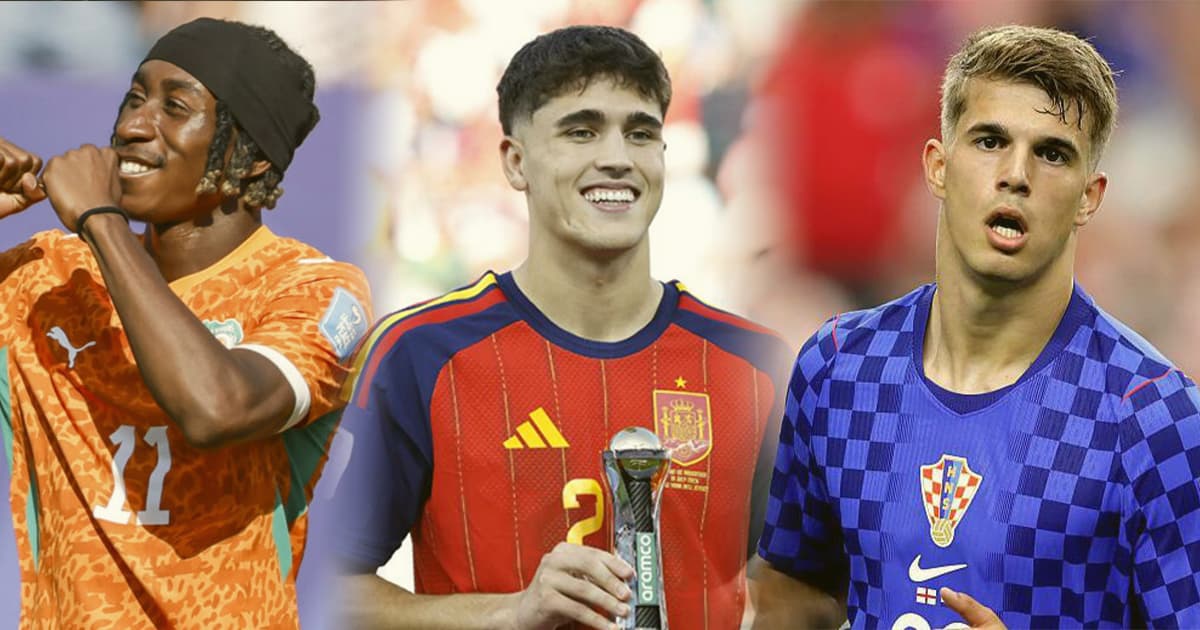
8. Pau Cubarsi (Spain & Barcelona)

Pre-Tournament Rank: #8
World Cup Reality: FIFA World Cup Best Young Player & World Champion
Cubarsi produced one of the most dominant tournament performances by a teenage central defender in football history.
Starting all 8 matches for La Roja, the 19-year-old helped Spain keep 7 clean sheets while conceding just one goal the entire tournament.
He completed 107 out of 109 passes against Cape Verde and 98 out of 99 against Saudi Arabia, finishing as the most accurate passer in North America before shutting down Lionel Messi in the 1-0 final victory over Argentina.
7. Arda Guler (Turkey & Real Madrid)

Pre-Tournament Rank: #7
World Cup Reality: Group Stage Orchestrator
Operating out of the right half-space, Guler delivered flashes of absolute brilliance during Turkey’s group campaign.
He registered 11 shot-creating actions across three matches and scored a stunning curling effort in Group D play.
Though Turkey suffered a premature group-stage exit behind the United States and Australia, Guler’s individual creativity remained a bright spot.
6. Kendry Paez (Ecuador & Chelsea/Independiente del Valle)

Pre-Tournament Rank: #6
World Cup Reality: Round of 32 Starter
Paez provided Ecuador with necessary technical poise amidst their high-tempo, physical style.
Playing across all three group fixtures and their Round of 32 tie against Mexico, Paez completed 12 successful dribbles and maintained an 83% pass retention rate between the lines before Ecuador were eliminated 2-0 by the co-hosts.
5. Antonio Nusa (Norway & RB Leipzig)

Pre-Tournament Rank: #5
World Cup Reality: Quarter-final Breakout Star
Nusa emerged as one of the breakout wingers of the entire tournament. With opposing backlines focusing their attention on Erling Haaland, Nusa exploited 1v1 isolation on the left flank, recording 24 progressive carries across five matches.
His explosive performances against Ivory Coast in the Round of 32 where he scored the opening goal in a 2-1 win, and then in the Round of 16 against Brazil-powered Norway to a landmark 2-1 victory, taking the Vikings to their furthest World Cup run in national history.
4. Kenan Yildiz (Turkey & Juventus)

Pre-Tournament Rank: #4
World Cup Reality: Flank Threat
Yildiz provided a direct line-breaking threat for Turkey, completing 8 successful take-ons in 240 tournament minutes.
While Turkey failed to progress out of Group D, Yildiz demonstrated his spatial awareness and direct dribbling capability against top-tier international full-backs.
3. Yan Diomande (Ivory Coast & RB Leipzig)

Pre-Tournament Rank: #3
World Cup Reality: Group Stage Standout
Diomande brought explosive verticality to Ivory Coast’s attack in Group E. Playing as an inverted winger, he registered 14 touches inside the penalty box across three group matches, helping the Elephants finish second in their pool behind Germany with two wins from three games.
2. Ayyoub Bouaddi (Morocco & Lille)

Pre-Tournament Rank: #2
World Cup Reality: Quarter-final Metronome (No. 6 World Rank)
At just 18 years old, Bouaddi anchored Morocco's midfield with surgical precision as the Atlas Lions reached the quarter-finals and surged to a historic No. 6 spot in the FIFA World Rankings.
Bouaddi completed over 50 passes in back-to-back knockout matches and averaged 3.2 ball recoveries per 90, confirming his status as one of Europe's most sought-after deep playmakers.
1. Luka Vuskovic (Croatia & Brighton)

Pre-Tournament Rank: #1
World Cup Reality: Single Appearance vs England
Our number one pick faced a harsh reality check on international football's grandest stage. The 19-year-old defender made history as Croatia's youngest-ever World Cup player when he started their opening match against England.
However, after a difficult 66-minute outing where Croatia conceded three goals during his time on the pitch in a 4-2 defeat, Vuskovic was substituted off and did not feature again for the remainder of Croatia's tournament.
What The 2026 FIFA World Cup Taught Us About Football's Next Generation
The 2026 World Cup proved that youth projections are never linear. While Pau Cubarsi, Antonio Nusa, and Ayyoub Bouaddi translated their underlying metrics into tournament-defining performances, other youngsters like Luka Vuskovic and Endrick learned firsthand how unforgiving the highest level of international football can be.
While the tournament crowned new world champions, it also offered a glimpse into who could define international football over the next decade.
Some players arrived ready to become leaders immediately, while others discovered just how steep the jump from club football to the World Cup can be. Both experiences are an important part of elite player development.
Perhaps the biggest lesson from North America was that potential alone is never enough. The players who thrived combined technical quality with composure, tactical intelligence and the ability to perform under immense pressure.
As attention now turns towards the 2027-28 international competitions and ultimately the 2030 FIFA World Cup, many of these names will return with greater experience, making this tournament not the end of their story, but the beginning of it.