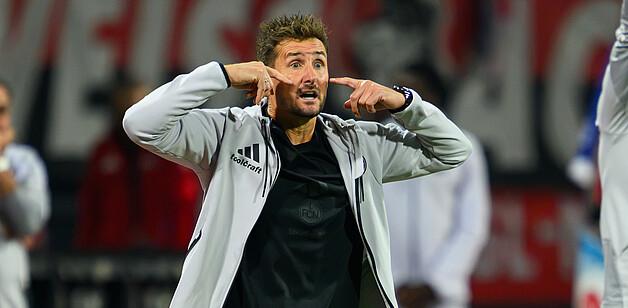
Miroslav Klose retired as Germany's all-time leading goalscorer and the record scorer in men's FIFA World Cup history, but his influence on football is now extending into management.
Now 48, the former Germany striker is building a reputation as a manager, with his work at 1. FC Nurnberg attracting attention in the 2. Bundesliga.
Appointed head coach of Nurnberg in June 2024, Klose guided the club to 10th- and eighth-place finishes in his first two seasons before turning them into promotion contenders.
After 11 matches, Nurnberg sit second in the 2. Bundesliga with 24 points and have scored a league-high 26 goals, putting them firmly in the promotion race as they target a return to the top flight for the first time since 2019.
A key part of Klose's approach has been trusting young players, with Nurnberg boasting the youngest average squad age in the division and giving emerging talents regular first-team opportunities.
How Miroslav Klose is building Nurnberg around young players
According to Transfermarkt data, Nurnberg have the youngest squad in the 2. Bundesliga, with an average age of 23.3 years.
Although promotion-chasing teams often rely on experienced players, Klose is willing to give younger talents opportunities when he believes they are ready to compete at this level.
Klose has acknowledged the importance of balancing youth with experience, while explaining why Nurnberg are willing to trust emerging players: "You need that balance and a certain core of experienced players, but we're very brave in that respect. Over the three years I've been here, we've made progress in how we assess young players and in the conversations we have about them," Klose told BBC.
Seven of Nurnberg's 11 most-used players this season are aged 22 or younger, including top scorer Mohamed Ali Zoma, who has already represented Italy, and 17-year-old midfielder Marc Kornwachs.
How Klose is connecting Nurnberg's academy with the first team
Klose's coaching career has developed through several stages. He worked as an assistant to Hansi Flick with Germany and Bayern Munich, coached Bayern's U17s and later took his first senior managerial role at Austrian club Rheindorf Altach.
When he arrived at Nurnberg, Klose spoke with the academy coaches about the club's existing identity and coaching philosophy, identifying areas where the youth and senior teams could work more closely together.
Drills, positional rotations, and press-resistance principles are now practiced at the U17 and U19 levels to mirror the first-team framework. This helps young academy graduates step into first-team matches without suffering tactical shock.
Why possession is central to Klose's coaching philosophy
As a world-class finisher, Klose thrived on team control. As a manager, his teams demand dominance through possession of the ball: "Personally, as a player, I always liked having the ball for long periods, and that hasn't changed. When you have the ball, you have a certain level of dominance."
However, Klose’s Nurnberg are not dogmatic. He equips his young squad with multiple escape routes under high pressure, teaching them how to break opposition lines based on visual cues rather than fixed, rigid formations.
How Klose is developing as a manager alongside his young team
Klose’s ascent is guided by the same self-awareness that defined his playing career, where he went from playing 5th-tier amateur football at age 20 to lifting the World Cup at 36.
Acknowledging that his managerial career is still in its developmental phase, Klose embraces daily tactical refining: "I'm very comfortable with the steps I've taken... I've said that I'm already a much better manager than I was three years ago. That's perfectly normal, and you have to embrace it," Klose added.
Can Klose take Nurnberg back to the Bundesliga?
As Nurnberg push for a return to the Bundesliga, Klose’s methodology is showing that success takes time to build thanks to brave selection, clear tactical principles, and relentless daily work.