Alexis Mac Allister’s reaction to Noni Madueke during Liverpool’s defeat to Arsenal has reignited the debate around players exaggerating contact. But should football be doing more to discourage these theatrics?
Football is an emotional game. Tempers flare, challenges become heated and players are entitled to stand their ground when they feel they have been wronged. But there is a growing frustration with the way some players react when those confrontations occur.
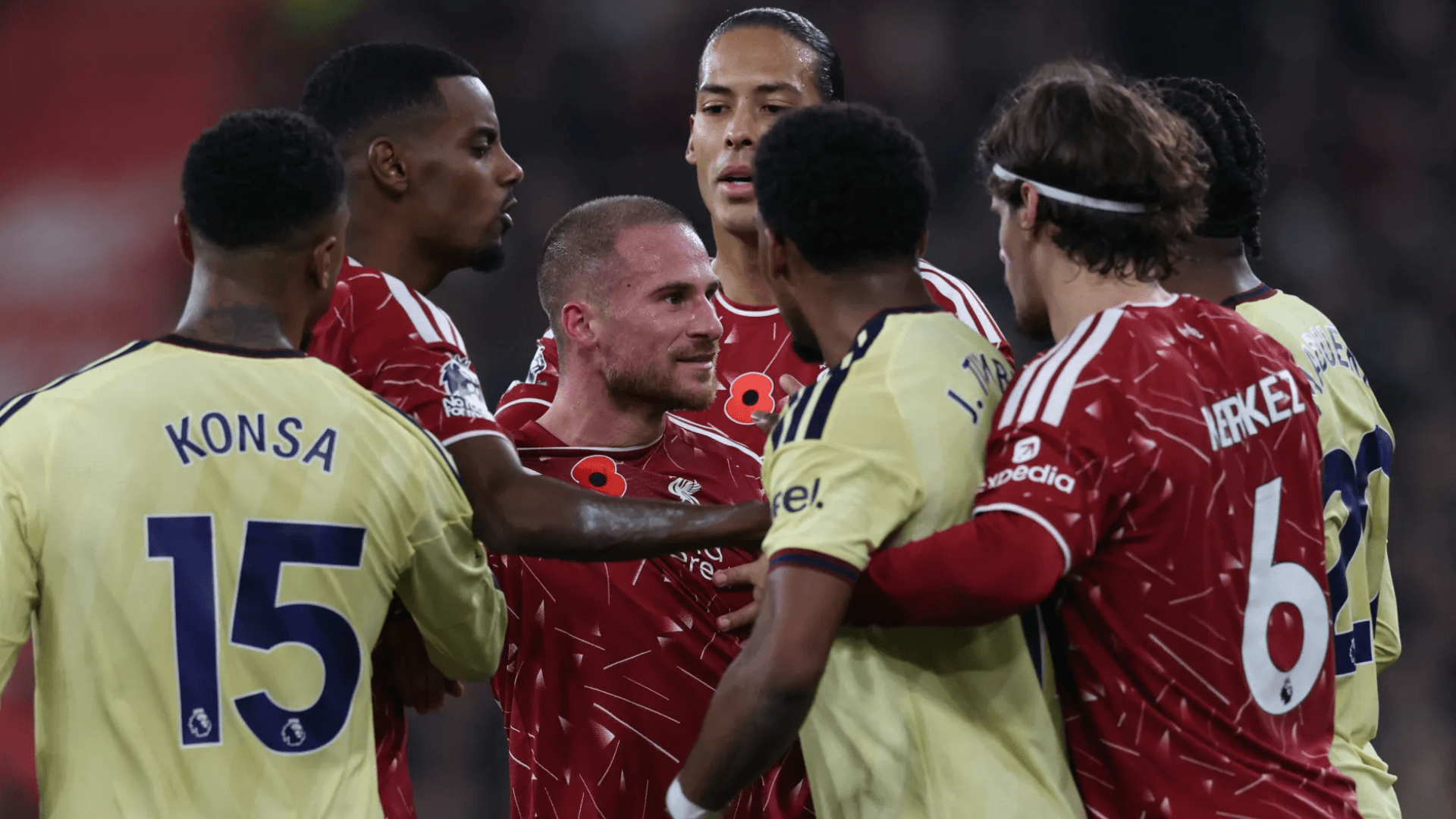
Liverpool’s 1-0 defeat to Arsenal at Anfield provided another example, with Alexis Mac Allister at the centre of a late flashpoint involving Noni Madueke and Jurriën Timber.
The incident prompted Jamie Carragher to speak out on Sky Sports, and his comments raised an important question: are players increasingly trying to influence refereeing decisions by making minimal contact look far worse than it really is?
Jamie Carragher calls out Mac Allister after Madueke confrontation
The confrontation developed after Mac Allister fouled Martin Ødegaard and appeared to slap the Arsenal captain on the back of the head. Timber stepped in, before Madueke became involved and squared up to the Liverpool midfielder.
Their foreheads made contact, but Mac Allister immediately went to ground holding his face. VAR reviewed the incident, with Madueke avoiding a red card and Mac Allister receiving a yellow.
Carragher, speaking in the Sky Sports studio after the match, was clear that he did not believe Madueke deserved to be dismissed.
“I’m delighted he (Madueke) didn’t get sent off there,” Carragher said.
“We have really got to be calling people out and just say ‘This is embarrassing’. I think Gary said it on commentary. It’s got to stop. It’s ridiculous. I can’t stand it. If someone pulls their head back and butts, of course (that’s a) red card.”
I agree with Carragher. There is a clear difference between a genuine headbutt and two players coming together during a heated exchange. If Madueke had deliberately driven his head into Mac Allister with force, a red card would have been justified. But minimal contact, or even simply standing forehead to forehead, should not automatically result in a player being sent off.
Mac Allister's reaction was unnecessary. Going to ground and holding his face after such slight contact risks turning an ordinary confrontation into something much more serious in the eyes of the officials.
Bruno Fernandes and Phil Foden show why the reaction matters
This is not an isolated issue, either. The recent Manchester derby between Manchester United and Manchester City provided another example of how these situations can influence disciplinary decisions.
Bruno Fernandes made contact with Phil Foden while the Manchester City midfielder was on the ground. Foden then reacted by kicking out at Fernandes and was shown a straight red card for violent conduct.
The incident sparked debate because Fernandes' initial actions were also questioned, with some arguing that the Manchester United captain should have faced punishment. Pro Ref chief Howard Webb later said Fernandes should have been booked for a petulant kick, although VAR could not intervene to issue a yellow card.
Read more about the Fernandes-Foden incident
The two incidents are not identical, but they highlight the same problem: players know that their reactions can have a significant impact on the outcome of a disciplinary decision.
There is no place for deliberate attempts to deceive officials. Equally, players should not be punished with a red card simply because an opponent exaggerates minimal contact.
Mac Allister was booked for his part in the confrontation, and that should be the end of the matter from a disciplinary perspective. However, that does not mean his reaction should escape criticism.
Football is competitive, and nobody expects players to be emotionless. But there is a difference between showing passion and trying to win an advantage by making contact look worse than it was.
If the game wants to cut out these incidents, players, pundits and governing bodies need to be consistent in calling them out, regardless of the shirt involved.