Italian football has spent much of the past two decades struggling to maintain its place among Europe's leading nations. A country long associated with tactical sophistication and elite defensive play reached a significant low point when it missed out on a third consecutive FIFA World Cup.
The aftermath brought significant changes across the Italian football federation and national-team setup. Head coach Gennaro Gattuso resigned, FIGC President Gabriele Gravina stepped down, and delegation chief Gianluigi Buffon walked away.
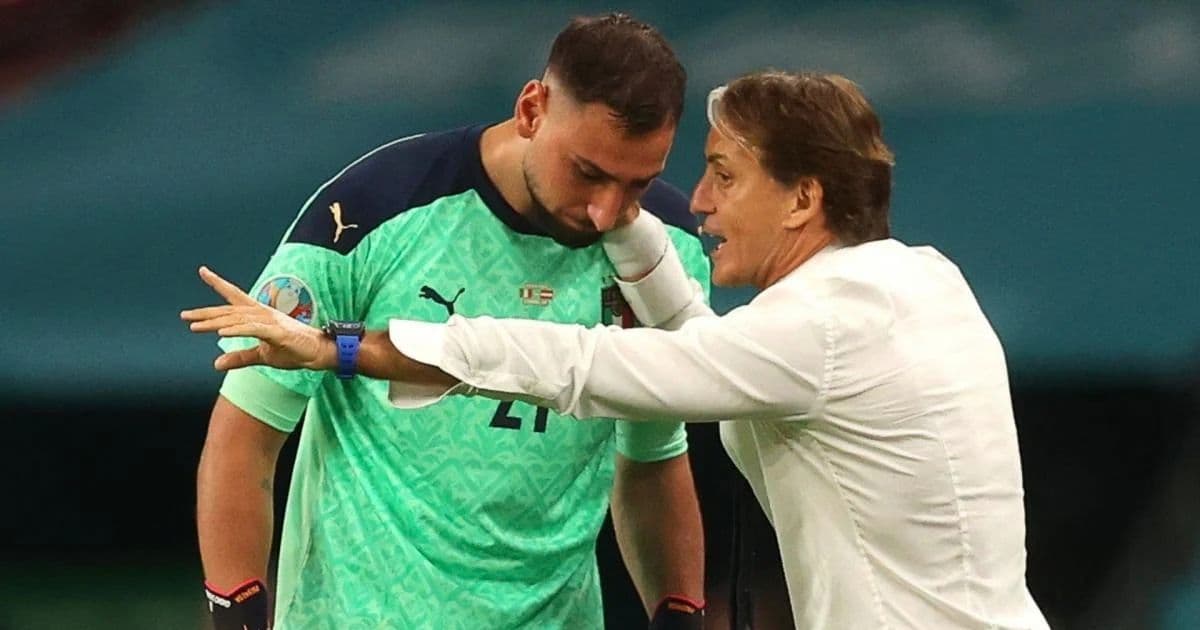
Yet, as Italy began rebuilding after another World Cup qualification failure, a familiar face returned to the hot seat at Coverciano: Roberto Mancini.
For Italy captain Gianluigi Donnarumma, Mancini's return offers an opportunity to integrate a new generation into the national team.
"Only We Know How Much It Hurts": Donnarumma on Italy's World Cup Absence
Speaking to Sky Sports, Donnarumma made no attempt to disguise the psychological toll that missing out on football’s grandest stage for a third straight time has taken on the squad.
"It's a sensitive subject that affects me a lot, because not qualifying for three World Cups in a row is tough, and Italy certainly doesn't deserve that," Donnarumma, who won the EURO 2020 tournament in which he was named the best player, admitted to Sky Sports.
"We have to work. The only way forward is to work. There has now been a change of coach, the return of Mr. Mancini—and the objective is to work and try to take Italy back to where it deserves to be."
Manchester City goalkeeper Donnarumma emphasised the responsibility that comes with wearing the Azzurri shirt.
"I know it's not easy for the fans, but especially for us, because only we know how much it means to us to play in a competition like the World Cup," he added.
"So we'll give everything to bring Italy back to where it deserves to be. We have a great responsibility because history says that Italy should always be there."
Why Italy's Youth Pathway Has Struggled to Produce the Next Generation
Italy’s inability to qualify for World Cups in 2018, 2022, and now 2026 is not an anomaly—it is the byproduct of structural stagnation.
A look at the underlying data highlights concerns around Italy's talent pipeline following the retirement of key figures such as Giorgio Chiellini, Leonardo Bonucci and Andrea Pirlo.
According to the CIES Football Observatory, Italy produced 413 football exports between 2020 and 2025, ranking 24th globally, behind the United States, Japan and Russia.
The other four members of Europe's "Big Five" leagues each generated over 1,000 players in the same period.
The U21 Barrier: In 2025, players under the age of 21 eligible for Italy received 1.9% of Serie A playing time—the second-lowest figure among the 50 leagues analysed by the CIES Football Observatory, ahead of only the UAE Pro League.
Ageing Rosters: Between June 2025 and February 2026, Pio Esposito was the only Italy international under the age of 24 to feature for the national team, according to Sky Sports. England fielded 12 players in the same age bracket during that period.
Read More: Why Italy Have Missed Three Straight World Cups: Four Reasons Behind Italian Football’s Decline
How Roberto Mancini Is Rebuilding Italy With a New Generation
Where previous managers doubled down on battle-tested veterans in high-stakes qualifiers, Roberto Mancini's first squad selection for his second spell signalled an immediate change in approach.
Mancini named a 34-player squad featuring nine players receiving their first Italy call-up.
Among the new wave are Borussia Dortmund's 18-year-old forward Samuele Inacio, Crystal Palace defender Honest Ahanor, and Brentford’s dynamic wing-back Michael Kayode.
They join an emerging core featuring Inter's Esposito, FC Nurnberg's Mohamed Alì Zoma, who has scored 20 goals in 36 German second-tier appearances, and Sporting CP midfielder Issa Doumbia.
Donnarumma believes a blend of established players and younger talent can help Italy move forward.
"There will certainly be some established players. We're getting older, but we're still young, and there will also be some very young players joining the team," Donnarumma explained.
"So it will be a mixture, and we need to help these young players integrate well. They can give us a great deal of help.
"They're certainly talented players who need to play and gain experience, but I'm sure Italy will return to where it belongs."
What Roberto Mancini's Italy Rebuild Means for the Next Generation
Italy will face France, Belgium and Türkiye in their UEFA Nations League Group A campaign.
The rebuilding process will take time, while Mancini's squad selection has placed greater emphasis on assessing younger players alongside established internationals.
With Donnarumma providing leadership and a younger group entering the senior setup, Italy now have an opportunity to test a new generation alongside established internationals.
The trauma of missing three straight World Cups won't disappear, but Mancini's return gives Italy an opportunity to begin rebuilding around a new generation.