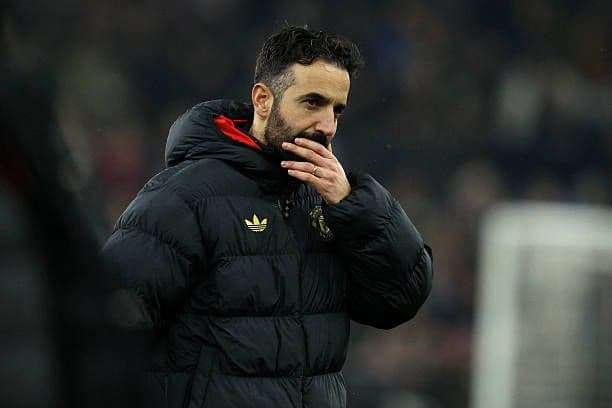
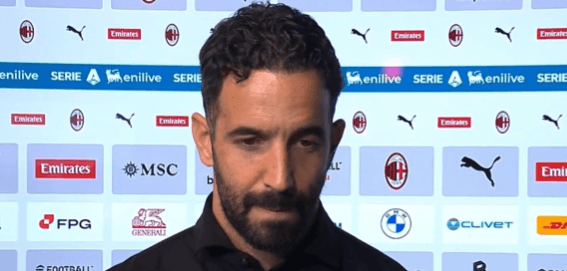
When Ruben Amorim reflects on his high-profile coaching career, his tenure at Old Trafford is referenced with a polite, measured detachment, often referred to simply as "my former club."
Yet, as AC Milan secured a historic 3-1 Derby della Madonnina victory over Cristian Chivu's reigning champion Inter Milan at the San Siro, marking Milan's fourth consecutive derby win across all competitions for the first time since 1973, it became glaringly apparent that the Portuguese coach has picked fundamental lessons from his past missteps.
In Manchester, Amorim was often accused of rigidity, refusing to compromise on his trademark 3-4-3 setup regardless of squad limitations. In Milano, backed closely by Gerry Cardinale and RedBird Capital, Amorim has unveiled a far more self-aware, tactically flexible, and data-integrated identity.
But how has he changed as a coach? Striver.Football puts you in the know:
More Flexibility Tactically
The downfall of many elite managers in new environments is an ideological refusal to bend. At Manchester United, Amorim tried to force a 3-4-3 framework onto a squad that lacked the specific profiles to execute high-intensity wing-back routines.
At Milan, the squad was naturally "Amorim-coded", having operated primarily in a back-three under previous management.
However, rather than forcing strict positional rigidity, Amorim has embraced tactical fluidity:
While maintaining a back-three foundation, Amorim has demonstrated a willingness to alter mid-block shapes, adjust press lines, and alter in-game structures based on opponent mechanics.
Rather than rushing players recovering from injury into intense starting blocks, he exercised patience with Christian Pulisic (recovering from a leg micro-fracture) and marquee €50m summer signing Diego Moreira, using them as tactical disruptors off the bench before integrating them as starters to dismantle Inter.
Data-Driven Selection Over Reputation
As reported by The Athletic, A hallmark of Amorim’s evolved process in Italy is his reliance on micro-data metrics to dictate defensive lineups in big-match environments.
Ahead of the derby against Inter, conventional logic suggested starting Mario Gila in the heart of the defense. However, internal performance metrics highlighted that Belgian center-back Koni de Winter possessed superior aerial dominance to neutralise Inter's crossing traps.
Amorim started De Winter centrally and shifted Gila to the right channel. The result? Milan effectively stopped crosses at the source, limited Inter's box access, and allowed veteran orchestrator Luka Modric to dictate tempo from deep without facing continuous physical transitions.
Managing Squad Depth
In modern football, squad rotation is inevitable in efforts to compete on all fonts a balance Amorim struggled to achieve in England.
Following a shocking 4-2 midweek setback to Bologna where Amorim rotated key starters, pressure mounted on the coaching staff. Yet, that rotation ensured Pulisic, Moreira, and Modric possessed fresh legs to overwhelm Inter over 90 minutes.
While criticised early in the season for making frequent half-time changes, Amorim views matchdays as two distinct 45-minute tactical chapters rather than a static starting XI setup.
Maximising Set-Piece Output
With club-record €73m forward Goncalo Ramos struggling for open-play goals (logging just two league goals thus far), Amorim adapted by turning set-piece execution into a primary scoring engine.
In the derby, Milan exploited Inter's defensive disorientation. Christian Pulisic opened the scoring by attacking central space left completely unmarked by Inter's modified defensive shape.
Adrien Rabiot then doubled their lead after capitalising on pinpoint delivery from Diego Moreira, who himself provided the final cushion to seal a commanding 3-1 outcome.
Final Thoughts
Ruben Amorim has learnt to adapt and become more flexible, which has helped him enjoy a fine start to life as AC Milan coach.
Amorim has transformed AC Milan into a genuine Scudetto contender for the first time since 2022 when they won it under Stefano Pioli.
His time at the club might bode him on for bigger responsibilities further down the line, something he might not have been ready for at United.