In Greek mythology, the mighty warrior Achilles was invulnerable everywhere except for one solitary spot: the tendon connecting his calf to his heel. Thousands of years later, that identical anatomical flaw has become the ultimate disrupter of modern sport, shattering World Cup dreams in the process.
As the 2026 FIFA World Cup unfolds across North America, a heartbreaking pattern has emerged. While host cities prepare for the biggest sporting event on earth, some of the world's most exciting, high-flying players won't be stepping onto the pitch.
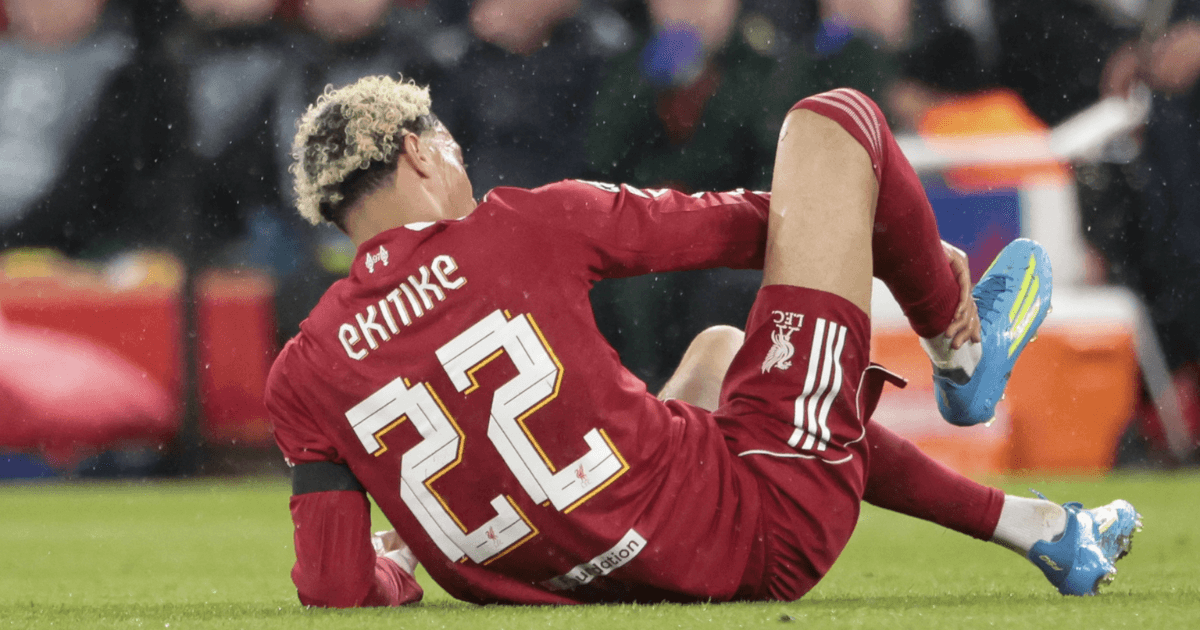
Instead, stars like France’s emerging forward Hugo Ekitike and the United States’ Patrick Agyemang will be watching from home, their World Cup dreams brought down by the modern equivalent of Paris’s arrow, a ruptured Achilles tendon.
Even the icons who made the roster are locked in a high-stakes race against their own anatomy. Brazil's Neymar Jr. narrowly avoided missing the tournament but enters the group stage under an spotlight after a late-stage Grade 2 right calf muscle strain.
His resolve to step onto the pitch for his team is incredibly inspiring, but from a medical standpoint, it highlights the intense physical demands placed on modern players.
When the calf muscles are healing from a strain, it alters how the entire leg absorbs impact, meaning his body will be working under an immense biomechanical load to keep him performing at his usual elite level.
While torn ACLs have long been the traditional villain of tournament injury headlines, this sudden, explosive spike in snapped Achilles tendons and calf muscle injury leading into this 2026 World Cup is becoming impossible to ignore.
As a foot and ankle surgeon specializing in sports medicine, I look at the game a bit differently than most fans. Where others see a breathtaking counter-attack, I see a high-stakes physics equation involving joints, muscles, and playing surface. And right now, the math isn't adding up.
Football has never been faster or more explosive. Players are sprinting at high velocities and cutting on a dime, all while enduring brutal, non-stop playing schedules.
This push for elite speed, and endless training without rest, highlights a stark biomechanical reality: the velocities achieved with modern footwear, and all too demanding training schedules, are pushing past the natural structural limits of the human foot and ankle.
How Modern Football Boots Increase Achilles Tendon Stress
Today’s soccer cleat has evolved far beyond basic footwear into a sophisticated tool engineered for elite traction, rapid response, and speed. Modern footwear design uses modern synthetics, carbon-fiber plates, and studs designed to maximize a player's first-step acceleration.
The goal isn't to harm the player; it's to give them elite performance. But in biomechanics, there is a golden rule: energy never disappears; it just moves.
Modern boots are engineered for absolute efficiency, which means minimizing wasted energy. When a player plants their foot in a modern cleat on a hybrid pitch, the shoe does its job perfectly: it provides traction and prevents slipping.
However, with that increased traction for the sake of speed, the stopping forces don't disappear. They travel up the player's leg. And the tendon caught right in the crosshairs of this performance trade-off is the Achilles.
How Achilles Tendon Ruptures Happen in Football
To understand how an Achilles snaps, think of it as a heavy-duty cable connecting your calf muscle to your heel bone. It’s the ultimate slingshot for sprinting, but it has a physiological breaking point.
While exploding forward is stressful, the absolute danger zone for an Achilles rupture is sudden, high-speed deceleration: braking hard to change direction.
When a player is sprinting down the pitch and tries to stop on a dime, their upper body keeps moving forward with momentum. If their cleat locks the shoe completely flat to the playing surface, the heel stays planted against the ground. As the player's body transitions forward over the planted heel, the shin bone is forced forward, causing the ankle to bend upward at a high velocity.
This instantly stretches the Achilles tendon. The calf muscle then contracts with maximum intensity to act as an emergency brake, preventing the player from falling forward.
Because the shoe plate is designed with less bend and the studs are made for traction, the ankle is temporarily jammed. It cannot roll forward or lift the heel to relieve the pressure. When these braking forces spike, sometimes reaching a staggering 12 to 14 times the player's body weight, the energy has nowhere to escape.
A damaged or stained tissue from over training fails completely, resulting in a sudden, non-contact snap that players often say feels like being kicked or shot in the back of the leg: The Achilles Tendon Rupture.
Why Overuse and Fatigue Lead to Achilles Injuries
Importantly, a rupture is rarely a sudden lightning bolt hitting a perfectly healthy tendon out of nowhere. It is a failure where chronic tissue fatigue meets this planted heel.
Under a microscope, a ruptured Achilles tendon almost always shows signs of pre-existing degeneration. Because the Achilles has a notoriously poor blood supply just above the heel bone, it struggles to repair the damage caused by months of relentless training.
As a club schedule transitions straight into intensive national team camps preparing for the World Cup, accumulated fatigue makes the tendon brittle with no time for Type I Collagen repair. It loses its elasticity, and its ability to safely handle sudden, massive spikes in load.
When that weakened tendon is suddenly subjected to a high-speed deceleration where the heel stays rigidly planted, the force exceeds what the compromised tissue can handle. The tendon cannot dissipate the energy through natural joint movement, and the microscopic fraying instantly turns into a complete tendon failure.
Of course, these injuries are deeply complicated and multifactorial. A player's age, baseline conditioning, genetics, foot type, and overall fatigue all dictate how a body holds up.
But as sports medicine professionals, we can no longer ignore how traction profiles are fundamentally altering the loads placed on the human kinetic chain during high-stakes play.
The Missing Injury Data in Modern Football
What's truly wild is that despite soccer being a multi-billion dollar industry, clubs are virtually blind to this data. Teams track their players using GPS vests, they know exactly how many miles a midfielder ran, their peak sprint speeds, and their rate of acceleration down to the decimal point.
Yet, there is almost zero centralized data tracking what shoes they were wearing when they got hurt, or the playing surface they were on.
Nobody is systematically cross-referencing which boot models, soleplate stiffness levels, or stud shapes players are wearing when injuries occur, or on which specific types of grass or turf. Until we close that data gap, we are missing a massive piece of the injury prevention puzzle.
What Football Must Learn From the Achilles Injury Crisis
Football has entered an incredible new era of sports science where we monitor sleep, hydration, and nutrition down to the gram.
As the 2026 World Cup kicks off and the intense physical demands of tournament play begin, it is time we start looking at the most critical interface in the entire sport: the point where the player meets the ground.
Innovation shouldn't just be measured by how fast a cleat helps an athlete sprint into the penalty box or changes direction. It has to be measured by how safely it balances performance with protection.
The tragic reality is that injury science is currently playing catch-up to engineering. As the world watches the drama of this World Cup unfold over the coming weeks, the prominent stars left behind at home should serve as a powerful reminder to the global game.
If modern football keeps chasing elite performance, maximum grip, and explosive speed without leaving a safety release for the athlete's body, we will continue to prove that even the game's greatest warriors are only as strong as their weakest tendon.